Seaman Kendra L, Leong Josiah K, Wu Charlene C, Knutson Brian, Samanez-Larkin Gregory R
Center for Cognitive Neuroscience, Duke University, Durham, NC, 27708, USA.
Department of Psychology, Stanford University, Palo Alto, CA, 94305, USA.
Cogn Affect Behav Neurosci. 2017 Dec;17(6):1232-1241. doi: 10.3758/s13415-017-0545-5.
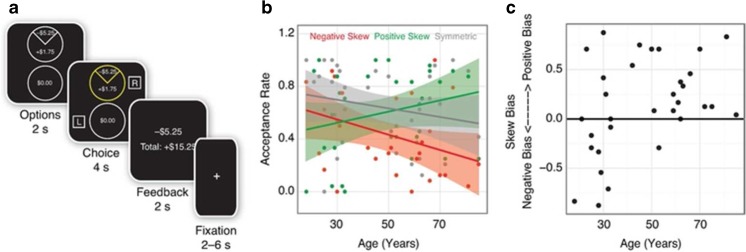
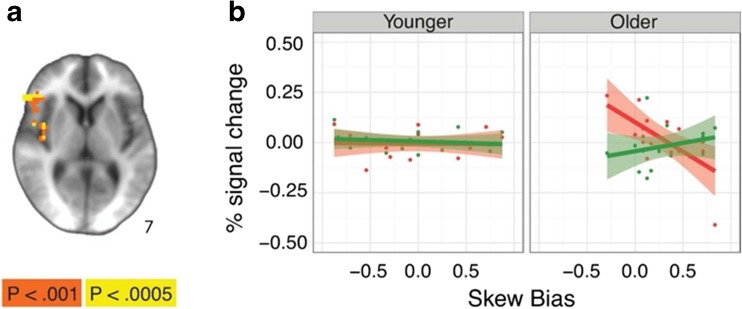
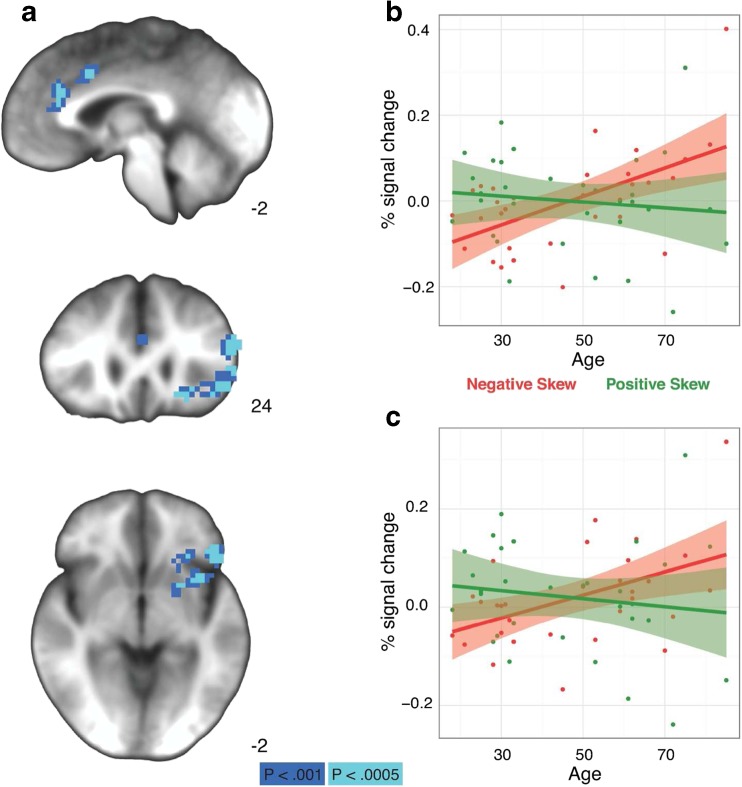
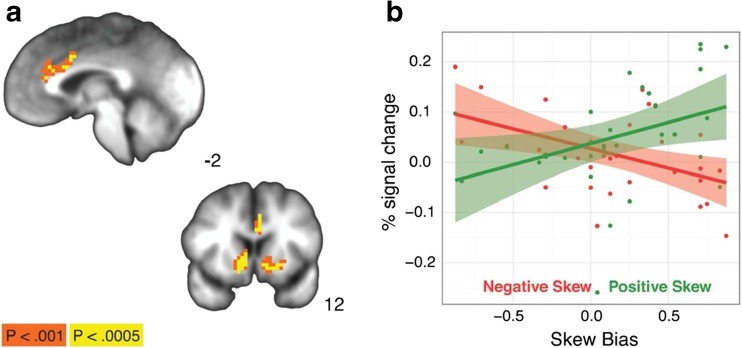
Older adults are disproportionately targeted by fraud schemes that advertise unlikely but large returns (positively skewed risks). We examined adult age differences in choice and neural activity as individuals considered risky gambles. Gambles were symmetric (50% chance of modest win or loss), positively skewed (25% chance of large gain), or negatively skewed (25% chance of large loss). The willingness to accept positively skewed relative to symmetric gambles increased with age, and this effect replicated in an independent behavioral study. Whole-brain functional magnetic resonance imaging analyses comparing positively (vs. negatively) skewed trials revealed that relative to younger adults, older adults showed increased anticipatory activity for negatively skewed gambles but reduced activity for positively skewed gambles in the anterior cingulate and lateral prefrontal regions. Individuals who were more biased toward positively skewed gambles showed increased activity in a network of regions including the nucleus accumbens. These results reveal age biases toward positively skewed gambles and age differences in corticostriatal regions during skewed risk-taking, and have implications for identifying financial decision biases across adulthood.
针对老年人的欺诈计划往往将目标对准那些宣传回报虽不太可能但数额巨大(风险呈正偏态分布)的项目。我们研究了成年人在考虑风险赌博时的选择和神经活动方面的年龄差异。赌博类型包括对称型(适度输赢的概率均为50%)、正偏态型(获得大幅收益的概率为25%)或负偏态型(遭受大幅损失的概率为25%)。相对于对称型赌博,接受正偏态赌博的意愿随年龄增长而增加,这一效应在一项独立的行为研究中得到了重复验证。通过全脑功能磁共振成像分析比较正偏态(与负偏态)试验发现,与年轻人相比,老年人在前扣带回和外侧前额叶区域对负偏态赌博表现出增强的预期活动,但对正偏态赌博的活动则有所减少。对正偏态赌博更有偏向性的个体在包括伏隔核在内的一系列区域表现出活动增加。这些结果揭示了在倾斜风险承担过程中,老年人对正偏态赌博的偏向以及皮质纹状体区域的年龄差异,对识别成年期的财务决策偏差具有重要意义。