Singh Mini, Ruhnke Isabelle, de Koning Carolyn, Drake Kelly, Skerman Alan G, Hinch Geoff N, Glatz Philip C
Sydney School of Veterinary Science, University of Sydney, Camden, New South Wales, Australia.
Animal Science, School of Environmental and Rural Science, University of New England, Armidale, New South Wales, Australia.
PLoS One. 2017 Oct 24;12(10):e0187057. doi: 10.1371/journal.pone.0187057. eCollection 2017.
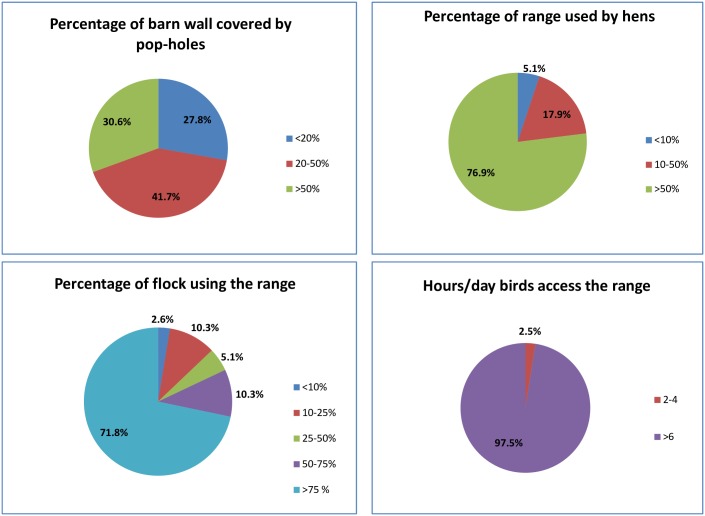
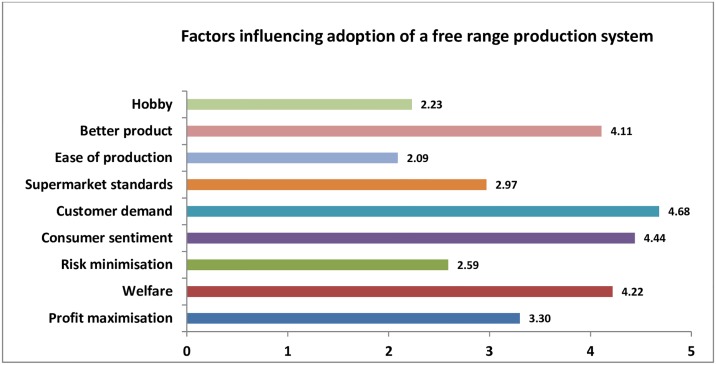
Baseline information on demographics and practices on semi-intensive free-range egg farms with an outdoor stocking density of ≤1500 hens/hectare in Australia is presented. Free-range egg production is changing the structure of the egg industry in Australia and a broad variety and tiers of free-range systems have emerged due to lack of concrete legislative standards on outdoor stocking densities in the past. Information was extracted from a pre-existing online free-range poultry survey dataset, consisting of a total of 79 questions related to nutrition, pasture management, welfare and health, animal housing, environmental impact and economics. Forty-one free-range egg farms, with an outdoor stocking density of ≤1500 hens/hectare, were identified in the dataset from all major Australian states. Two types of semi-intensive free-range housing systems were documented: mobile (modified caravan/trailer) housing (56%), and fixed sheds (44%). Seventy-two percent of respondents reported >75% of the hens in the flock used the outdoor range. All respondents reported ingestion of range components by hens in the form of vegetation, insects, stones and grit. Up to 10% mortality was reported by 40% respondents with predation (34%), cannibalism (29%), heat stress (24%) and grass impaction (19.5%) as major causes. Biosecurity on farms was sub-optimal with 8 of the 10 actions implemented by <50% respondents. Customer demand, consumer sentiment and welfare were the major factors for farmers moving into free-range egg production. This study resulted in identification of current practices and key challenges on semi-intensive free-range egg farms. Applied research and communication of results to farmers is highly recommended to ensure optimum health and welfare of free-range laying hens and sustained egg production.
本文介绍了澳大利亚户外饲养密度≤1500只母鸡/公顷的半集约化散养蛋鸡场的人口统计学和养殖实践的基线信息。散养鸡蛋生产正在改变澳大利亚的鸡蛋产业结构,由于过去缺乏关于户外饲养密度的具体立法标准,已经出现了各种各样、不同层次的散养系统。信息从一个现有的在线散养家禽调查数据集提取,该数据集共有79个与营养、牧场管理、福利与健康、禽舍、环境影响和经济相关的问题。在该数据集中,从澳大利亚所有主要州确定了41个户外饲养密度≤1500只母鸡/公顷的散养蛋鸡场。记录了两种类型的半集约化散养禽舍系统:移动(改装大篷车/拖车)禽舍(56%)和固定鸡舍(44%)。72%的受访者报告说,鸡群中超过75%的母鸡使用户外场地。所有受访者都报告母鸡以植被、昆虫、石头和沙砾的形式摄入场地中的成分。40%的受访者报告死亡率高达10%,主要原因是捕食(34%)、同类相食(29%)、热应激(24%)和草类阻塞(19.5%)。农场的生物安全措施未达到最佳水平,10项措施中有8项实施的受访者不到50%。客户需求、消费者情绪和福利是农民转向散养鸡蛋生产的主要因素。本研究确定了半集约化散养蛋鸡场的当前养殖实践和关键挑战。强烈建议开展应用研究并将结果传达给农民,以确保散养产蛋母鸡的最佳健康和福利以及持续的鸡蛋生产。