Institute of Biomedical Engineering National Taiwan University, No1, Sec 1, Jen-Ai Rd., Taipei, Taiwan.
Department of Anesthesiology, National Taiwan University Hospital Yun-Lin Branch, No 579, Sec 2, Yun-Lin Rd., Douliu, Yun-Lin, Taiwan.
BMC Geriatr. 2017 Oct 24;17(1):245. doi: 10.1186/s12877-017-0629-7.
Elderly patients with aged physical status and increased underlying disease suffered from more postoperative complication and mortality. We design this retrospective cohort study to investigate the relationship between existing comorbidity of elder patients and 30 day post-anesthetic mortality by using International Classification of Diseases, 9th Revision, Clinical Modification (ICD-9-CM) from Health Insurance Database.
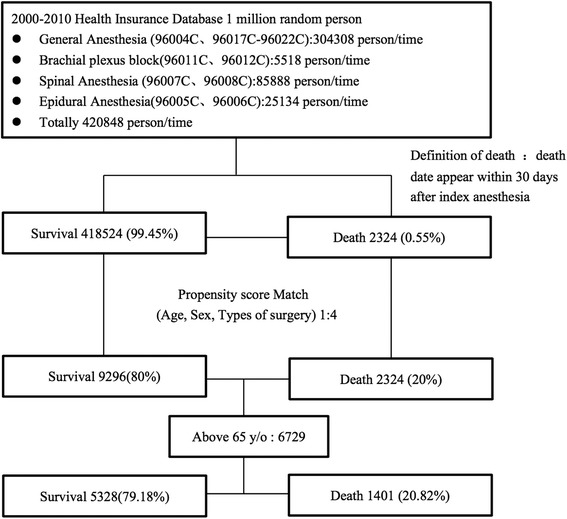
Patients aged above 65 years old who received anesthesia between 2000 and 2010 were included from 1 million Longitudinal Health Insurance Database in (LHID) 2005 in Taiwan. We use age, sex, type of surgery to calculate propensity score and match death group and survival one with 1:4 ratio (death: survival = 1401: 5823). Multivariate logistic model with stepwise variable selection was employed to investigate the factors affecting death 30 days after anesthesia.
Thirty seven comorbidities can independently predict the post-anesthetic mortality. In our study, the leading comorbidities predict post-anesthetic mortality is chronic renal disease (OR = 2.806), acute myocardial infarction (OR = 4.58), and intracranial hemorrhage (OR = 3.758).
In this study, we present the leading comorbidity contributing to the postoperative mortality in elderly patients in Taiwan from National Health Insurance Database. Chronic renal failure is the leading contributing comorbidity of 30 days mortality after anesthesia in Taiwan which can be explained by the great number of hemodialysis and prolong life span under National Taiwan Health Insurance. Large scale database can offer enormous information which can help to improve quality of medical care.
身体状况较差且合并基础疾病较多的老年患者术后并发症和死亡率更高。我们设计了这项回顾性队列研究,通过使用医疗保险数据库中的国际疾病分类,第 9 修订版,临床修正版(ICD-9-CM),调查老年患者现有合并症与麻醉后 30 天死亡率之间的关系。
从台湾 2005 年 100 万纵向健康保险数据库(LHID2005)中纳入 2000 年至 2010 年间接受麻醉的年龄在 65 岁以上的患者。我们使用年龄、性别、手术类型计算倾向评分,并以 1:4 的比例(死亡:存活=1401:5823)匹配死亡组和存活组。采用逐步变量选择的多变量逻辑模型调查麻醉后 30 天死亡的影响因素。
37 种合并症可独立预测麻醉后死亡率。在我们的研究中,预测麻醉后死亡率的主要合并症是慢性肾脏病(OR=2.806)、急性心肌梗死(OR=4.58)和颅内出血(OR=3.758)。
本研究从国家健康保险数据库中展示了导致台湾老年患者术后死亡率的主要合并症。慢性肾衰竭是台湾麻醉后 30 天死亡率的主要合并症,这可以用国家健康保险下大量的血液透析和延长寿命来解释。大型数据库可以提供大量信息,有助于提高医疗质量。