Takahashi Rina, Sakamoto Kazuhiro, Ro Hisashi, Kure Kazumasa, Kawai Masaya, Ishiyama Shun, Sugimoto Kiichi, Kojima Yutaka, Okuzawa Atsushi, Tomiki Yuichi
Department of Coloproctological Surgery, Faculty of Medicine, Juntendo University, Tokyo, Japan.
J Minim Access Surg. 2018 Jan-Mar;14(1):71-73. doi: 10.4103/jmas.JMAS_110_17.
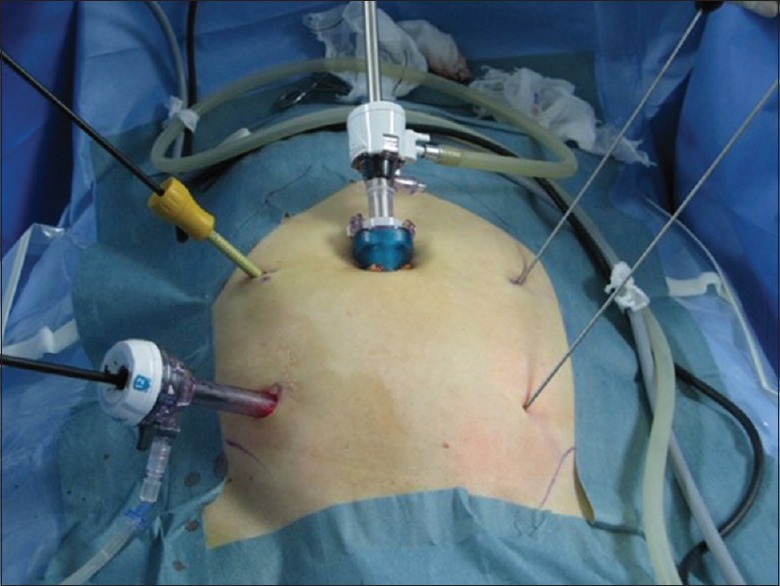
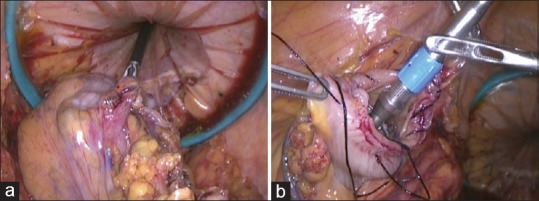
A 76-year-old male underwent endoscopic mucosal resection for a stage T1 tumour of the sigmoid colon. We performed laparoscopic sigmoidectomy through 5 ports using needlescopic instruments. The resected specimen was extracted from the abdominal cavity transanally. After attaching an anvil to the sigmoidal stump, the rectal stump was reclosed using an endoscopic linear stapler, and then, colorectal anastomosis was conducted using the double stapling technique. Performing transanal specimen extraction using needlescopic forceps improves aesthetic outcomes and reduces post-operative pain and the risk of abdominal incisional hernias. This method is an easy to introduce a form of reduced-port surgery because of its feasibility and conventional port arrangement. Hence, we consider that it is an option for minimally invasive surgery.
一名76岁男性因乙状结肠T1期肿瘤接受了内镜黏膜切除术。我们使用针状器械通过5个端口进行了腹腔镜乙状结肠切除术。切除的标本经肛门从腹腔取出。在乙状结肠残端连接一个吻合器砧座后,使用内镜直线缝合器重新闭合直肠残端,然后采用双吻合器技术进行结直肠吻合。使用针状钳经肛门取出标本可改善美观效果,减轻术后疼痛及腹部切口疝的风险。由于其可行性和传统的端口布置,这种方法是一种易于采用的减少端口手术形式。因此,我们认为它是微创手术的一种选择。