Miyazawa Kazunari, Shikama Naoto, Okazaki Shohei, Koyama Tadaaki, Takahashi Takao, Kato Shingo
Department of Radiation Oncology, Saitama Medical University, International Medical Center, 1397-1 Yamane, Hidaka City, Saitama, 350-1298, Japan.
Department of Palliative Medicine, Saitama Medical University, International Medical Center, 1397-1 Yamane, Hidaka City, Saitama, 350-1298, Japan.
J Radiat Res. 2018 Jan 1;59(1):43-49. doi: 10.1093/jrr/rrx058.
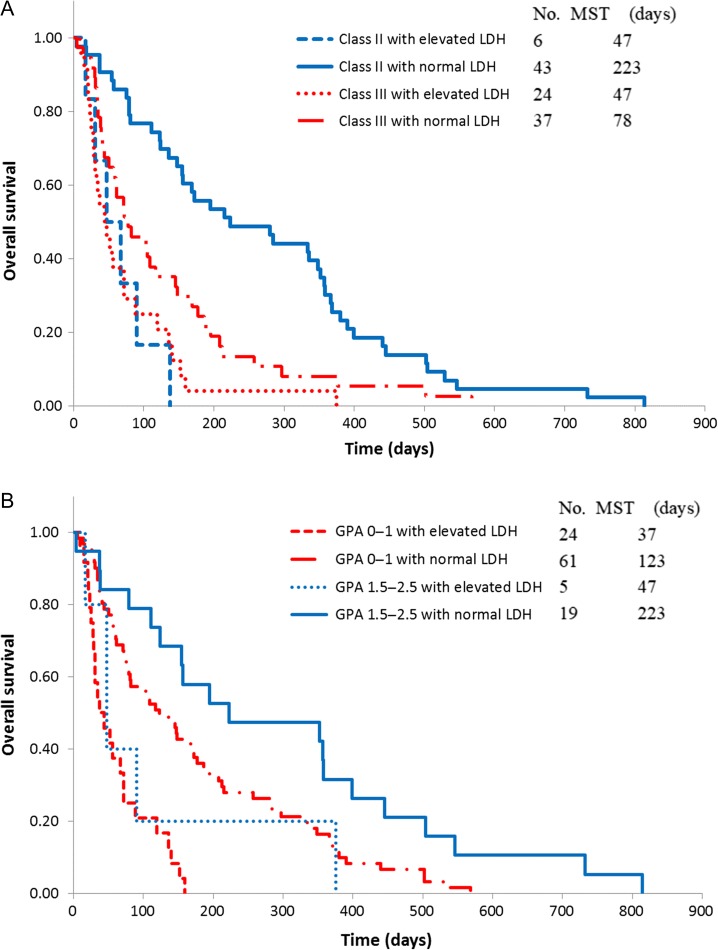
Using existing prognostic models, including the Graded Prognostic Assessment (GPA), it is difficult to identify patients with brain metastases (BMs) who are not likely to survive 2 months after whole-brain radiotherapy (WBRT). The purpose of this study was to identify a subgroup of patients who would not benefit clinically from WBRT. We retrospectively reviewed the records of 111 patients with BMs who were ineligible for surgery or stereotactic irradiation and who underwent WBRT between March 2013 and April 2016. Most patients were scheduled to receive a total dose of 30 Gy in 10 fractions. Non-small cell lung cancer represented the most common primary cancer type (67%), followed by breast cancer (12%). Median survival time (MST) was 109 days (range, 4-883). Univariate analysis identified five factors significantly associated with poor prognosis: performance status (PS) 2-4, perilesional edema, elevated serum lactate dehydrogenase (LDH), using steroids during WBRT, and presence of hepatic metastases. Multivariate analysis confirmed elevated LDH (>300 IU/l) as an independent predictor. MST for LDH >300 IU/l (n = 30) and LDH ≤300 IU/L (n = 87) cohorts were 47 days and 148 days, respectively (P < 0.001). MSTs for GPA 0-1 patients (n = 85) with and without elevated LDH were 37 days and 123 days, respectively (P < 0.001). More than half of the patients with GPA 0-1 and elevated LDH died within two months. Adding elevated LDH to the GPA will permit identification of patients with BMs who have extremely unfavorable prognoses.
使用现有的预后模型,包括分级预后评估(GPA),很难识别出全脑放疗(WBRT)后存活期不足2个月的脑转移瘤(BMs)患者。本研究的目的是识别出临床无法从WBRT中获益的患者亚组。我们回顾性分析了111例无法进行手术或立体定向放疗且在2013年3月至2016年4月期间接受WBRT的BMs患者的记录。大多数患者计划接受10次分割的30 Gy总剂量照射。非小细胞肺癌是最常见的原发癌类型(67%),其次是乳腺癌(12%)。中位生存时间(MST)为109天(范围4 - 883天)。单因素分析确定了与预后不良显著相关的五个因素:体能状态(PS)2 - 4级、瘤周水肿、血清乳酸脱氢酶(LDH)升高、WBRT期间使用类固醇以及存在肝转移。多因素分析证实LDH升高(>300 IU/l)是独立预测因素。LDH >300 IU/l组(n = 30)和LDH≤300 IU/L组(n = 87)的MST分别为47天和148天(P < 0.001)。GPA 0 - 1级且LDH升高和未升高的患者MST分别为37天和123天(P < 0.001)。超过一半的GPA 0 - 1级且LDH升高的患者在两个月内死亡。将LDH升高纳入GPA可识别出预后极差的BMs患者。