Clinic of Radiotherapy and Radiation Oncology, University Hospital Basel, Petersgraben 4, 4031, Basel, Switzerland.
Department of Radiation Oncology, Kantonsspital Baden, Baden, Switzerland.
Strahlenther Onkol. 2024 Nov;200(11):942-948. doi: 10.1007/s00066-024-02275-x. Epub 2024 Aug 12.
To study survival outcomes and prognostic factors in patients undergoing whole brain radiation therapy (WBRT) for brain metastases in the contemporary setting.
Patients undergoing WBRT from 2013-2021 were retrospectively included in an ethics-approved institutional database. Patient and treatment characteristics were assessed, including patient age, primary tumor histology, Karnofsky Performance Status (KPS), extracranial disease, as well as WBRT dose. Overall survival (OS) was calculated from onset of WBRT using the Kaplan-Meier method.
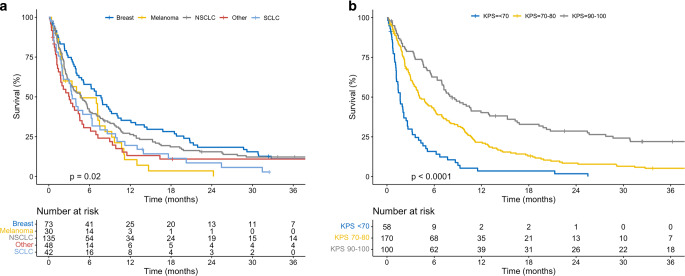
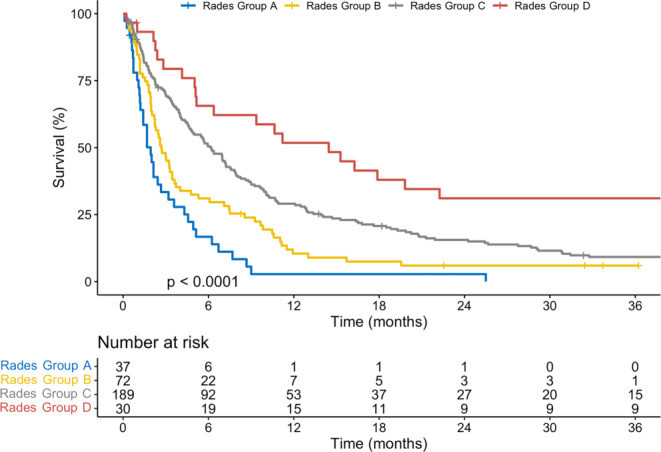
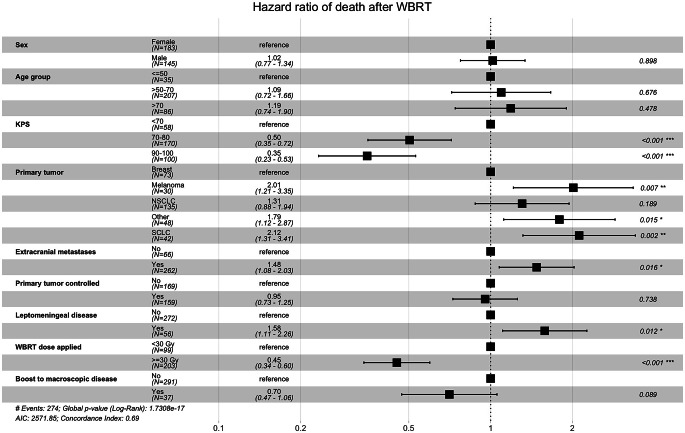
A total of 328 patients (median age 63 years) were included. Most patients (52%) had ≥ 10 brain metastases, and 17% had leptomeningeal disease. WBRT was delivered with 10 × 3 Gy (64%), 5 × 4 Gy (25%), or other regimens (11%). Median follow-up was 4.4 months (range, 0.1-154.3), and median OS was 4.7 months (95%CI, 3.8-6.0). OS differed between histologies (p = 0.01), with the longest survival seen in breast cancer (median 7.7 months). Patients with KPS of 90-100 survived for a median of 8.3 months, compared to 4.1 months with KPS 70-80, and 1.7 months with KPS < 70 (p < 0.01). Multivariate analyses revealed that KPS had the largest impact on survival. Patients who received a WBRT dose of ≥ 30 Gy also had a reduced risk of death (HR 0.45; p < 0.001). Survival differed between subgroups reclassified according to the Rades scoring system (p < 0.01).
Survival outcomes of patients undergoing WBRT in the contemporary era appear comparable to historical cohorts, although individual patient factors need to be considered. Patients with otherwise favorable prognostic factors may benefit from longer-course WBRT.
研究在当代背景下接受全脑放疗(WBRT)治疗脑转移瘤患者的生存结果和预后因素。
回顾性纳入 2013 年至 2021 年期间在机构数据库中接受 WBRT 的患者。评估患者和治疗特征,包括患者年龄、原发肿瘤组织学、卡氏功能状态评分(KPS)、颅外疾病以及 WBRT 剂量。使用 Kaplan-Meier 方法从 WBRT 开始计算总生存期(OS)。
共纳入 328 例患者(中位年龄 63 岁)。大多数患者(52%)有≥10 个脑转移瘤,17%有软脑膜疾病。WBRT 采用 10×3Gy(64%)、5×4Gy(25%)或其他方案(11%)进行治疗。中位随访时间为 4.4 个月(范围为 0.1-154.3),中位 OS 为 4.7 个月(95%CI,3.8-6.0)。不同组织学类型的 OS 不同(p=0.01),乳腺癌患者的生存时间最长(中位 7.7 个月)。KPS 为 90-100 的患者中位生存期为 8.3 个月,KPS 为 70-80 的患者中位生存期为 4.1 个月,KPS <70 的患者中位生存期为 1.7 个月(p<0.01)。多因素分析显示 KPS 对生存的影响最大。接受≥30Gy WBRT 剂量的患者死亡风险也降低(HR 0.45;p<0.001)。根据 Rades 评分系统重新分类的亚组之间的生存情况存在差异(p<0.01)。
在当代,接受 WBRT 的患者的生存结果似乎与历史队列相当,但需要考虑个别患者的因素。具有其他有利预后因素的患者可能受益于更长疗程的 WBRT。