Department of Epidemiology and Preventive Medicine, Monash University, Melbourne, VIC, Australia.
Cancer & Disease Epigenetics, Murdoch Childrens Research Institute, Royal Children's Hospital & Department of Paediatrics, University of Melbourne, Parkville, VIC, 3052, Australia.
BMC Psychiatry. 2017 Oct 25;17(1):354. doi: 10.1186/s12888-017-1515-8.
It is well established that there is a link between inflammation and depression, with several studies reporting increased circulating levels of the pro-inflammatory cytokine, interleukin-6 (IL6), in depressed individuals. Peripheral epigenetic marks, including DNA methylation, hold promise as biomarkers for a range of complex conditions, with potential to inform diagnosis and tailor interventions. The aim of this study was to determine whether individuals with depression display differential methylation of the IL6 gene promoter compared to individuals without depression.
The ESPRIT study of later life neuropsychiatric disorders used a random sampling framework to select non-institutionalised participants aged ≥65 years and over living in the Montpellier region of France. Major depressive disorder (MDD) was assessed using the Mini International Neuropsychiatric Interview (MINI) according to DSM-IV criteria. High levels of depressive symptoms were defined as a score of ≥16 on the Centre for Epidemiologic Studies Depression Scale (CES-D). IL6 promoter DNA methylation was measured on a sub-sample of 380 participants who provided buccal samples.
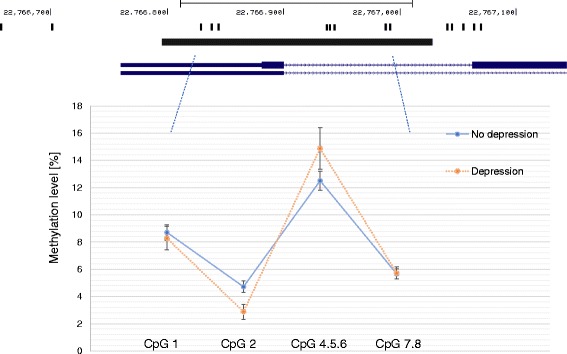
Individuals with depression (current MDD or high depressive symptoms) had lower IL6 methylation levels at one of the four sites investigated, however the effect size was small (∆ 2.4%, SE 0.009, p = 0.006). Interestingly, antidepressant use was independently associated with higher IL-6 methylation at the same site (∆ 4.6%, SE 0.019, p = 0.015). In multivariate linear regression analyses adjusting for covariates, including sex and smoking status, these associations remained. There was no effect modification when considering IL6 genotype.
This study presents evidence that IL6 methylation may be a marker of depression status in older individuals, however further work is now needed to replicate these findings and to assess the association with inflammatory status of individuals.
炎症与抑郁之间存在关联,这已得到充分证实,多项研究报告称,抑郁个体的循环促炎细胞因子白细胞介素-6(IL6)水平升高。外周表观遗传标记,包括 DNA 甲基化,作为一系列复杂疾病的生物标志物具有很大的潜力,可以为诊断提供信息并调整干预措施。本研究旨在确定与无抑郁个体相比,抑郁个体的 IL6 基因启动子是否存在差异甲基化。
晚年神经精神障碍的 ESPRIT 研究使用随机抽样框架选择居住在法国蒙彼利埃地区的年龄≥65 岁的非机构化参与者。使用根据 DSM-IV 标准的迷你国际神经精神访谈(MINI)评估重度抑郁症(MDD)。使用中心流行病学研究抑郁量表(CES-D),将高抑郁症状定义为得分≥16。对 380 名提供口腔样本的参与者进行了亚组 IL6 启动子 DNA 甲基化测量。
患有抑郁症(当前 MDD 或高抑郁症状)的个体在四个研究的一个位点的 IL6 甲基化水平较低,但效应量较小(∆2.4%,SE 0.009,p=0.006)。有趣的是,抗抑郁药的使用与同一部位的更高 IL-6 甲基化独立相关(∆4.6%,SE 0.019,p=0.015)。在调整了包括性别和吸烟状况在内的协变量的多元线性回归分析中,这些关联仍然存在。当考虑 IL6 基因型时,没有效应修饰。
本研究提供了证据表明,IL6 甲基化可能是老年个体抑郁状态的标志物,但现在需要进一步的工作来复制这些发现,并评估与个体炎症状态的关联。