Department of Biomedical Engineering, University of Wisconsin-Madison, Madison, WI, 53705, United States.
Department of Surgery, University of Wisconsin-Madison, Madison, WI, 53705, United States.
Sci Rep. 2017 Oct 25;7(1):14070. doi: 10.1038/s41598-017-14325-9.
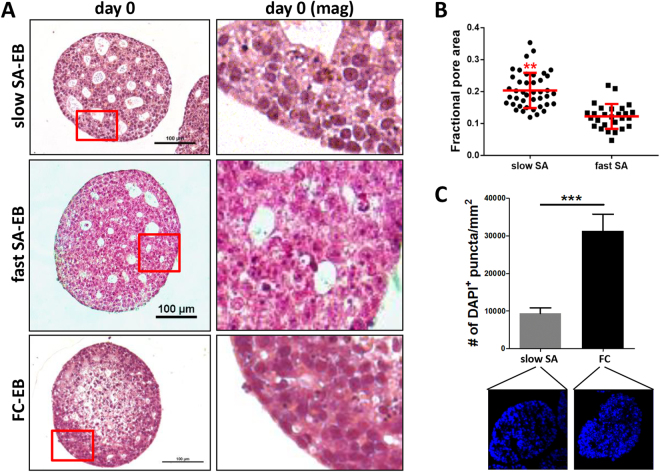
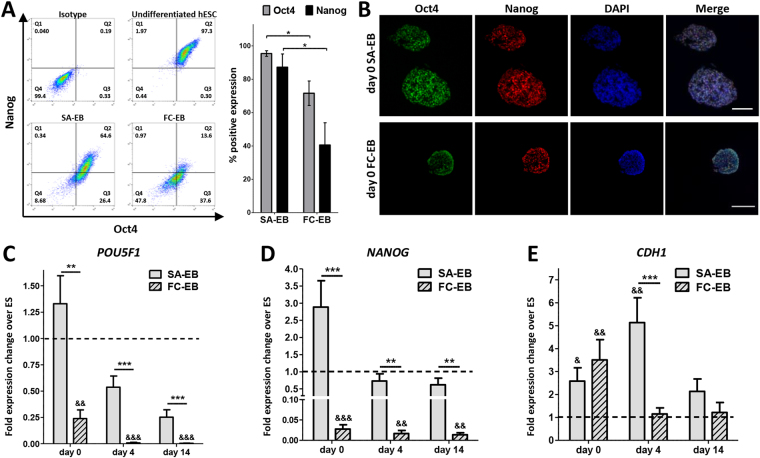
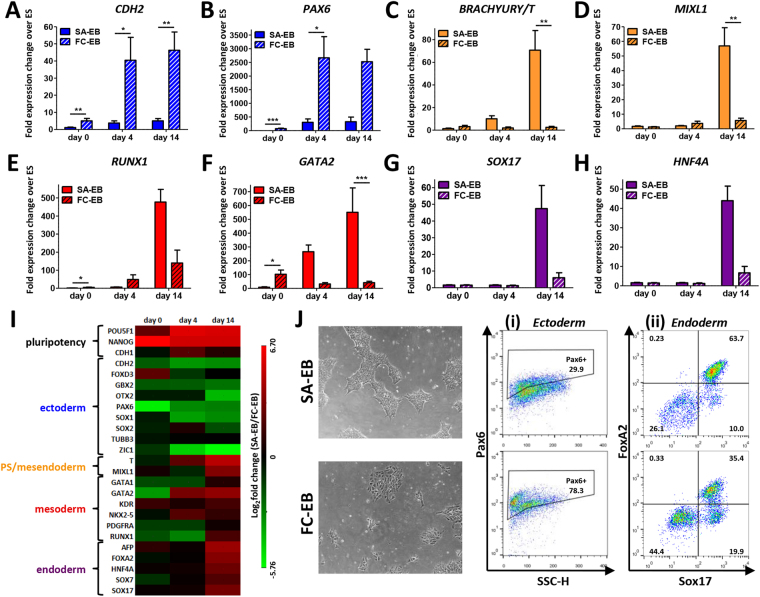
Stem cell-derived organoids and other 3D microtissues offer enormous potential as models for drug screening, disease modeling, and regenerative medicine. Formation of stem/progenitor cell aggregates is common in biomanufacturing processes and critical to many organoid approaches. However, reproducibility of current protocols is limited by reliance on poorly controlled processes (e.g., spontaneous aggregation). Little is known about the effects of aggregation parameters on cell behavior, which may have implications for the production of cell aggregates and organoids. Here we introduce a bioengineered platform of labile substrate arrays that enable simple, scalable generation of cell aggregates via a controllable 2D-to-3D "self-assembly". As a proof-of-concept, we show that labile substrates generate size- and shape-controlled embryoid bodies (EBs) and can be easily modified to control EB self-assembly kinetics. We show that aggregation method instructs EB lineage bias, with faster aggregation promoting pluripotency loss and ectoderm, and slower aggregation favoring mesoderm and endoderm. We also find that aggregation kinetics of EBs markedly influence EB structure, with slower kinetics resulting in increased EB porosity and growth factor signaling. Our findings suggest that controlling internal structure of cell aggregates by modifying aggregation kinetics is a potential strategy for improving 3D microtissue models for research and translational applications.
干细胞衍生的类器官和其他 3D 微组织为药物筛选、疾病建模和再生医学提供了巨大的潜力。干细胞/祖细胞聚集的形成在生物制造过程中很常见,对许多类器官方法至关重要。然而,当前协议的可重复性受到对控制不良的过程(例如自发聚集)的依赖的限制。关于聚集参数对细胞行为的影响知之甚少,这可能对细胞聚集和类器官的产生有影响。在这里,我们引入了一个不稳定基质阵列的生物工程平台,该平台可通过可控的 2D 到 3D“自组装”来简单、可扩展地生成细胞聚集。作为概念验证,我们展示了不稳定的基质可以产生大小和形状可控的胚胎体(EBs),并且可以很容易地修改以控制 EB 自组装动力学。我们表明,聚集方法指导 EB 谱系偏向,更快的聚集促进多能性丧失和外胚层,而更慢的聚集有利于中胚层和内胚层。我们还发现 EB 的聚集动力学显著影响 EB 的结构,较慢的动力学导致 EB 孔隙率增加和生长因子信号传导增加。我们的研究结果表明,通过改变聚集动力学来控制细胞聚集物的内部结构是改善用于研究和转化应用的 3D 微组织模型的潜在策略。