Di Vincenzo Fabio, Profico Antonio, Bernardini Federico, Cerroni Vittorio, Dreossi Diego, Schlager Stefan, Zaio Paola, Benazzi Stefano, Biddittu Italo, Rubini Mauro, Tuniz Claudio, Manzi Giorgio
Dipartimento di Biologia Ambientale, Sapienza Università di Roma, Roma, Italy.
Istituto Italiano di Paleontologia Umana, Roma, Italy.
Sci Rep. 2017 Oct 25;7(1):13974. doi: 10.1038/s41598-017-14437-2.
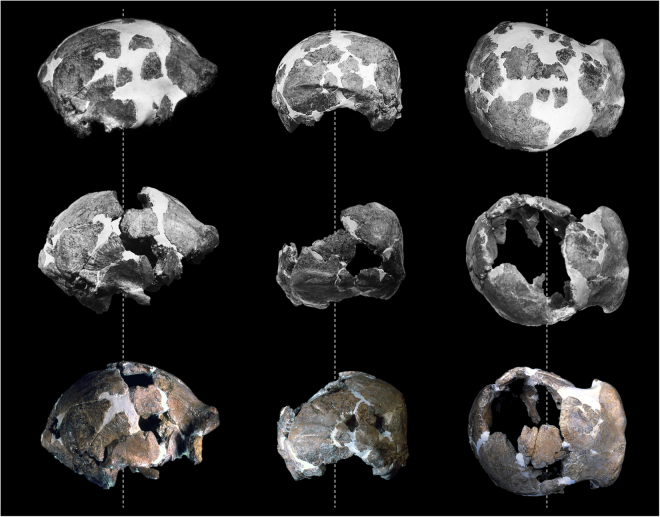
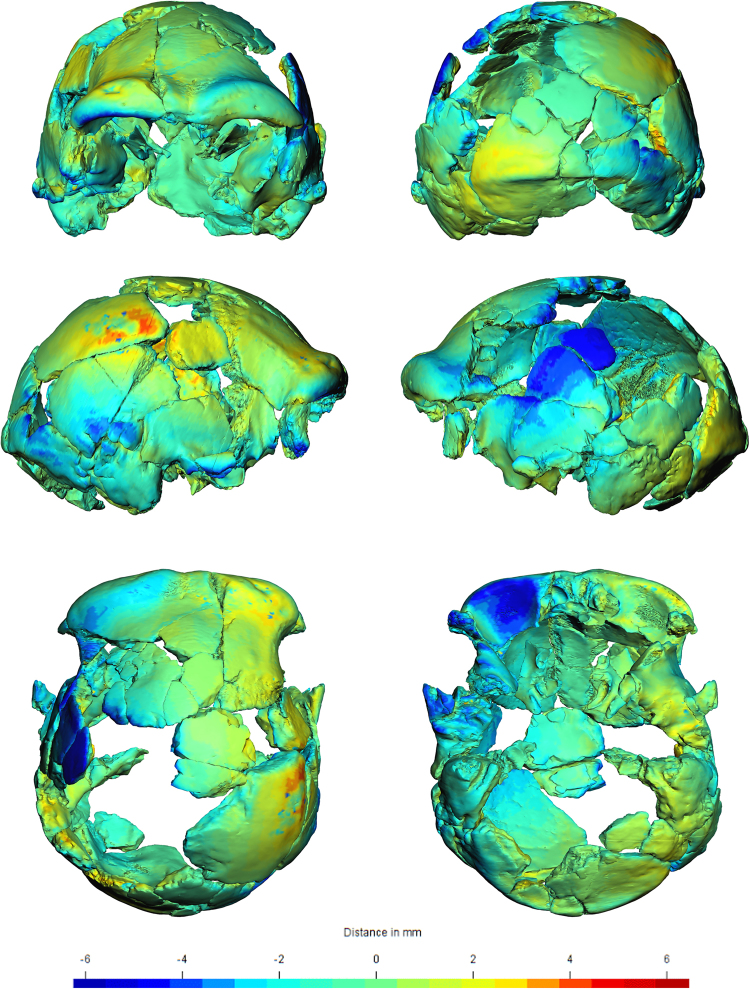
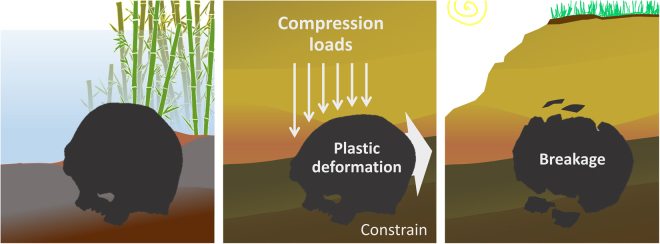
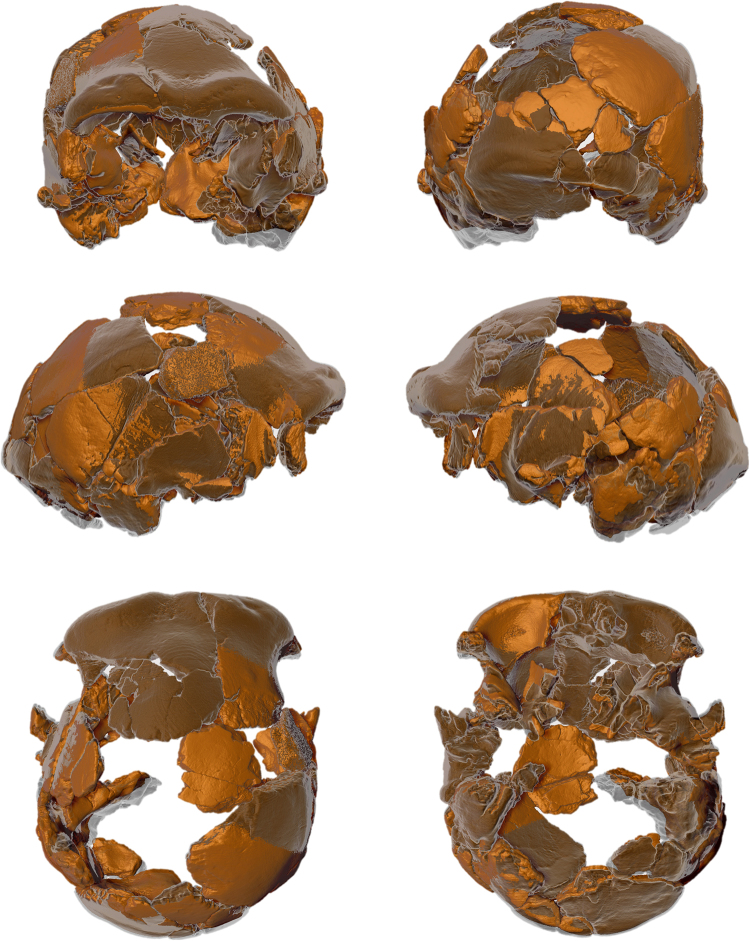
The Ceprano calvarium was discovered in fragments on March 1994 near the town of Ceprano in southern Latium (Italy), embedded in Middle Pleistocene layers. After reconstruction, its morphological features suggests that the specimen belongs to an archaic variant of H. heidelbergensis, representing a proxy for the last common ancestor of the diverging clades that respectively led to H. neanderthalensis and H. sapiens. Unfortunately, the calvarium was taphonomically damaged. The postero-lateral vault, in particular, appears deformed and this postmortem damage may have influenced previous interpretations. Specifically, there is a depression on the fragmented left parietal, while the right cranial wall is warped and angulated. This deformation affected the shape of the occipital squama, producing an inclination of the transverse occipital torus. In this paper, after X-ray microtomography (μCT) of both the calvarium and several additional fragments, we analyze consistency and pattern of the taphonomic deformation that affected the specimen, before the computer-assisted retrodeformation has been performed; this has also provided the opportunity to reappraise early attempts at restoration. As a result, we offer a revised interpretation for the Ceprano calvarium's original shape, now free from the previous uncertainties, along with insight for its complex depositional and taphonomic history.
1994年3月,在意大利拉齐奥南部的切普拉诺镇附近发现了切普拉诺颅骨碎片,其嵌于中更新世地层中。重建后,其形态特征表明该标本属于海德堡人(H. heidelbergensis)的一个古老变种,代表了分别导致尼安德特人(H. neanderthalensis)和智人(H. sapiens)的分化分支的最后一个共同祖先的代表。不幸的是,该颅骨在埋藏学上受到了损坏。特别是后外侧穹顶看起来变形了,这种死后损伤可能影响了先前的解释。具体而言,破碎的左顶骨上有一个凹陷,而右侧颅壁扭曲且有角度。这种变形影响了枕鳞的形状,导致枕横嵴倾斜。在本文中,在对该颅骨和其他几块碎片进行X射线显微断层扫描(μCT)之后,我们在进行计算机辅助逆向变形之前,分析了影响该标本的埋藏学变形的一致性和模式;这也为重新评估早期的修复尝试提供了机会。结果,我们对切普拉诺颅骨的原始形状给出了一个经过修订的解释,现在已摆脱了先前的不确定性,同时还对其复杂的沉积和埋藏历史有了深入了解。