Department of Anesthesiology and Pain Medicine, Asan Medical Center, University of Ulsan College of Medicine, Seoul, Korea.
Department of Thoracic and Cardiovascular Surgery, Asan Medical Center, University of Ulsan College of Medicine, Seoul, Korea.
Sci Rep. 2017 Oct 25;7(1):14020. doi: 10.1038/s41598-017-14147-9.
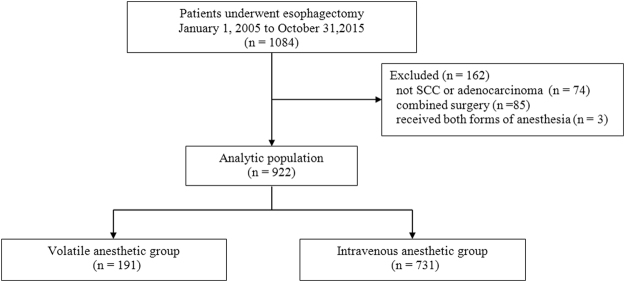
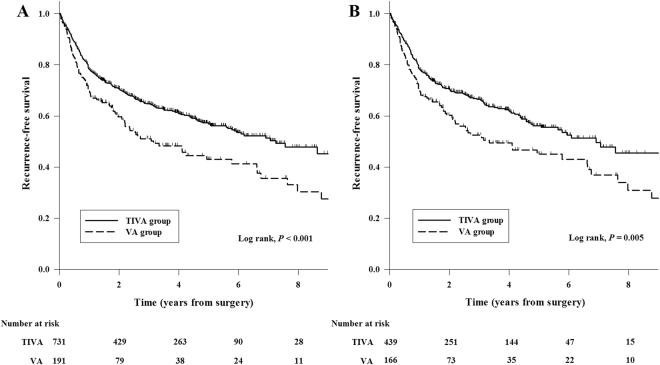
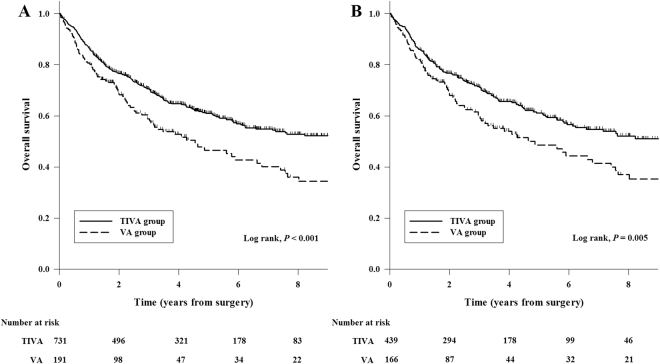
Given that surgical stress response and surgical excision may increase the likelihood of post-surgery cancer dissemination and metastasis, the appropriate choice of surgical anesthetics may be important for oncologic outcomes. We evaluated the association of anesthetics used for general anesthesia with overall survival and recurrence-free survival in patients who underwent esophageal cancer surgery. Adult patients (922) underwent elective esophageal cancer surgery were included. The patients were divided into two groups according to the anesthetics administered during surgery: volatile anesthesia (VA) or intravenous anesthesia with propofol (TIVA). Propensity score and Cox regression analyses were performed. There were 191 patients in the VA group and 731 in the TIVA group. In the entire cohort, VA was independently associated with worse overall survival (HR 1.58; 95% CI 1.24-2.01; P < 0.001) and recurrence-free survival (HR 1.42; 95% CI 1.12-1.79; P = 0.003) after multivariable analysis adjustment. Similarly, in the propensity score matched cohorts, VA was associated with worse overall survival (HR 1.45; 95% CI 1.11-1.89; P = 0.006) and recurrence-free survival (HR 1.44; 95% CI 1.11-1.87; P = 0.006). TIVA during esophageal cancer surgery was associated with better postoperative survival rates compared with volatile anesthesia.
鉴于手术应激反应和手术切除可能增加术后癌症扩散和转移的可能性,因此选择适当的手术麻醉方法对于肿瘤学结果可能很重要。我们评估了全身麻醉中使用的麻醉剂与接受食管癌手术的患者的总生存率和无复发生存率之间的关系。纳入了 922 名接受择期食管癌手术的成年患者。根据手术期间使用的麻醉剂将患者分为两组:挥发性麻醉剂(VA)或异丙酚静脉麻醉(TIVA)。进行了倾向评分和 Cox 回归分析。VA 组有 191 例患者,TIVA 组有 731 例患者。在整个队列中,VA 与总生存率(HR 1.58;95%CI 1.24-2.01;P<0.001)和无复发生存率(HR 1.42;95%CI 1.12-1.79;P=0.003)独立相关。同样,在倾向评分匹配队列中,VA 与总生存率(HR 1.45;95%CI 1.11-1.89;P=0.006)和无复发生存率(HR 1.44;95%CI 1.11-1.87;P=0.006)较差相关。与挥发性麻醉相比,食管癌手术期间使用 TIVA 与术后生存率的提高相关。