Soh Avril Zixin, Chee Cynthia Bin Eng, Wang Yee-Tang, Yuan Jian-Min, Koh Woon-Puay
Saw Swee Hock School of Public Health, National University of Singapore, Singapore, Singapore.
Singapore Tuberculosis Control Unit, Tan Tock Seng Hospital, Singapore, Singapore.
BMJ Open Respir Res. 2017 Oct 13;4(1):e000247. doi: 10.1136/bmjresp-2017-000247. eCollection 2017.
Heavy alcohol consumption increases the risk of active tuberculosis (TB). However, the relation between lower levels of alcohol intake and TB risk remains unclear. We aimed to evaluate the association between alcohol intake and risk of active TB and assess whether the associations were modified by smoking status, which is another risk factor for active TB.
The Singapore Chinese Health Study is a prospective cohort of 63 257 adults aged 45-74 years recruited from 1993 to 1998. Information on alcohol intake and smoking history was collected at recruitment. Active TB cases were identified via linkage with National TB Notification Registry.
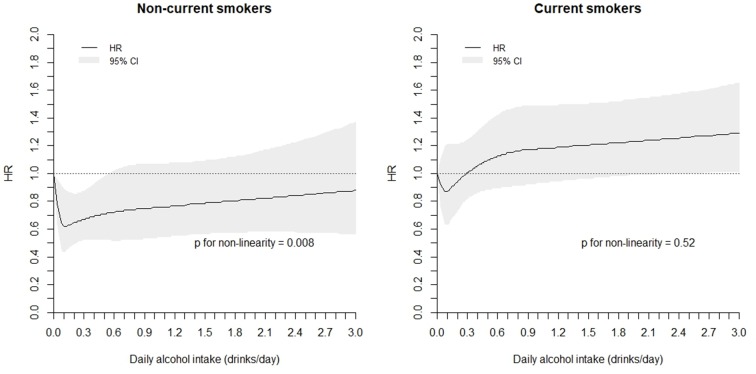
During a mean follow-up of 16.8 years, 1249 incident cases of active TB were identified. Among non-smokers, compared with total abstinence, participants who had monthly to weekly intake of alcohol had reduced TB risk (HR 0.70, 95% CI 0.55 to 0.89), but this reduction in risk with low-dose drinking was not observed among current smokers (HR 0.96, 95% CI 0.77 to 1.18; p for interaction=0.02). Comparatively, drinking 2+ drinks daily was associated with increased TB risk among current smokers (HR 1.51, 95% CI 1.11 to 2.05). This increased risk was not observed among non-smokers (HR 0.93, 95% CI 0.49 to 1.77) and the interaction between alcohol intake and smoking status was of borderline significance (p for interaction=0.08). In joint effect, compared with those who neither smoked nor drank, the risk of active TB increased from 1.82 (95% CI 1.57 to 2.10) in current smokers who were non-drinkers to 3.16 (95% CI 2.35 to 4.24) in current smokers who also drank 2+ drinks daily.
While low intake of alcohol may protect against active TB among non-smokers, drinking 2+ drinks daily could act synergistically with smoking to increase the risk of active TB in current smokers.
大量饮酒会增加活动性肺结核(TB)的发病风险。然而,较低水平的酒精摄入量与肺结核风险之间的关系仍不明确。我们旨在评估酒精摄入量与活动性肺结核风险之间的关联,并评估这种关联是否会因吸烟状况(活动性肺结核的另一个风险因素)而改变。
新加坡华人健康研究是一项前瞻性队列研究,于1993年至1998年招募了63257名年龄在45 - 74岁的成年人。在招募时收集了酒精摄入量和吸烟史的信息。通过与国家结核病通报登记处的关联确定活动性肺结核病例。
在平均16.8年的随访期间,共确定了1249例活动性肺结核新发病例。在不吸烟者中,与完全戒酒者相比,每月至每周饮酒的参与者患肺结核的风险降低(风险比[HR]为0.70,95%置信区间[CI]为0.55至0.89),但在当前吸烟者中未观察到低剂量饮酒带来的风险降低(HR为0.96,95%CI为0.77至1.18;交互作用p值 = 0.02)。相比之下,每天饮用2杯及以上酒与当前吸烟者患肺结核风险增加相关(HR为1.51,95%CI为1.11至2.05)。在不吸烟者中未观察到这种风险增加(HR为0.93,95%CI为0.49至1.77),酒精摄入量与吸烟状况之间的交互作用具有临界显著性(交互作用p值 = 0.08)。综合来看,与既不吸烟也不饮酒者相比,当前不饮酒的吸烟者患活动性肺结核的风险为1.82(95%CI为1.57至2.10),而当前每天饮用2杯及以上酒的吸烟者患活动性肺结核的风险增至3.16(95%CI为2.35至4.24)。
虽然低酒精摄入量可能对不吸烟者预防活动性肺结核有保护作用,但每天饮用2杯及以上酒可能与吸烟协同作用,增加当前吸烟者患活动性肺结核的风险。