Szendrői Miklós, Antal Imre, Szendrői Attila, Lazáry Áron, Varga Péter Pál
Department of Orthopaedics, Semmelweis University, H-1082 Budapest, Üllői 78/b, Hungary.
Department of Urology, Semmelweis University, H-1082 Budapest, Üllői 78/b, Hungary.
EFORT Open Rev. 2017 Sep 1;2(9):372-381. doi: 10.1302/2058-5241.2.170006. eCollection 2017 Sep.
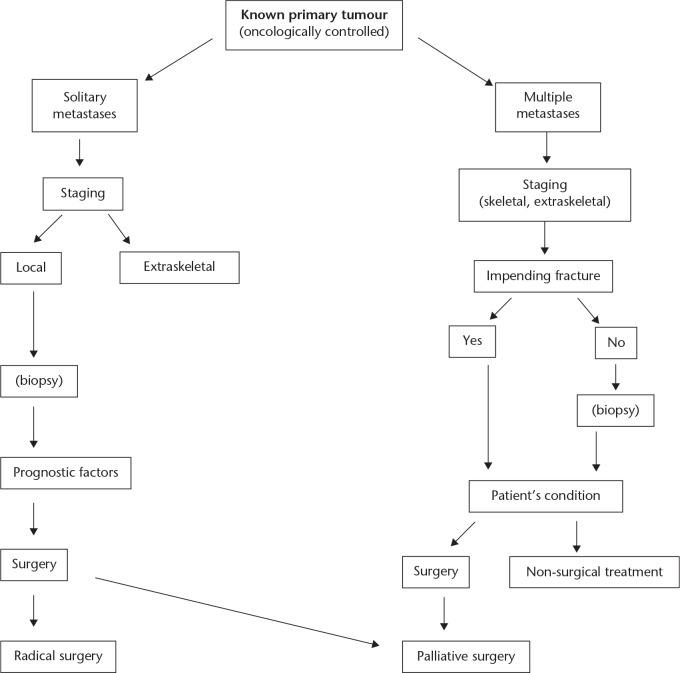
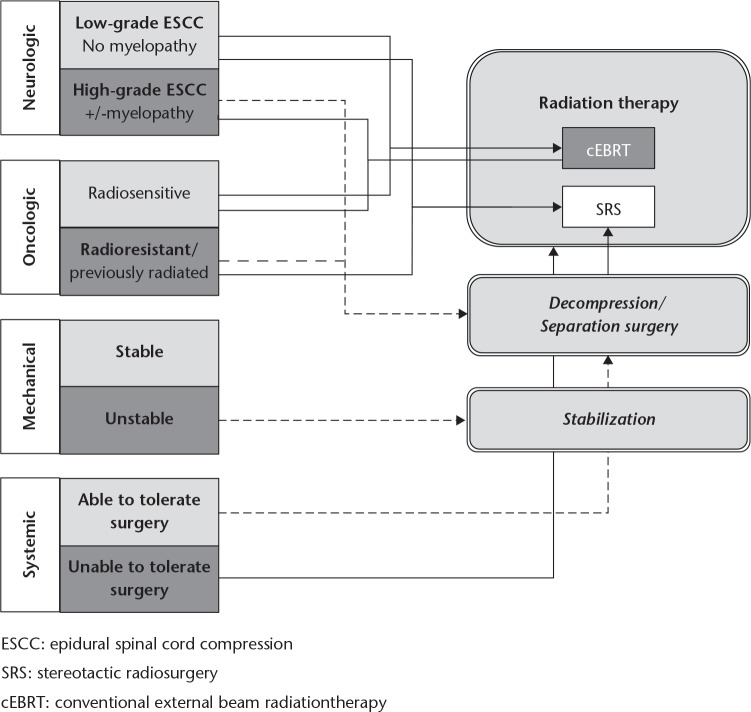
Oncological management of skeletal metastases has changed dramatically in the last few decades. A significant number of patients survive for many years with their metastases.Surgeons are more active and the technical repertoire is broader, from plates to intramedullary devices to (tumour) endoprostheses.The philosophy of treatment should be different in the case of a trauma-related fracture and a pathological fracture. A proper algorithm for establishing a diagnosis and evaluation of prognostic factors helps in planning the surgical intervention.The aim of palliative surgery is usually to eliminate pain and to allow the patient to regain his/her mobility as well as to improve the quality of life through minimally invasive techniques using life-long durable devices.In a selected group of patients with an oncologically controlled primary tumour site and a solitary bone metastasis with positive prognostic factors, which meet the criteria for radical excision (approximately 10% to 15% of the cases), a promising three to five years of survival may be achieved, especially in cases of metastases from breast and kidney cancer.Spinal metastases require meticulous evaluation because decisions on treatment mostly depend on the tumour type, segmental stability, the patient's symptoms and general state of health.Advanced radiotherapy combined with minimally invasive surgical techniques (minimally invasive stabilisation and separation surgery) provides durable local control with a low complication rate in a number of patients. Cite this article: 2017;2:372-381.
在过去几十年中,骨骼转移瘤的肿瘤学管理发生了巨大变化。相当一部分患者带着转移瘤存活多年。外科医生更加积极,技术手段也更加广泛,从钢板到髓内装置再到(肿瘤)人工关节。对于创伤相关骨折和病理性骨折,治疗理念应该有所不同。建立诊断和评估预后因素的适当算法有助于规划手术干预。姑息性手术的目的通常是消除疼痛,使患者恢复活动能力,并通过使用耐用的终身装置的微创技术提高生活质量。在一组经过肿瘤学控制的原发肿瘤部位且有孤立性骨转移且预后因素为阳性、符合根治性切除标准(约占病例的10%至15%)的特定患者中,尤其是乳腺癌和肾癌转移的病例,有望实现三到五年的生存期。脊柱转移瘤需要细致评估,因为治疗决策大多取决于肿瘤类型、节段稳定性、患者症状和总体健康状况。先进的放射治疗与微创外科技术(微创稳定和分离手术)相结合,可为许多患者提供持久的局部控制,且并发症发生率较低。引用本文:2017;2:372 - 381。