Jairath Ankush, Singh Abhishek, Sabnis Ravindra, Ganpule Arvind, Desai Mahesh
Muljibhai Patel Urological Hospital, Nadiad, Gujarat, India.
Arab J Urol. 2017 Mar 6;15(2):170-176. doi: 10.1016/j.aju.2017.01.004. eCollection 2017 Jun.
To devise a minimally invasive, less morbid yet effective alternative technique for basilic vein transposition (BVT) in the arm/forearm and to compare perioperative outcomes with the conventional technique.
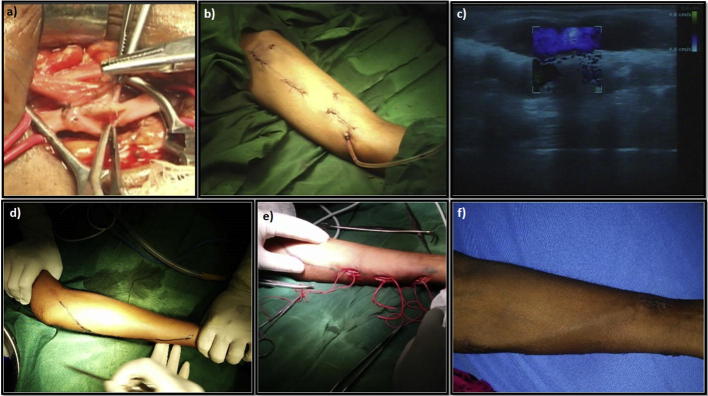
Patients undergoing BVT in the last two years (June 2013 to June 2015) were included in the study and the results were analysed. All patients were preoperatively evaluated using colour Doppler ultrasonography performed by the operating surgeon himself. For minimally invasive BVT, two or three small 1-2 cm incisions were made to completely mobilise the basilic vein, transposed in an anterolateral arm/forearm tunnel, and then anastomosed to the brachial or radial artery in the forearm and arm, respectively. The incision in the conventional technique was along the full length of the basilic vein, with the rest of the procedure remaining the same. Complications, pain, analgesic use, maturation and primary patency rates were compared between the techniques.
In all, 30 patients underwent minimally invasive BVT and 34 patients underwent conventional BVT, with mean age of 52 and 55 years, respectively. The complications of wound haematoma (one vs four) and wound infection/dehiscence (two vs six) were less common in the minimally invasive BVT group compared to the conventional group. The analgesic requirement and visual analogue scale pain score was significantly less in the minimally invasive BVT group. All other variables assessed, such as maturation and primary patency rate at 1 year, were not significantly different between the groups.
Minimally invasive dissection of the basilic vein for vascular access transposition is a safe, reliable procedure with patency and functional outcomes comparable with those of conventional BVT.
设计一种用于手臂/前臂贵要静脉转位术(BVT)的微创、低创伤且有效的替代技术,并将围手术期结果与传统技术进行比较。
纳入过去两年(2013年6月至2015年6月)接受BVT的患者并分析结果。所有患者术前均由主刀医生亲自进行彩色多普勒超声检查评估。对于微创BVT,做两到三个1-2厘米的小切口以完全游离贵要静脉,将其转位至手臂/前臂前外侧隧道,然后分别与前臂和手臂的肱动脉或桡动脉吻合。传统技术的切口沿贵要静脉全长,其余操作相同。比较两种技术的并发症、疼痛、镇痛药物使用、血管成熟度和一期通畅率。
共有30例患者接受了微创BVT,34例患者接受了传统BVT,平均年龄分别为52岁和55岁。与传统组相比,微创BVT组伤口血肿(1例对4例)和伤口感染/裂开(2例对6例)的并发症较少见。微创BVT组的镇痛需求和视觉模拟评分疼痛得分明显更低。评估的所有其他变量,如1年时的血管成熟度和一期通畅率,两组之间无显著差异。
用于血管通路转位的微创游离贵要静脉是一种安全、可靠的手术,通畅率和功能结果与传统BVT相当。