Veeramani Muthu, Vyas Jigish, Sabnis Ravindra, Desai Mahesh
Department of Urology, Muljibhai Patel Urological Hospital, Nadiad, Gugarat - 387 001, India.
Indian J Urol. 2010 Jan-Mar;26(1):145-7. doi: 10.4103/0970-1591.60466.
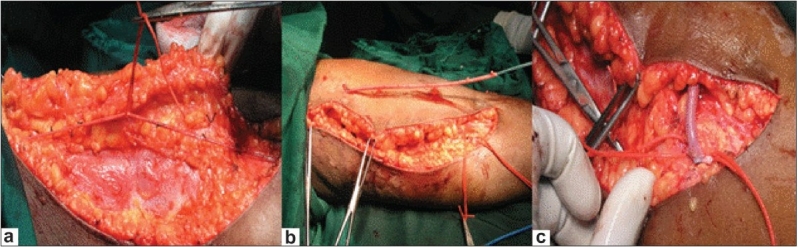
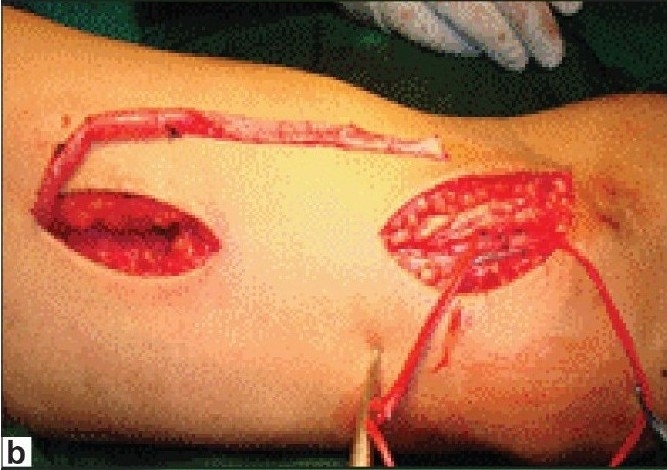
End-stage renal disease is a significant health problem. The primary use of the autogenous arteriovenous access is recommended by NKF-DOQI (National Kidney Foundation-Dialysis Outcomes Quality Initiative) guidelines. Though basilic vein transposition is well established in multiple failed fistulae's and obese patients, it requires large incision and morbidities like edema and infection. To avoid such compilations we, at our institution, adopted a small incision technique using two small 3-4 cm incisions. This method is inspired by videoendoscopic minimally invasive method used to dissect the basilic vein, thus avoiding extensive dissection and related morbidities.
终末期肾病是一个严重的健康问题。NKF-DOQI(美国国家肾脏基金会-透析预后质量倡议)指南推荐自体动静脉内瘘为主要治疗方式。尽管在多次动静脉内瘘失败的患者和肥胖患者中,贵要静脉转位术已得到广泛应用,但该手术需要较大切口,且存在水肿和感染等并发症。为避免此类并发症,我们机构采用了一种小切口技术,即做两个3-4厘米的小切口。该方法受视频内镜微创技术启发,用于解剖贵要静脉,从而避免广泛的解剖操作及相关并发症。