Shanghai National Clinical Research Center for Endocrine and Metabolic Diseases, Key Laboratory for Endocrine and Metabolic Diseases of Chinese Ministry of Health, Shanghai Institute of Endocrine and Metabolic Diseases, Ruijin Hospital, Shanghai Jiaotong University School of Medicine, 197 Ruijin Er Road, Shanghai, 200025, China.
Department of Endocrinology, Ren Ji Hospital, Shanghai Jiao Tong University School of Medicine, 160 Pujian Road, Shanghai, 200127, China.
Sci Rep. 2017 Oct 26;7(1):14156. doi: 10.1038/s41598-017-14534-2.
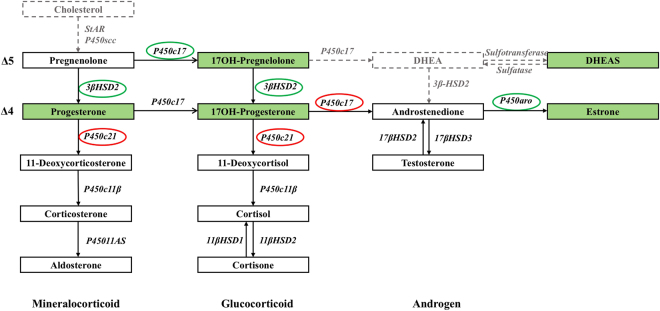
The study explored differences in the steroidogenic pathway between obese and nonobese women with polycystic ovary syndrome (PCOS) using liquid chromatography-tandem mass spectrometry (LC-MS/MS). 1044 women with PCOS (including 350 lean, 312 overweight and 382 obese) and 366 control women without PCOS (including 203 lean, 32 overweight and 131 obese) were enrolled. The differences in steroid hormones were amplified in lean PCOS versus lean controls compared with obese PCOS versus obese controls. Compared with obese PCOS, lean PCOS demonstrated increased dehydroepiandrosterone sulfate (P = 0.015), 17-hydropregnenolone (P = 0.003), 17-hydroprogesterone (17-OHP) (P < 0.001), progesterone (P < 0.001) and estrone (P < 0.001) levels. Enzyme activity evaluation showed that lean PCOS had increased activity of P450c17 (17-hydropregnenolone/pregnenolone, P < 0.001), P450aro (P < 0.001), 3βHSD2 (progesterone/ pregnenolone and 17-OHP/17-hydropregnenolone, both P < 0.001) and decreased activity of P450c21(11-deoxycorticorsterone/progesterone and 11-deoxycortisol/17-OHP, P < 0.001). Moreover, we found higher frequencies of CYP21A2- (encoding P450c21) c.552 C > G (p. D184E) in lean PCOS compared with obese PCOS patients (P = 0.006). In conclusion, this study demonstrated for the first time that the adrenal-specific enzyme P450c21 showed decreased activity in lean PCOS patients, and that the adrenal androgen excess may play different roles in lean and obese PCOS patients, which represents as different enzyme activity in the steroidogenic pathway.
本研究采用液相色谱-串联质谱法(LC-MS/MS)探讨了多囊卵巢综合征(PCOS)肥胖和非肥胖妇女之间甾体生成途径的差异。共纳入 1044 名 PCOS 妇女(包括 350 名瘦型、312 名超重和 382 名肥胖)和 366 名非 PCOS 对照妇女(包括 203 名瘦型、32 名超重和 131 名肥胖)。与肥胖 PCOS 相比,瘦型 PCOS 与瘦型对照相比,甾体激素的差异更大。与肥胖 PCOS 相比,瘦型 PCOS 的脱氢表雄酮硫酸酯(DHEAS)(P=0.015)、17-羟孕烯醇酮(17-OHP)(P=0.003)、孕酮(P<0.001)和雌酮(P<0.001)水平增加。酶活性评估显示,瘦型 PCOS 的 P450c17(17-羟孕烯醇酮/孕烯醇酮,P<0.001)、P450aro(P<0.001)、3βHSD2(孕酮/孕烯醇酮和 17-OHP/17-羟孕烯醇酮,均 P<0.001)活性增加,P450c21(11-去氧皮质酮/孕酮和 11-去氧皮质醇/17-OHP,P<0.001)活性降低。此外,我们发现瘦型 PCOS 患者 CYP21A2-(编码 P450c21)c.552C>G(p.D184E)的频率高于肥胖型 PCOS 患者(P=0.006)。总之,本研究首次证实,肾上腺特异性酶 P450c21 在瘦型 PCOS 患者中活性降低,而肾上腺雄激素过多在瘦型和肥胖型 PCOS 患者中可能发挥不同的作用,表现为甾体生成途径中不同的酶活性。