Liu Fenye, Ma Tianbao, Che Xiaolin, Wang Qirong, Yu Shudong
Department of Traditional Chinese Medicine, Shandong Provincial Hospital Affiliated to Shandong University, Jinan, China.
Department of Hearing Central, Women and Children's Health Care Hospital of Linyi, Linyi, China.
Front Neurol. 2017 Oct 11;8:524. doi: 10.3389/fneur.2017.00524. eCollection 2017.
Different types of medications are currently used in vestibular migraine (VM) prophylaxis, although recommendations for use are generally based on expert opinion rather than on solid data from randomized trials. We evaluated the efficacy and safety of venlafaxine, flunarizine, and valproic acid in a randomized comparison trial for VM prophylaxis.
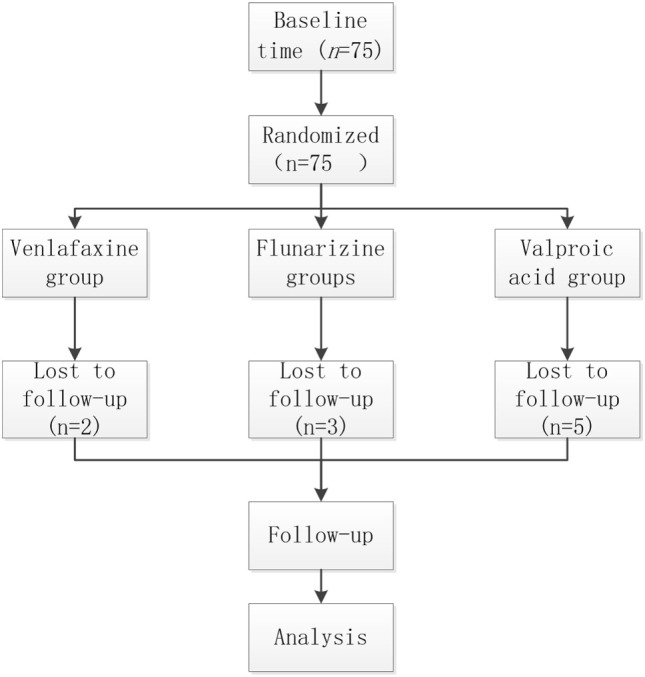
Subjects were randomly allocated to one of three groups (venlafaxine group, flunarizine group, and valproic acid group). To assess the efficacy of treatment on vertigo symptoms, the following parameters were assessed at baseline and 3 months after treatment: Dizziness Handicap Inventory (DHI) scores, number of vertiginous attacks in the previous month, and Vertigo Severity Score (VSS). Adverse events also were evaluated.
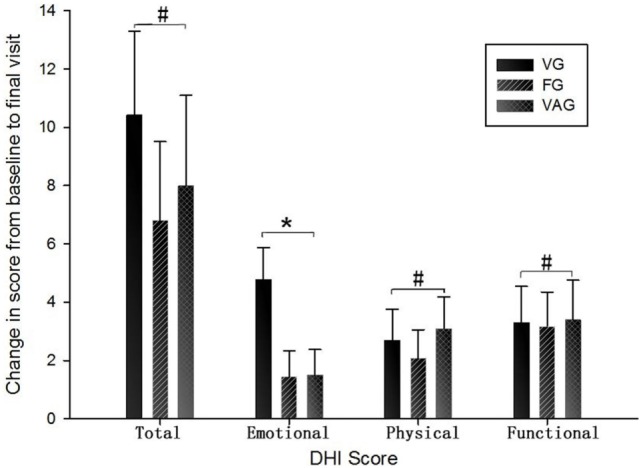
A decrease in DHI total scores was shown following treatment with all three medications, with no obvious differences between the groups. Treatment effects differed, however, in the DHI physical, functional, and emotional domains with only venlafaxine showing a decreased effect in all of three domains. Flunarizine and valproic acid showed an effect in only one DHI domain. Venlafaxine and flunarizine showed decreased VSS scores ( = 0 and = 0.03, respectively). Although valproic acid had no obvious effect on VSS ( = 0.27), decreased vertigo attack frequency was observed in this group ( = 0). Venlafaxine also had an effect on vertigo attack frequency ( = 0), but flunarizine had no obvious effect ( = 0.06). No serious adverse events were reported in the three groups.
Our data confirm the efficacy and safety of venlafaxine, flunarizine, and valproic acid in the prophylaxis of VM, venlafaxine had an advantage in terms of emotional domains. Venlafaxine and valproic acid also were shown to be preferable to flunarizine in decreasing the number of vertiginous attacks, but valproic acid was shown to be less effective than venlafaxine and flunarizine to decrease vertigo severity.
ChiCTR-OPC-17011266 (http://www.chictr.org.cn/).
目前,前庭性偏头痛(VM)预防中使用了不同类型的药物,尽管用药建议通常基于专家意见而非随机试验的确切数据。我们在一项VM预防的随机对照试验中评估了文拉法辛、氟桂利嗪和丙戊酸的疗效和安全性。
受试者被随机分配到三组之一(文拉法辛组、氟桂利嗪组和丙戊酸组)。为评估治疗对眩晕症状的疗效,在基线和治疗后3个月评估以下参数:头晕残障量表(DHI)评分、前一个月眩晕发作次数和眩晕严重程度评分(VSS)。还评估了不良事件。
所有三种药物治疗后DHI总分均降低,组间无明显差异。然而,在DHI的身体、功能和情感领域,治疗效果有所不同,只有文拉法辛在所有三个领域均显示出降低作用。氟桂利嗪和丙戊酸仅在一个DHI领域有效果。文拉法辛和氟桂利嗪的VSS评分降低(分别为P = 0和P = 0.03)。尽管丙戊酸对VSS无明显影响(P = 0.27),但该组眩晕发作频率降低(P = 0)。文拉法辛对眩晕发作频率也有影响(P = 0),但氟桂利嗪无明显影响(P = 0.06)。三组均未报告严重不良事件。
我们的数据证实了文拉法辛、氟桂利嗪和丙戊酸在VM预防中的疗效和安全性,文拉法辛在情感领域具有优势。在减少眩晕发作次数方面,文拉法辛和丙戊酸也优于氟桂利嗪,但在降低眩晕严重程度方面,丙戊酸的效果不如文拉法辛和氟桂利嗪。
ChiCTR-OPC-17011266(http://www.chictr.org.cn/)