Mersin University, School of Medicine, Department of Otorhinolaryngology, Mersin, Turkey.
Mersin University, School of Medicine, Department of Otorhinolaryngology, Mersin, Turkey.
Braz J Otorhinolaryngol. 2022 Nov-Dec;88(6):975-981. doi: 10.1016/j.bjorl.2021.02.005. Epub 2021 Mar 7.
Vestibular migraine is the most common cause of spontaneous episodic vertigo in adult patients and the second most common cause of vertigo in patients of all ages.
To assess the effectiveness of oral medication type (propranolol, flunarizine, and amitriptyline) and botulinum toxin A application on vestibular symptoms, headache severity and attack frequency for vestibular migraine patients.
Sixty patients with vestibular migraine were enrolled. Thirty patients received botulinum toxin A treatment (B+ group) in addition to the oral medication, whereas 30 patients received only oral medication (B- group). Headache severity was evaluated with Migraine Disability Assessment Scale and vertigo severity was evaluated with Dizziness Handicap Inventory scale. Vestibular migraine attack frequencies in the last three months were also evaluated.
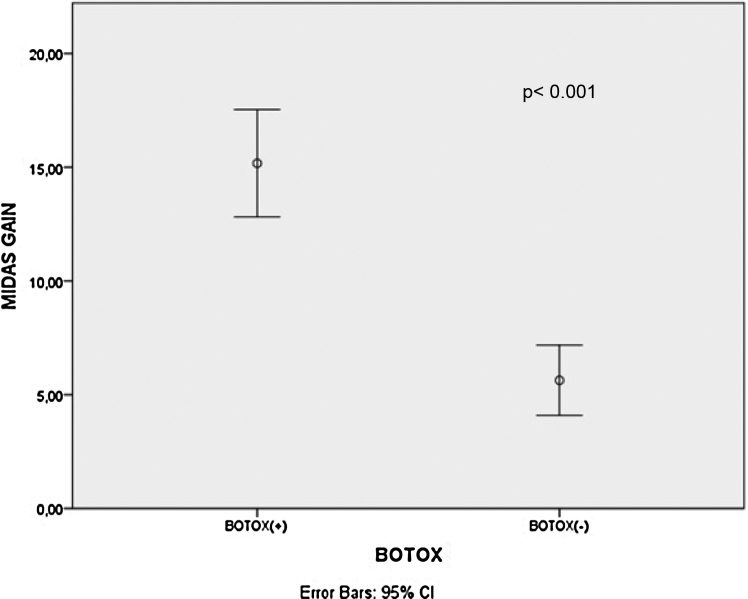
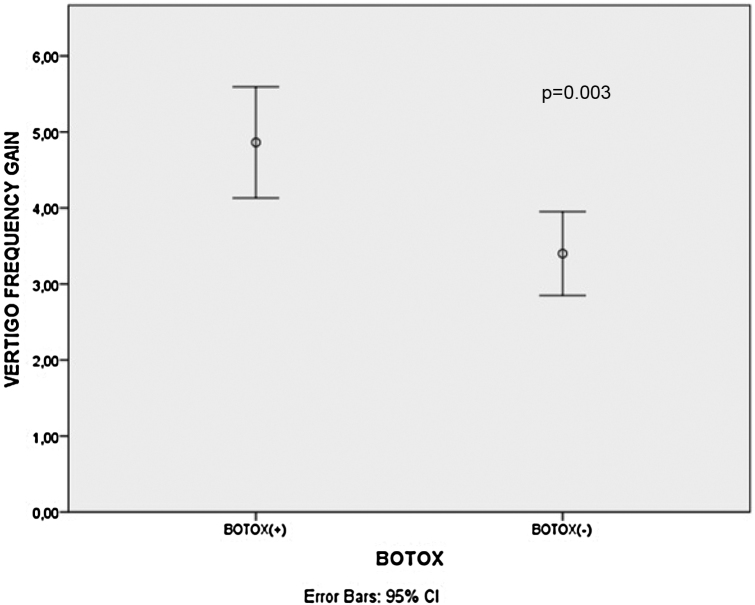
There was a statistically significant decrement in mean Dizziness Handicap Inventory scores, Migraine Disability Assessment Scale scores and vertigo attack frequencies after treatment for all patients, B+ and B- group patients (p<0.001 for all). The mean Migraine Disability Assessment Scale score gains (p<0.001) and vertigo attack frequency gains (p= 0.003) were significantly higher in the B+ patients than B- patients.
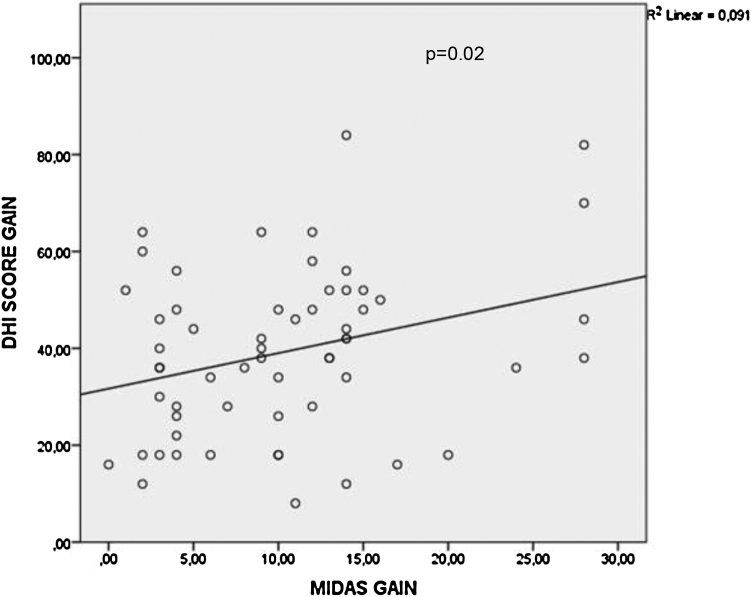
Both B+ and B- group patients exhibited significant improvement in vestibular migraine attack frequencies, Dizziness Handicap Inventory score and Migraine Disability Assessment Scale score values. However, botulinum toxin A application had a more pronounced effect for Migraine Disability Assessment Scale score gain and vestibular migraine attack frequency values, but not for Dizziness Handicap Inventory score gain values. Thus, botulinum toxin A application should be considered for vestibular migraine patients whose headache severity degrees are more profound. The oral medication type (propranolol, flunarizine or amitriptyline) did not differ in influencing the vestibular migraine attack frequency, Dizziness Handicap Inventory score gain and Migraine Disability Assessment Scale score gain values.
前庭性偏头痛是成人自发性阵发性眩晕的最常见原因,也是各年龄段眩晕的第二大常见原因。
评估口服药物类型(普萘洛尔、氟桂利嗪和阿米替林)和肉毒毒素 A 应用对前庭性偏头痛患者的前庭症状、头痛严重程度和发作频率的疗效。
共纳入 60 例前庭性偏头痛患者。30 例患者除口服药物外还接受肉毒毒素 A 治疗(B+组),30 例患者仅接受口服药物治疗(B-组)。使用偏头痛残疾评估量表评估头痛严重程度,使用眩晕残障量表评估眩晕严重程度。还评估了过去三个月的前庭性偏头痛发作频率。
所有患者、B+组和 B-组患者在治疗后,眩晕残障量表评分、偏头痛残疾评估量表评分和眩晕发作频率均有显著下降(所有 P 值均<0.001)。B+组患者偏头痛残疾评估量表评分增加(P<0.001)和眩晕发作频率增加(P=0.003)均显著高于 B-组患者。
B+组和 B-组患者的前庭性偏头痛发作频率、眩晕残障量表评分和偏头痛残疾评估量表评分均有显著改善。然而,肉毒毒素 A 应用对偏头痛残疾评估量表评分增加和前庭性偏头痛发作频率更有显著影响,而对眩晕残障量表评分增加无显著影响。因此,对于头痛严重程度较高的前庭性偏头痛患者,应考虑应用肉毒毒素 A。口服药物类型(普萘洛尔、氟桂利嗪或阿米替林)对前庭性偏头痛发作频率、眩晕残障量表评分增加和偏头痛残疾评估量表评分增加无显著影响。