Anderson Christopher J, Kendall Melissa M
Department of Microbiology, Immunology, and Cancer Biology, University of Virginia School of Medicine,, Charlottesville, VA, United States.
Front Microbiol. 2017 Oct 12;8:1983. doi: 10.3389/fmicb.2017.01983. eCollection 2017.
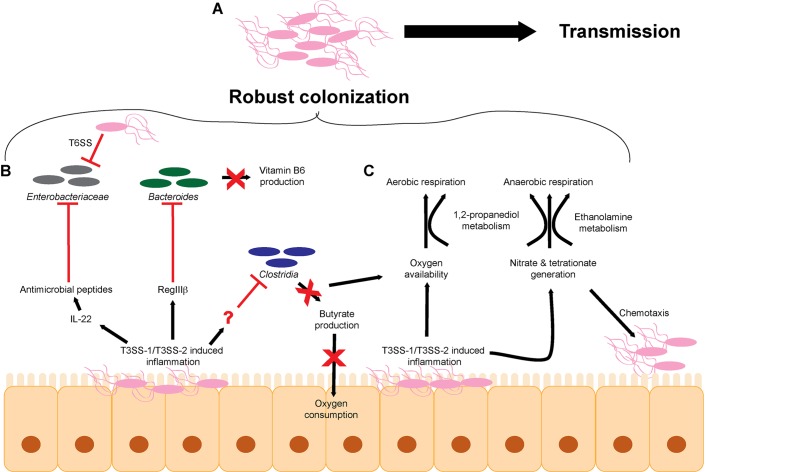
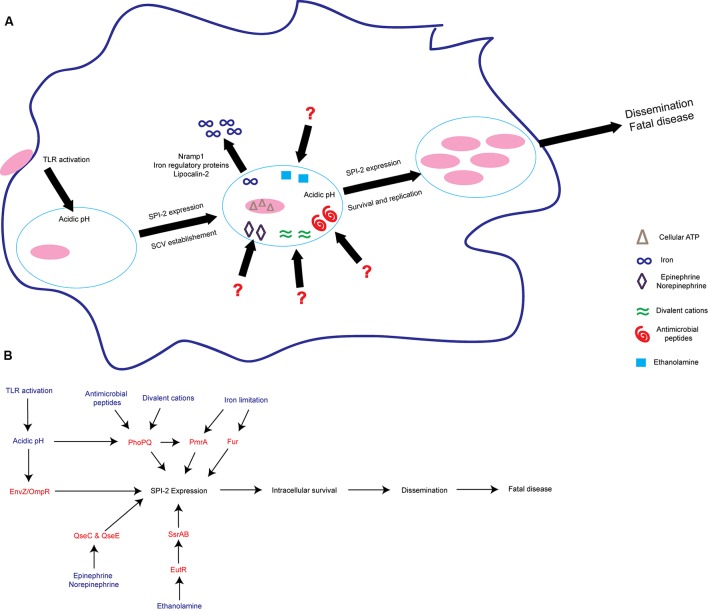
Bacterial pathogens must sense and respond to newly encountered host environments to regulate the expression of critical virulence factors that allow for niche adaptation and successful colonization. Among bacterial pathogens, non-typhoidal serovars of , such as serovar Typhimurium ( Tm), are a primary cause of foodborne illnesses that lead to hospitalizations and deaths worldwide. . Tm causes acute inflammatory diarrhea that can progress to invasive systemic disease in susceptible patients. The gastrointestinal tract and intramacrophage environments are two critically important niches during . Tm infection, and each presents unique challenges to limit . Tm growth. The intestinal tract is home to billions of commensal microbes, termed the microbiota, which limits the amount of available nutrients for invading pathogens such as Tm. Therefore, Tm encodes strategies to manipulate the commensal population and side-step this nutritional competition. During subsequent stages of disease, Tm resists host immune cell mechanisms of killing. Host cells use antimicrobial peptides, acidification of vacuoles, and nutrient limitation to kill phagocytosed microbes, and yet Tm is able to subvert these defense systems. In this review, we discuss recently described molecular mechanisms that Tm uses to outcompete the resident microbiota within the gastrointestinal tract. Tm directly eliminates close competitors via bacterial cell-to-cell contact as well as by stimulating a host immune response to eliminate specific members of the microbiota. Additionally, Tm tightly regulates the expression of key virulence factors that enable Tm to withstand host immune defenses within macrophages. Additionally, we highlight the chemical and physical signals that . Tm senses as cues to adapt to each of these environments. These strategies ultimately allow Tm to successfully adapt to these two disparate host environments. It is critical to better understand bacterial adaptation strategies because disruption of these pathways and mechanisms, especially those shared by multiple pathogens, may provide novel therapeutic intervention strategies.
细菌病原体必须感知并响应新遇到的宿主环境,以调节关键毒力因子的表达,从而实现生态位适应和成功定殖。在细菌病原体中,非伤寒血清型的,如鼠伤寒血清型(Tm),是导致全球范围内住院和死亡的食源性疾病的主要原因。Tm会引发急性炎症性腹泻,在易感患者中可能发展为侵袭性全身性疾病。胃肠道和巨噬细胞内环境是Tm感染过程中两个至关重要的生态位,每个生态位都对限制Tm生长提出了独特挑战。肠道中栖息着数十亿共生微生物,称为微生物群,这限制了入侵病原体如Tm可利用的营养物质数量。因此,Tm编码了操纵共生菌群并避开这种营养竞争的策略。在疾病的后续阶段,Tm能抵抗宿主免疫细胞的杀伤机制。宿主细胞利用抗菌肽、液泡酸化和营养限制来杀死吞噬的微生物,但Tm能够颠覆这些防御系统。在这篇综述中,我们讨论了最近描述的Tm用于在胃肠道中战胜常驻微生物群的分子机制。Tm通过细菌细胞间接触以及刺激宿主免疫反应以消除微生物群的特定成员,直接消除紧密竞争者。此外,Tm严格调控关键毒力因子的表达,使Tm能够在巨噬细胞内抵御宿主免疫防御。此外,我们强调了Tm感知到的作为适应每种环境线索的化学和物理信号。这些策略最终使Tm能够成功适应这两种截然不同的宿主环境。更好地理解细菌适应策略至关重要,因为破坏这些途径和机制,尤其是多种病原体共有的那些,可能会提供新的治疗干预策略。