Singh Vineet, Lee GyuDae, Son HyunWoo, Koh Hong, Kim Eun Soo, Unno Tatsuya, Shin Jae-Ho
Department of Applied Biosciences, Kyungpook National University, Daegu, Republic of Korea.
Department of Pediatrics, Severance Fecal Microbiota Transplantation Center, Severance Hospital, Yonsei University College of Medicine, Seoul, Republic of Korea.
Front Microbiol. 2023 Jan 12;13:1103836. doi: 10.3389/fmicb.2022.1103836. eCollection 2022.
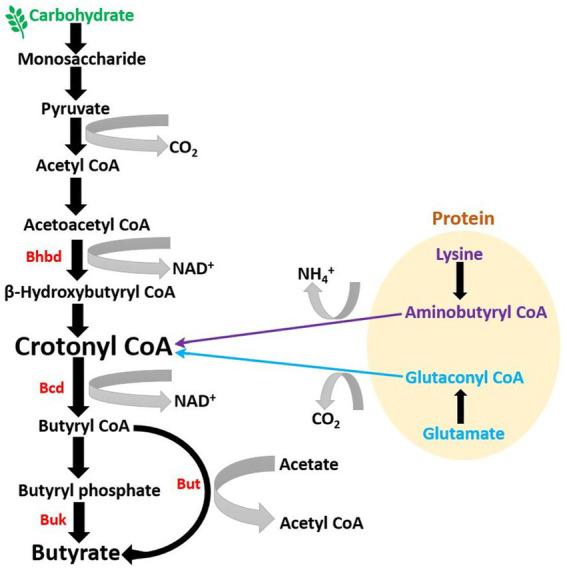
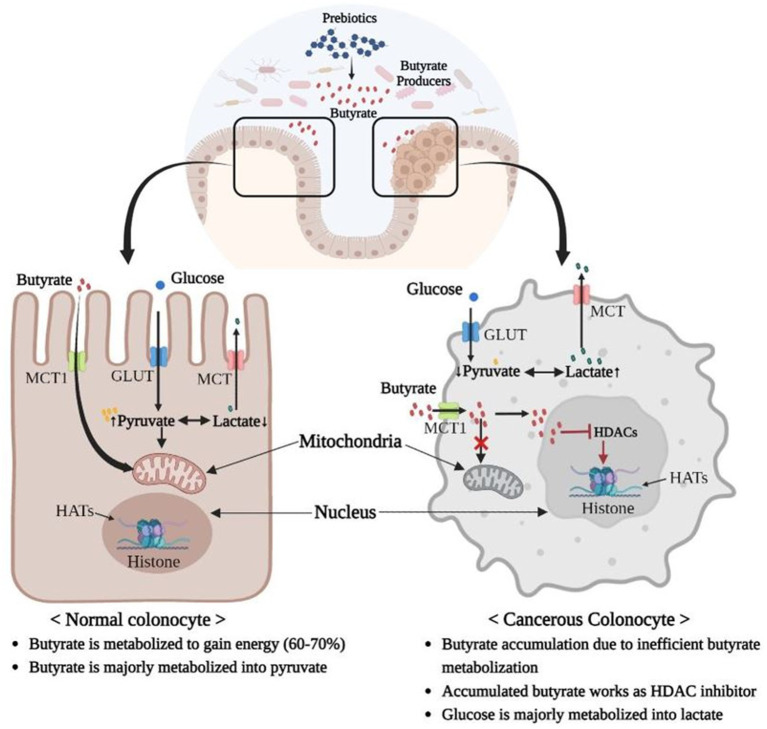
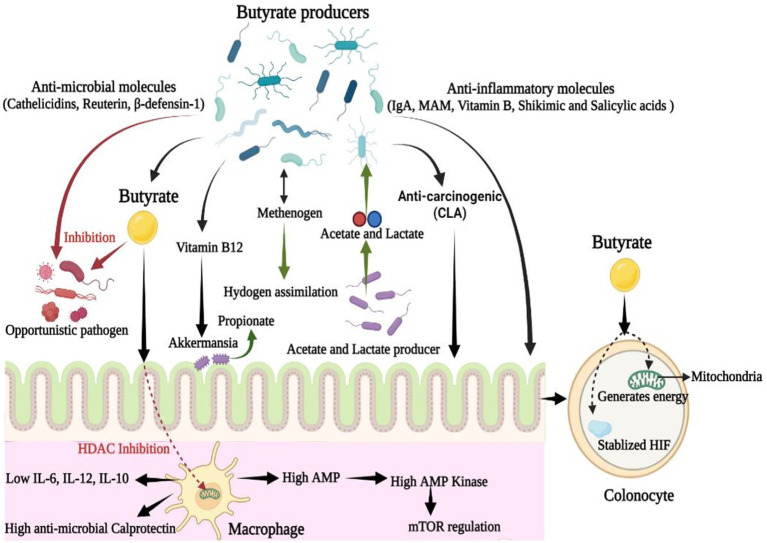
Gut-microbial butyrate is a short-chain fatty acid (SCFA) of significant physiological importance than the other major SCFAs (acetate and propionate). Most butyrate producers belong to the Clostridium cluster of the phylum Firmicutes, such as , , , , , , and . They metabolize carbohydrates the butyryl-CoA: acetate CoA-transferase pathway and butyrate kinase terminal enzymes to produce most of butyrate. Although, in minor fractions, amino acids can also be utilized to generate butyrate glutamate and lysine pathways. Butyrogenic microbes play a vital role in various gut-associated metabolisms. Butyrate is used by colonocytes to generate energy, stabilizes hypoxia-inducible factor to maintain the anaerobic environment in the gut, maintains gut barrier integrity by regulating Claudin-1 and synaptopodin expression, limits pro-inflammatory cytokines (IL-6, IL-12), and inhibits oncogenic pathways (Akt/ERK, Wnt, and TGF-β signaling). Colonic butyrate producers shape the gut microbial community by secreting various anti-microbial substances, such as cathelicidins, reuterin, and β-defensin-1, and maintain gut homeostasis by releasing anti-inflammatory molecules, such as IgA, vitamin B, and microbial anti-inflammatory molecules. Additionally, butyrate producers, such as , produce anti-carcinogenic metabolites, such as shikimic acid and a precursor of conjugated linoleic acid. In this review, we summarized the significance of butyrate, critically examined the role and relevance of butyrate producers, and contextualized their importance as microbial therapeutics.
肠道微生物产生的丁酸是一种短链脂肪酸(SCFA),其生理重要性高于其他主要的短链脂肪酸(乙酸盐和丙酸盐)。大多数丁酸产生菌属于厚壁菌门的梭菌属簇,如 、 、 、 、 、 和 。它们通过丁酰辅酶A:乙酸辅酶A转移酶途径和丁酸激酶终端酶代谢碳水化合物来产生大部分丁酸。尽管在较小比例下,氨基酸也可通过谷氨酸和赖氨酸途径用于生成丁酸。产丁酸微生物在各种肠道相关代谢中发挥着至关重要的作用。结肠细胞利用丁酸来产生能量,稳定缺氧诱导因子以维持肠道内的厌氧环境,通过调节闭合蛋白-1和突触素的表达来维持肠道屏障完整性,限制促炎细胞因子(IL-6、IL-12),并抑制致癌途径(Akt/ERK、Wnt和TGF-β信号传导)。结肠丁酸产生菌通过分泌各种抗菌物质,如cathelicidins、罗伊氏菌素和β-防御素-1,塑造肠道微生物群落,并通过释放抗炎分子,如IgA、维生素B和微生物抗炎分子来维持肠道稳态。此外,诸如 等丁酸产生菌会产生抗癌代谢产物,如莽草酸和共轭亚油酸的前体。在这篇综述中,我们总结了丁酸的重要性,批判性地审视了丁酸产生菌的作用和相关性,并阐述了它们作为微生物疗法的重要性。