Department of Neurology University of California San Francisco CA USA.
Sandler Neurosciences Center San Francisco CA USA.
Brain Behav. 2017 Sep 14;7(10):e00807. doi: 10.1002/brb3.807. eCollection 2017 Oct.
Empathy and shared feelings of reward motivate individuals to share resources with others when material gain is not at stake. Behavioral variant frontotemporal dementia (bvFTD) is a neurodegenerative disease that affects emotion- and reward-relevant neural systems. Although there is diminished empathy and altered reward processing in bvFTD, how the disease impacts prosocial behavior is less well understood.
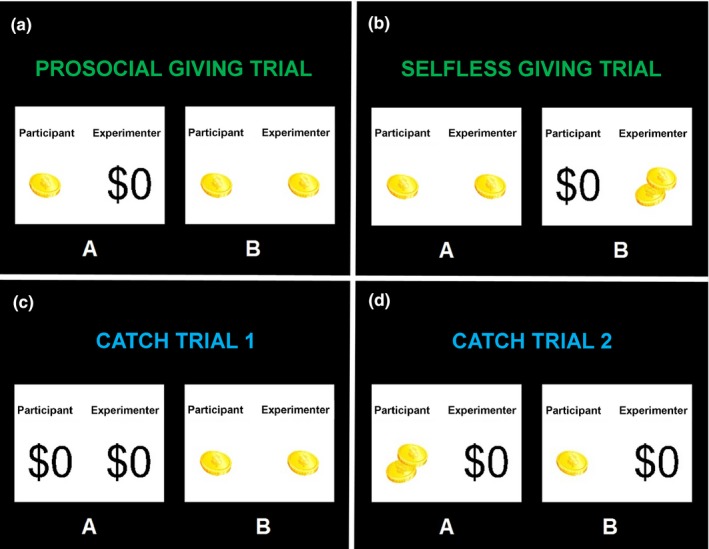
A total of 74 participants (20 bvFTD, 15 Alzheimer's disease [AD], and 39 healthy controls) participated in this study. Inspired by token-based paradigms from animal studies, we developed a novel task to measure prosocial giving (the "Giving Game"). On each trial of the Giving Game, participants decided how much money to offer to the experimenter, and prosocial giving was the total amount that participants gave to the experimenter when it cost them nothing to give. Voxel-based morphometry was then used to identify brain regions that were associated with prosocial giving.
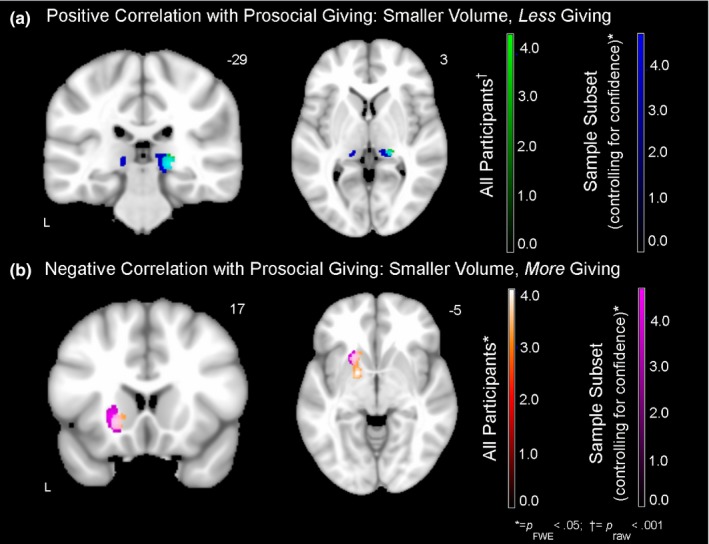
Prosocial giving was lower in bvFTD than in healthy controls; prosocial giving in AD did not differ significantly from either of the other groups. Whereas lower prosocial giving was associated with atrophy in the right pulvinar nucleus of the thalamus, greater prosocial giving was associated with atrophy in the left ventral striatum.
These findings suggest that simple acts of generosity deteriorate in bvFTD due to lateralized atrophy in reward-relevant neural systems that promote shared feelings of positive affect.
同理心和共同的奖励感促使个体在没有物质利益的情况下与他人分享资源。行为变异额颞叶痴呆症(bvFTD)是一种影响情绪和奖励相关神经系统的神经退行性疾病。尽管 bvFTD 患者的同理心减弱,奖励处理改变,但该疾病如何影响亲社会行为还不太清楚。
共有 74 名参与者(20 名 bvFTD、15 名阿尔茨海默病 [AD] 和 39 名健康对照组)参加了这项研究。受动物研究中基于代币的范式启发,我们开发了一种新的任务来衡量亲社会给予(“给予游戏”)。在给予游戏的每一轮中,参与者决定给实验者多少钱,而当给予实验者不花费任何代价时,亲社会给予就是参与者给予实验者的总金额。然后使用基于体素的形态测量学来识别与亲社会给予相关的大脑区域。
与健康对照组相比,bvFTD 患者的亲社会给予较低;AD 患者的亲社会给予与其他两组没有显著差异。亲社会给予与右侧丘脑髓质核的萎缩有关,而亲社会给予与左侧腹侧纹状体的萎缩有关。
这些发现表明,由于促进积极情感共享的奖励相关神经系统的侧化萎缩,bvFTD 患者的简单慷慨行为恶化。