Lautenbacher Stefan, Salinas-Ranneberg Melissa, Niebuhr Oliver, Kunz Miriam
Physiological Psychology, University of Bamberg, Bamberg, Germany.
Institute of Design and Communication, University of Southern Denmark, Odense, Denmark.
Pain Rep. 2017 May;2(3):e597. doi: 10.1097/PR9.0000000000000597. Epub 2017 Apr 15.
There have, yet, been only few attempts to phonetically characterize the vocalizations of pain, although there is wide agreement that moaning, groaning, or other nonverbal utterance can be indicative of pain. We studied the production of vowels "u," "a," "i", and "schwa" (central vowel, sounding like a darker "e" as in hesitations like "ehm")-as experimental approximations to natural vocalizations.
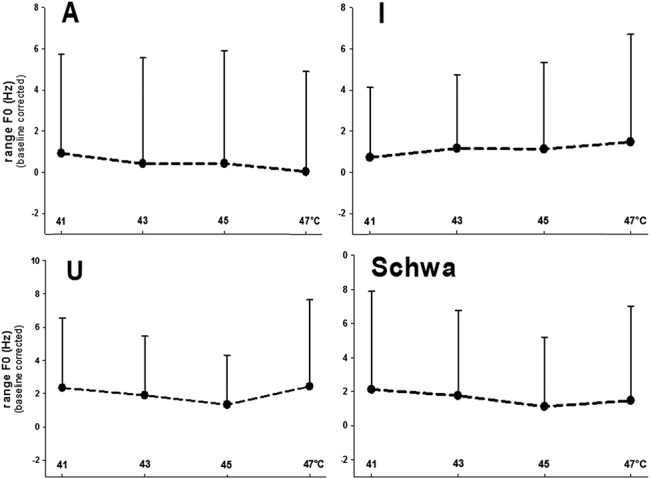
In 50 students vowel production and self-report ratings were assessed during painful and nonpainful heat stimulation (hot water immersion) as well as during baseline (no-stimulation). The phonetic parameters extracted were pitch (mean F), phonatory fluctuations (range F) and loudness (acoustic energy level).
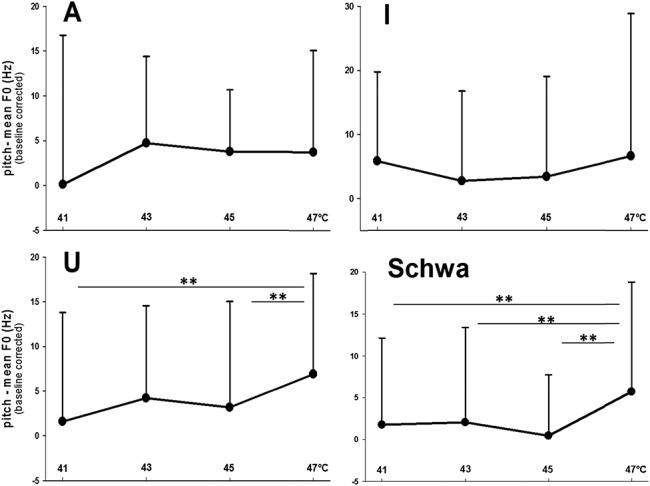
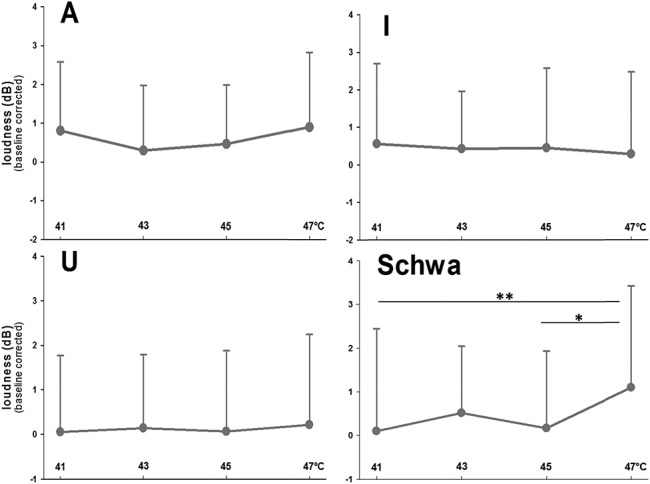
Only for the vowels "u" and "schwa," which might be considered best approximations to moaning and groaning, did pitch and loudness increase during pain. Furthermore, changes from nonpainful to painful stimulations in these parameters also significantly predicted concurrent changes in pain ratings.
Vocalization characteristics of pain seem to be best described by an increase in pitch and in loudness. Future studies using more specific and comprehensive phonetic analyses will surely help to provide an even more precise characterization of vocalizations because of pain.
尽管人们普遍认为呻吟、叹息或其他非言语发声可能表明疼痛,但对疼痛发声进行语音特征描述的尝试仍然很少。我们研究了元音“u”“a”“i”和“schwa”(央元音,听起来像“ehm”这种犹豫时较暗的“e”音)的发声,以此作为对自然发声的实验近似。
对50名学生在疼痛和非疼痛热刺激(热水浸泡)以及基线(无刺激)期间的元音发声和自我报告评分进行评估。提取的语音参数包括音高(平均F)、发声波动(F范围)和响度(声能水平)。
仅对于可能被认为最接近呻吟和叹息的元音“u”和“schwa”,疼痛期间音高和响度增加。此外,这些参数从非疼痛刺激到疼痛刺激的变化也显著预测了疼痛评分的同时变化。
疼痛的发声特征似乎最好用音高和响度的增加来描述。未来使用更具体和全面的语音分析的研究肯定会有助于更精确地描述因疼痛而产生的发声。