Moschetti Viktoria, Desch Michael, Goetz Sophia, Liesenfeld Karl-Heinz, Rosenbrock Holger, Kammerer Klaus-Peter, Wunderlich Glen, Wind Sven
Boehringer Ingelheim Pharma GmbH & Co. KG, Ingelheim am Rhein, Germany.
Boehringer Ingelheim Pharma GmbH & Co. KG, Biberach an der Riss, Germany.
Eur J Drug Metab Pharmacokinet. 2018 Apr;43(2):239-249. doi: 10.1007/s13318-017-0440-z.
Schizophrenia and Alzheimer's disease are characterised by glutamatergic pathway abnormalities related to N-methyl-D-aspartate (NMDA) receptor hypofunction and cognitive impairment. Glycine is an NMDA receptor co-agonist; inhibition of glycine transporter 1 (GlyT1) should improve NMDA receptor hypofunction. This study evaluated safety and pharmacokinetic properties of BI 425809-a potent and selective GlyT1 inhibitor.
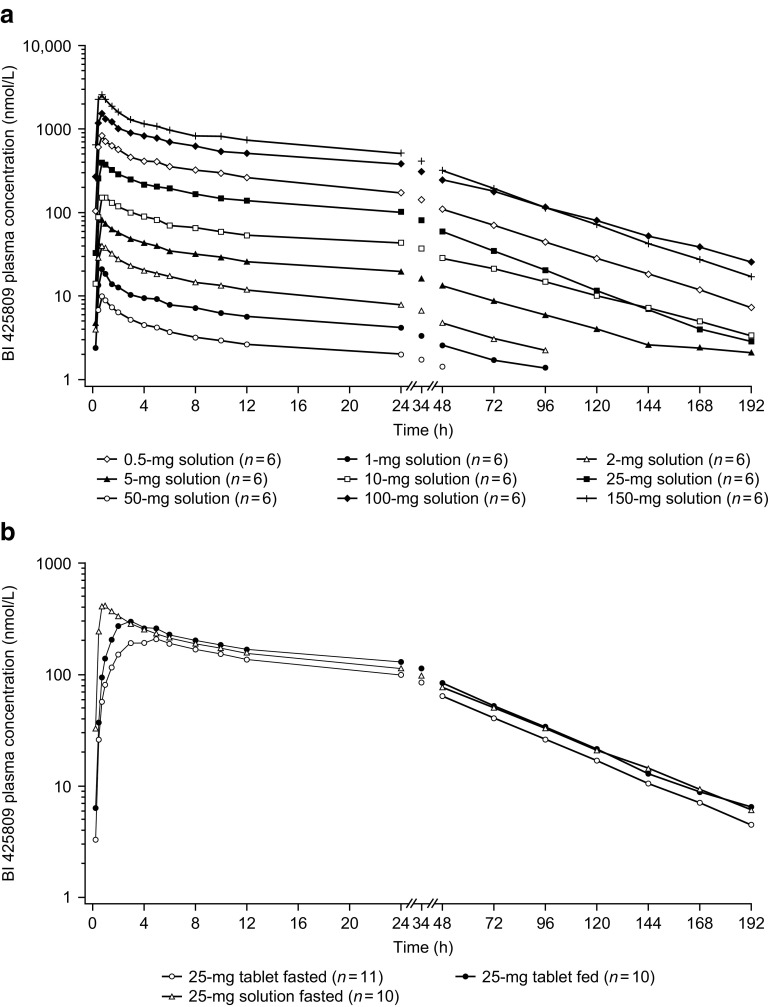
In the single-rising dose (SRD) component of this study, subjects were randomised to a single dose of BI 425809 [doses (mg): 0.5, 1, 2, 5, 10, 25, 50, 100 and 150], or placebo. The bioavailability/food effect (BA/FE) component investigated BI 425809 pharmacokinetics following single dosing (25-mg tablet) after overnight fasting or with a high-calorie meal or as solution (25 mg) after overnight fasting.
Overall, 33/83 (39.8%) subjects had ≥ 1 treatment-related adverse event (AE); there were no deaths or serious AEs. Reported SRD part AEs trended towards dose dependency, occurring at the higher doses (mostly central nervous system related). BI 425809 plasma concentration-time profiles were similarly shaped across all doses and plasma exposure increased proportional to dose. In the BA/FE component, geometric mean ratios for the area under the concentration-time curve from time zero to the last measurable concentration and the maximum plasma concentration for tablet fasted versus solution fasted were 80.5 and 50.0%, respectively, and for tablet fed versus fasted were 125.9 and 142.1%, respectively.
BI 425809 was generally well-tolerated at doses expected to be clinically relevant. The AE profile suggested possible GlyT1-inhibiting effects.
NCT02068690.
精神分裂症和阿尔茨海默病的特征是与N-甲基-D-天冬氨酸(NMDA)受体功能减退及认知障碍相关的谷氨酸能通路异常。甘氨酸是NMDA受体的协同激动剂;抑制甘氨酸转运体1(GlyT1)应可改善NMDA受体功能减退。本研究评估了强效选择性GlyT1抑制剂BI 425809的安全性和药代动力学特性。
在本研究的单次递增剂量(SRD)部分,受试者被随机分配接受单次剂量的BI 425809[剂量(mg):0.5、1、2、5、10、25、50、100和150]或安慰剂。生物利用度/食物效应(BA/FE)部分研究了过夜禁食后单次给药(25 mg片剂)、或与高热量餐同服、或过夜禁食后以溶液形式(25 mg)给药后BI 425809的药代动力学。
总体而言,33/83(39.8%)的受试者发生了≥1次与治疗相关的不良事件(AE);无死亡或严重AE。报告的SRD部分AE有剂量依赖性趋势,在较高剂量时出现(大多与中枢神经系统相关)。所有剂量下BI 425809的血浆浓度-时间曲线形状相似,血浆暴露量随剂量成比例增加。在BA/FE部分,从零时到最后可测浓度的浓度-时间曲线下面积以及片剂禁食与溶液禁食时的最大血浆浓度的几何平均比值分别为80.5%和50.0%,片剂进食与禁食时分别为125.9%和142.1%。
在预期具有临床相关性的剂量下,BI 425809总体耐受性良好。AE情况提示可能具有GlyT1抑制作用。
NCT02068690。