Houshmand-Oeregaard Azadeh, Hjort Line, Kelstrup Louise, Hansen Ninna S, Broholm Christa, Gillberg Linn, Clausen Tine D, Mathiesen Elisabeth R, Damm Peter, Vaag Allan
Center for Pregnant Women with Diabetes, Department of Obstetrics, Rigshospitalet, Copenhagen, Denmark.
Diabetes and Metabolism, Department of Endocrinology, Rigshospitalet, Copenhagen, Denmark.
PLoS One. 2017 Oct 27;12(10):e0187038. doi: 10.1371/journal.pone.0187038. eCollection 2017.
Fetal exposure to maternal diabetes increases the risk of type 2 diabetes (T2DM), possibly mediated by epigenetic mechanisms. Low blood TXNIP DNA methylation has been associated with elevated glucose levels and risk of T2DM, and increased skeletal muscle TXNIP gene expression was reported in subjects with impaired glucose metabolism or T2DM. Subcutaneous adipose tissue (SAT) and skeletal muscle play a key role in the control of whole body glucose metabolism and insulin action. The extent to which TXNIP DNA methylation levels are decreased and/or gene expression levels increased in SAT or skeletal muscle of a developmentally programmed at-risk population is unknown.
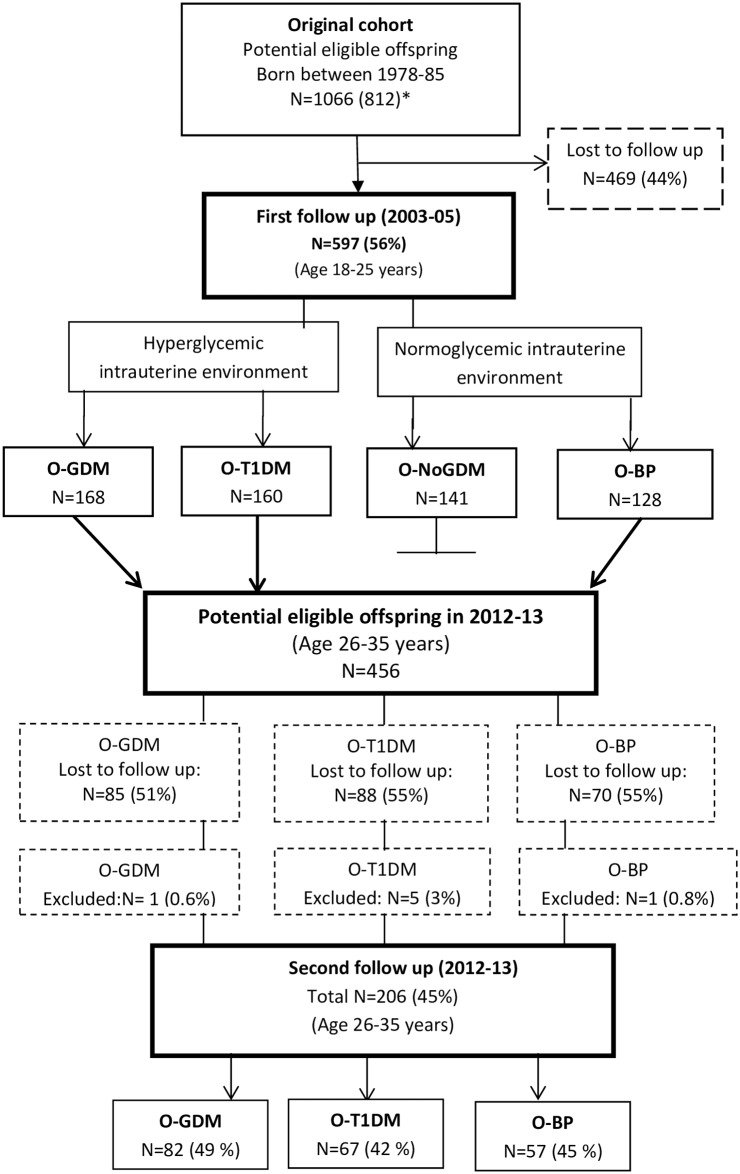
The objective of this study was to investigate TXNIP DNA methylation and gene expression in SAT and skeletal muscle, and DNA methylation in blood, from adult offspring of women with gestational diabetes (O-GDM, n = 82) or type 1 diabetes (O-T1DM, n = 67) in pregnancy compared with offspring of women from the background population (O-BP, n = 57).
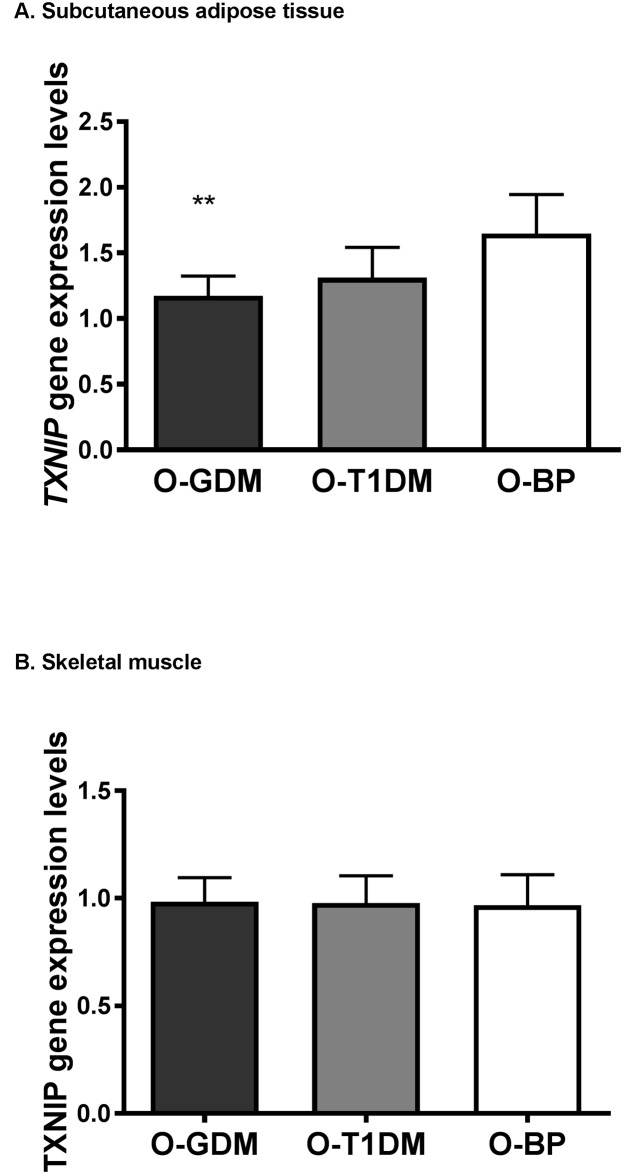
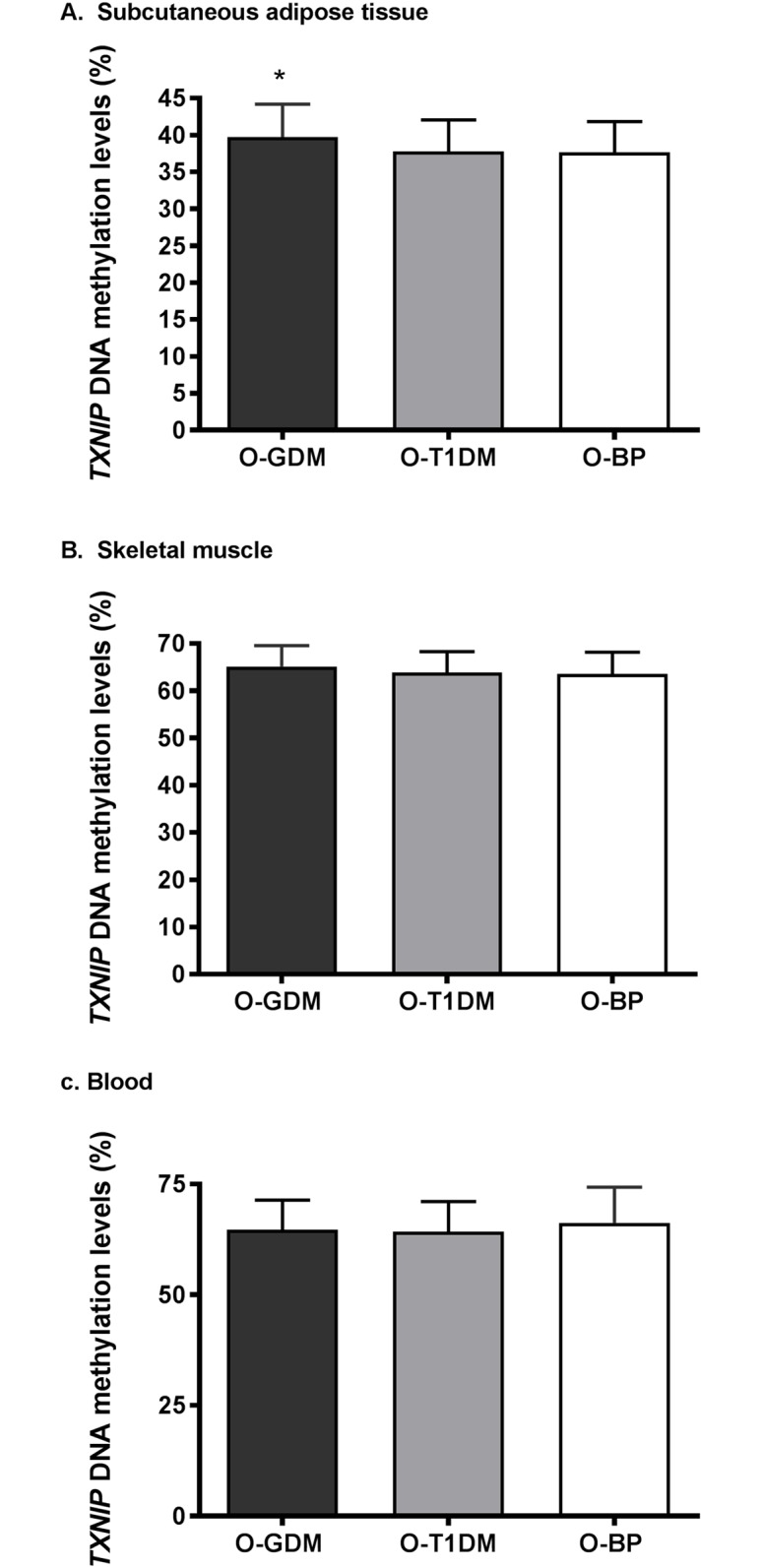
SAT TXNIP DNA methylation was increased (p = 0.032) and gene expression decreased (p = 0.001) in O-GDM, but these differences were attenuated after adjustment for confounders. Neither blood/muscle TXNIP DNA methylation nor muscle gene expression differed between groups.
We found no evidence of decreased TXNIP DNA methylation or increased gene expression in metabolic target tissues of offspring exposed to maternal diabetes. Further studies are needed to confirm and understand the paradoxical SAT TXNIP DNA methylation and gene expression changes in O-GDM subjects.
胎儿暴露于母体糖尿病会增加患2型糖尿病(T2DM)的风险,这可能是由表观遗传机制介导的。血液中TXNIP DNA甲基化水平低与血糖水平升高及T2DM风险相关,且在糖代谢受损或患有T2DM的受试者中,骨骼肌TXNIP基因表达增加。皮下脂肪组织(SAT)和骨骼肌在全身葡萄糖代谢和胰岛素作用的控制中起关键作用。在发育编程的高危人群的SAT或骨骼肌中,TXNIP DNA甲基化水平降低和/或基因表达水平升高的程度尚不清楚。
本研究的目的是调查妊娠期糖尿病妇女(O-GDM,n = 82)或1型糖尿病妇女(O-T1DM,n = 67)的成年后代与背景人群妇女的后代(O-BP,n = 57)相比,SAT和骨骼肌中TXNIP DNA甲基化和基因表达以及血液中的DNA甲基化情况。
O-GDM组的SAT中TXNIP DNA甲基化增加(p = 0.032),基因表达降低(p = 0.001),但在调整混杂因素后,这些差异减弱。各组之间血液/肌肉TXNIP DNA甲基化和肌肉基因表达均无差异。
我们没有发现暴露于母体糖尿病的后代的代谢靶组织中TXNIP DNA甲基化降低或基因表达增加的证据。需要进一步研究来证实并理解O-GDM受试者中SAT TXNIP DNA甲基化和基因表达的矛盾变化。