Department of Psychiatry and Neuropsychology, Alzheimer Center Limburg, School for Mental Health and Neuroscience, Maastricht University, Maastricht, the Netherlands.
Rush Alzheimer's Disease Center, Rush University Medical Center, Chicago, IL, USA; Department of Neurological Sciences, Rush University Medical Center, Chicago, IL, USA; Department of Behavioral Sciences, Rush University Medical Center, Chicago, IL, USA.
Neurobiol Aging. 2018 Jan;61:138-145. doi: 10.1016/j.neurobiolaging.2017.08.029. Epub 2017 Sep 5.
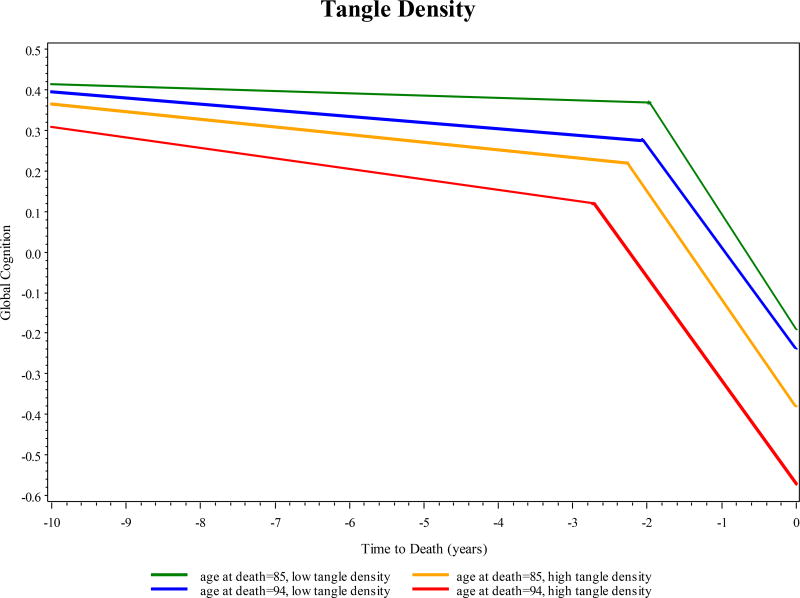
The association of dementia-related pathologies with cognition is hypothesized to decrease as age advances. We examined this in 413 persons without cognitive impairment at baseline who completed annual cognitive evaluations during a mean of 10.4 years. After death, neuropathologic examinations quantified beta amyloid plaque load, neurofibrillary tangles, and transactive response DNA-binding protein 43 pathology, and identified Lewy bodies, hippocampal sclerosis, and gross and microscopic cerebral infarcts. We tested whether age at death modified associations of these neuropathologies with the nonlinear trajectory of cognitive decline using mixed-effects change point models. The rate of global cognitive decline was gradual at first and then increased approximately 10-fold in the last 3 years of life. After adjustment for all other pathologic indices, tangle density, gross infarcts, Lewy bodies, and transactive response DNA-binding protein 43 were associated with global cognitive decline. However, the deleterious association of dementia-related pathologies with cognitive decline did not systematically vary by age. This suggests that the neuropathologic mechanisms underlying late-life cognitive decline do not substantially differ across the spectrum of age.
人们推测,随着年龄的增长,与痴呆相关的病理学与认知的关联会降低。我们在 413 名基线时无认知障碍的人群中进行了研究,这些人在平均 10.4 年的时间内完成了年度认知评估。死后,神经病理学检查量化了β淀粉样蛋白斑块负荷、神经纤维缠结和转位反应 DNA 结合蛋白 43 病理学,并确定了路易体、海马硬化以及大体和微观脑梗死。我们使用混合效应变化点模型测试了这些神经病理学与认知衰退非线性轨迹之间的关联是否因死亡时的年龄而改变。总的认知衰退速度起初较为缓慢,然后在生命的最后 3 年中增加了约 10 倍。在调整所有其他病理指标后,缠结密度、大体梗死、路易体和转位反应 DNA 结合蛋白 43 与总体认知衰退相关。然而,与痴呆相关的病理学与认知衰退的有害关联并未因年龄而异。这表明,与晚年认知衰退相关的神经病理学机制在整个年龄范围内并没有实质性差异。