Rahimi Jasmin, Kovacs Gabor G
Institute of Neurology, Medical University of Vienna, Waehringer Guertel 18-20, 1090 Vienna, Austria.
Alzheimers Res Ther. 2014 Nov 21;6(9):82. doi: 10.1186/s13195-014-0082-1. eCollection 2014.
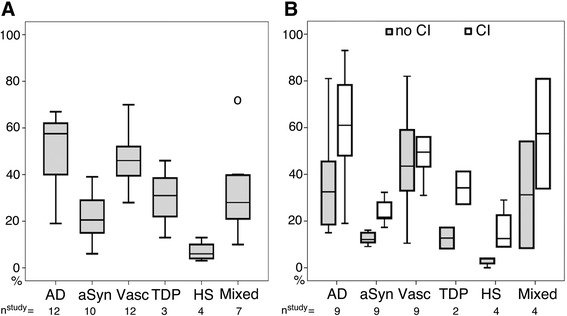
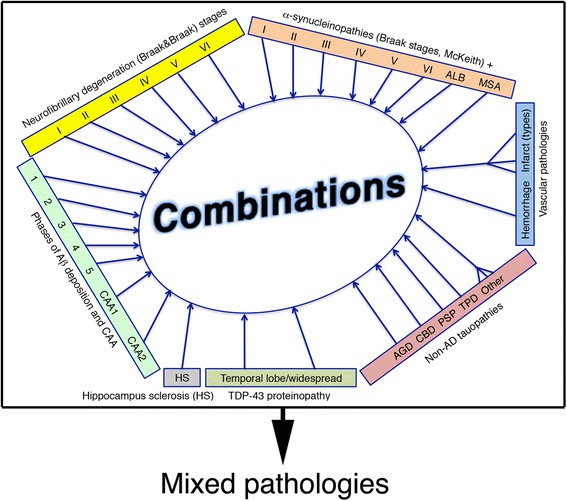
The spectrum of mixed brain pathologies expands beyond accompanying vascular pathology in brains with Alzheimer's disease-related pathology. Co-occurrence of neurodegenerative non-Alzheimer's disease-type proteinopathies is increasingly recognized to be a frequent event in the brains of symptomatic and asymptomatic patients, particularly in older people. Owing to the evolving concept of neurodegenerative diseases, clinical and neuropathological diagnostic criteria have changed during the last decades. Autopsy-based studies differ in the selection criteria and also in the applied staining methods used. The present review summarizes the prevalence of mixed brain pathologies reported in recent community-based studies. In these cohorts, irrespective of the clinical symptoms, the frequency of Alzheimer's disease-related pathology is between 19 and 67%, of Lewy body pathology is between 6 and 39%, of vascular pathologies is between 28 and 70%, of TDP-43 proteinopathy is between 13 and 46%, of hippocampal sclerosis is between 3 and 13% and, finally, of mixed pathologies is between 10 and 74%. Some studies also mention tauopathies. White-matter pathologies are not discussed specifically in all studies, although these lesions may be present in more than 80% of the aging brains. In summary, community-based neuropathology studies have shown that complex constellations of underlying pathologies may lead to cognitive decline, and that the number of possible combinations increases in the aging brain. These observations have implications for the prediction of the prognosis, for the development of biomarkers or therapy targets, or for the stratification of patient cohorts for genome-wide studies or, eventually, for therapy trials.
在患有阿尔茨海默病相关病理的大脑中,混合性脑病变的范围超出了伴随的血管病变。神经退行性非阿尔茨海默病型蛋白病的共现越来越被认为是有症状和无症状患者大脑中常见的情况,尤其是在老年人中。由于神经退行性疾病概念的不断演变,在过去几十年中,临床和神经病理学诊断标准发生了变化。基于尸检的研究在选择标准以及所应用的染色方法上也存在差异。本综述总结了近期基于社区的研究所报告的混合性脑病变的患病率。在这些队列中,无论临床症状如何,阿尔茨海默病相关病理的发生率在19%至67%之间,路易体病理的发生率在6%至39%之间,血管病变的发生率在28%至70%之间,TDP - 43蛋白病的发生率在13%至46%之间,海马硬化的发生率在3%至13%之间,最后,混合性病变的发生率在10%至74%之间。一些研究还提到了tau蛋白病。尽管这些病变可能存在于超过80%的老年大脑中,但并非所有研究都专门讨论白质病变。总之,基于社区的神经病理学研究表明,潜在病变的复杂组合可能导致认知能力下降,并且在老年大脑中可能的组合数量会增加。这些观察结果对预后预测、生物标志物或治疗靶点的开发、全基因组研究患者队列的分层或最终的治疗试验都有影响。