Department of Neurological Sciences, Behavioral Sciences, and Pathology, Rush Alzheimer's Disease Center, Rush University Medical Center, Chicago, Illinois.
JAMA Neurol. 2013 Nov;70(11):1418-24. doi: 10.1001/jamaneurol.2013.3961.
Cognitive decline is a leading cause of disability and death in old age but its neurobiological bases are not well understood.
To test the hypothesis that transactive response DNA-binding protein 43 (TDP-43) is related to late-life cognitive decline.
DESIGN, SETTING, AND PARTICIPANTS: Longitudinal clinical-pathologic cohort study involving more than 40 Catholic groups across the United States. A total of 130 older Catholic nuns, priests, and monks underwent annual clinical evaluations, including detailed cognitive testing, for a mean of 10.1 years prior to death. On neuropathologic examination, we collected semiquantitative measures of TDP-43 pathology, density of neuronal neurofibrillary tangles, area occupied by amyloid-beta plaques, and the presence of alpha-synuclein Lewy bodies from multiple brain regions. Gross and microscopic cerebral infarcts and hippocampal sclerosis were also identified.
Annual rate of change in a previously established composite measure of global cognition during a mean of 10.1 years of annual observation before death.
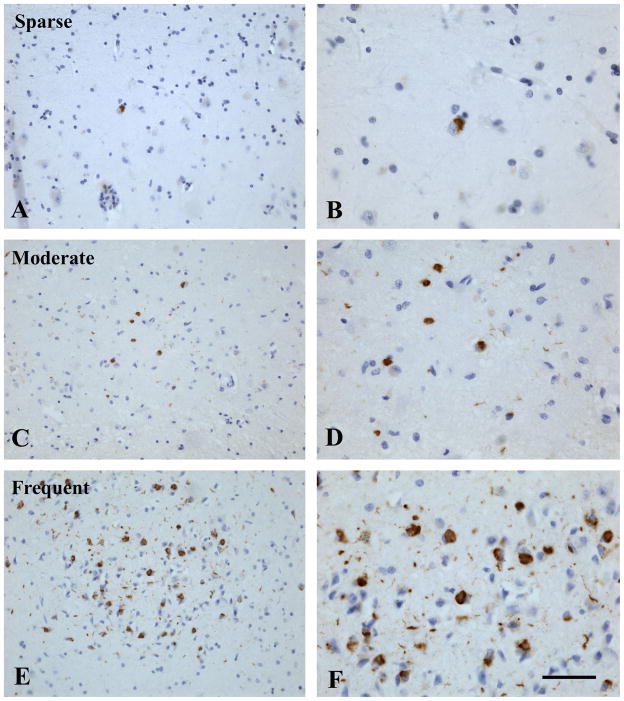
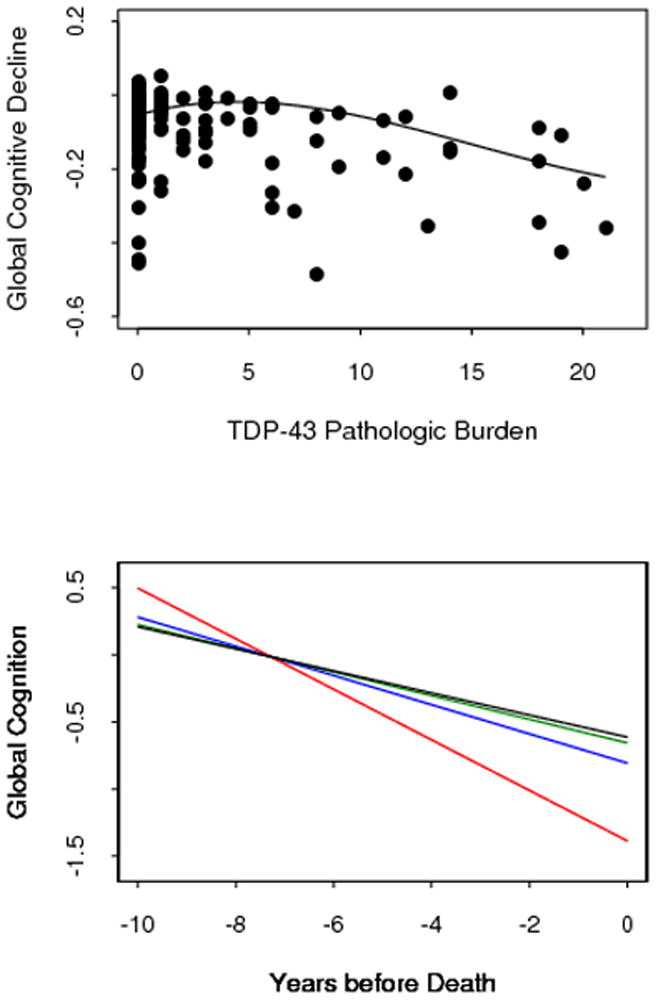
Transactive response DNA-binding protein 43 pathology, ranging from sparse to severe, was identified in 46% of participants and was associated with amyloid plaques, tangles, and hippocampal sclerosis but not neocortical Lewy bodies or cerebral infarcts. After controlling for amyloid plaques, tangles, and hippocampal sclerosis, TDP-43 pathology was associated with more rapid cognitive decline and accounted for nearly as much of the variability in rates of global cognitive decline as did tangles. Transactive response DNA-binding protein 43 pathology had a distinct cognitive profile that differed from other neuropathologic processes (related to decline in episodic and working memory but not in other cognitive domains), and it was elevated in those who developed dementia but not in those with mild cognitive impairment.
The results suggest that TDP-43 is an important brain pathology underlying cognitive decline and dementia in old age.
认知能力下降是老年人残疾和死亡的主要原因,但它的神经生物学基础尚不清楚。
检验假设,即反式作用反应 DNA 结合蛋白 43(TDP-43)与晚年认知能力下降有关。
设计、设置和参与者:这是一项在美国各地多个天主教团体中进行的纵向临床病理队列研究。共有 130 名年长的天主教修女、牧师和修道士接受了年度临床评估,包括详细的认知测试,在死亡前平均进行了 10.1 年的评估。在神经病理学检查中,我们从多个大脑区域收集了 TDP-43 病理学、神经元神经原纤维缠结密度、淀粉样β斑块所占面积以及α-突触核蛋白路易体的存在的半定量测量值。还确定了大体和微观脑梗死和海马硬化。
在死亡前平均 10.1 年的年度观察期间,先前建立的全球认知综合测量的年度变化率。
在 46%的参与者中发现了从稀疏到严重的反式作用反应 DNA 结合蛋白 43 病理学,与淀粉样斑块、缠结和海马硬化有关,但与新皮质路易体或脑梗死无关。在控制了淀粉样斑块、缠结和海马硬化后,TDP-43 病理学与认知能力下降较快有关,并且与缠结一样,对全球认知下降率的变化有很大的解释力。TDP-43 病理学具有独特的认知特征,与其他神经病理学过程不同(与情景记忆和工作记忆下降有关,但与其他认知领域无关),并且在发展为痴呆症的患者中升高,但在轻度认知障碍患者中没有升高。
研究结果表明,TDP-43 是老年认知能力下降和痴呆的重要脑病理学。