Elders P J M, Merlijn T, Swart K M A, van Hout W, van der Zwaard B C, Niemeijer C, Heymans M W, van der Heijden A A, Rutters F, van der Horst H E, Lips P, Netelenbos J C, van Schoor N M
Department of General Practice and Elderly Care Medicine, VU University Medical Center, Amsterdam Public Health research institute, Amsterdam, The Netherlands.
Stichting ArtsenLaboratorium en Trombosedienst, Koog aan de Zaan, The Netherlands.
BMC Musculoskelet Disord. 2017 Oct 27;18(1):424. doi: 10.1186/s12891-017-1783-y.
Several drugs have become available for the treatment of osteoporosis. However, screening and treatment of patients with a high fracture risk is currently not recommended in the Netherlands, because the effectiveness of bone sparing drugs has not been demonstrated in the general primary care population. Here we describe the design of the SALT Osteoporosis study, which aims to examine whether the screening and treatment of older, female patients in primary care can reduce fractures, in comparison to usual care.
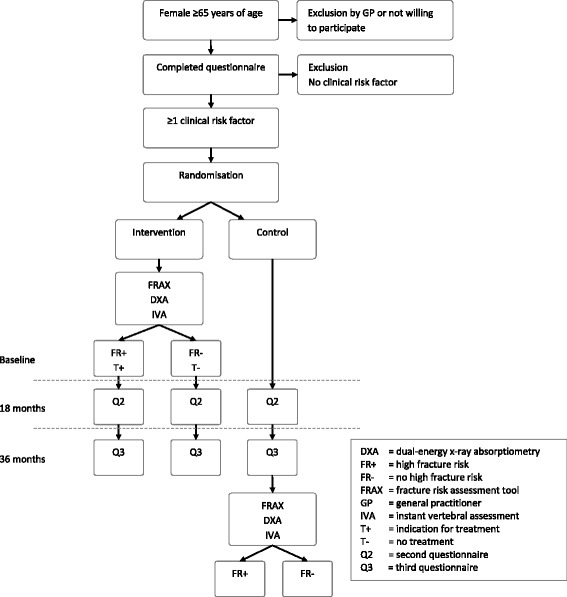
A randomised pragmatic trial has been designed using a stepwise approach in general care practices in the Netherlands. Women aged ≥65 years, who are not prescribed bone sparing drugs or corticosteroids are eligible for the study. First, women with at least one clinical risk factor for fractures, as determined by questionnaires, are randomly assigned to the intervention or control group. Second, women in the intervention group having a high fracture risk according to our screening program, including an adapted fracture risk assessment (FRAX) tool, combined with dual-energy x-ray absorptiometry (DXA), and instant vertebral assessment (IVA), are offered a structured treatment program. The women in the control group receive care as usual and will undergo the same screening as the intervention group at the end of the trial. The follow-up duration will be three years and the primary outcome is time to first incident fracture and the total number of fractures.
The results of the current study will be very important for underpinnings of the prevention strategy of the osteoporosis guidelines.
ID NTR2430 . Registered 26 July 2010.
已有多种药物可用于治疗骨质疏松症。然而,荷兰目前不建议对骨折风险高的患者进行筛查和治疗,因为在普通初级保健人群中尚未证实保骨药物的有效性。在此,我们描述了SALT骨质疏松症研究的设计,该研究旨在探讨与常规护理相比,初级保健中对老年女性患者进行筛查和治疗是否可以减少骨折。
在荷兰的普通护理实践中采用逐步方法设计了一项随机实用试验。年龄≥65岁、未开具保骨药物或皮质类固醇药物的女性符合研究条件。首先,通过问卷调查确定至少有一个骨折临床风险因素的女性被随机分配到干预组或对照组。其次,根据我们的筛查方案,包括改良的骨折风险评估(FRAX)工具、双能X线吸收法(DXA)和即时椎体评估(IVA),对干预组中骨折风险高的女性提供结构化治疗方案。对照组的女性接受常规护理,并将在试验结束时接受与干预组相同的筛查。随访期为三年,主要结局是首次发生骨折的时间和骨折总数。
本研究结果对于骨质疏松症指南预防策略的基础将非常重要。
ID NTR2430。2010年7月26日注册。