Department of Thyroid and Breast Surgery, Shanghai 10th People's Hospital, Clinical College of Nanjing Medical University, Shanghai, China (mainland).
Med Sci Monit. 2017 Oct 28;23:5130-5138. doi: 10.12659/msm.904492.
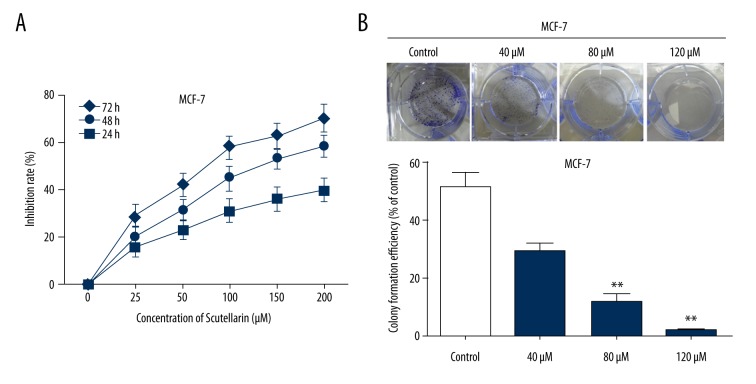
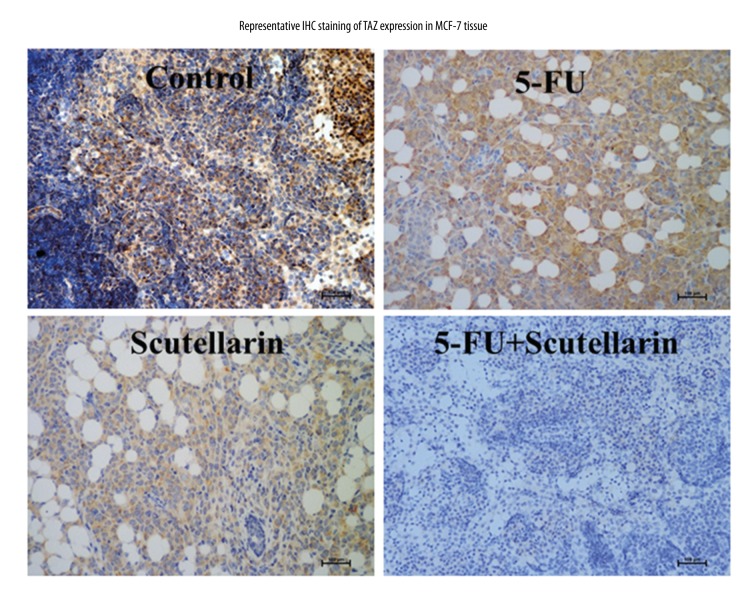
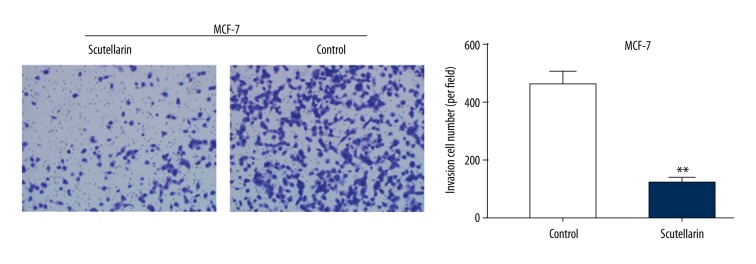
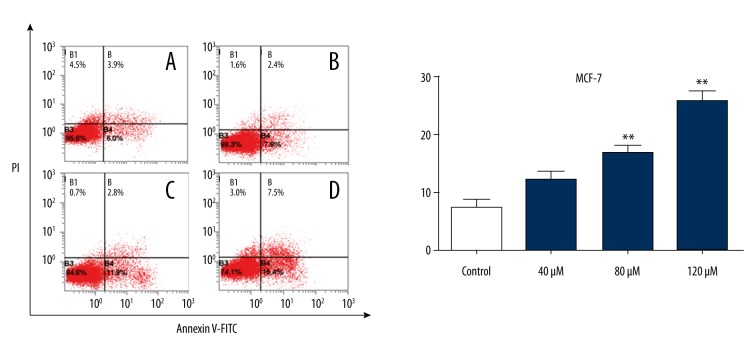
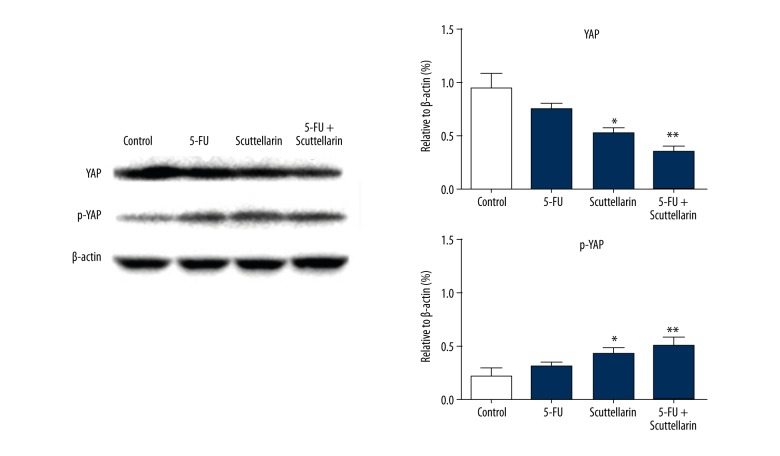
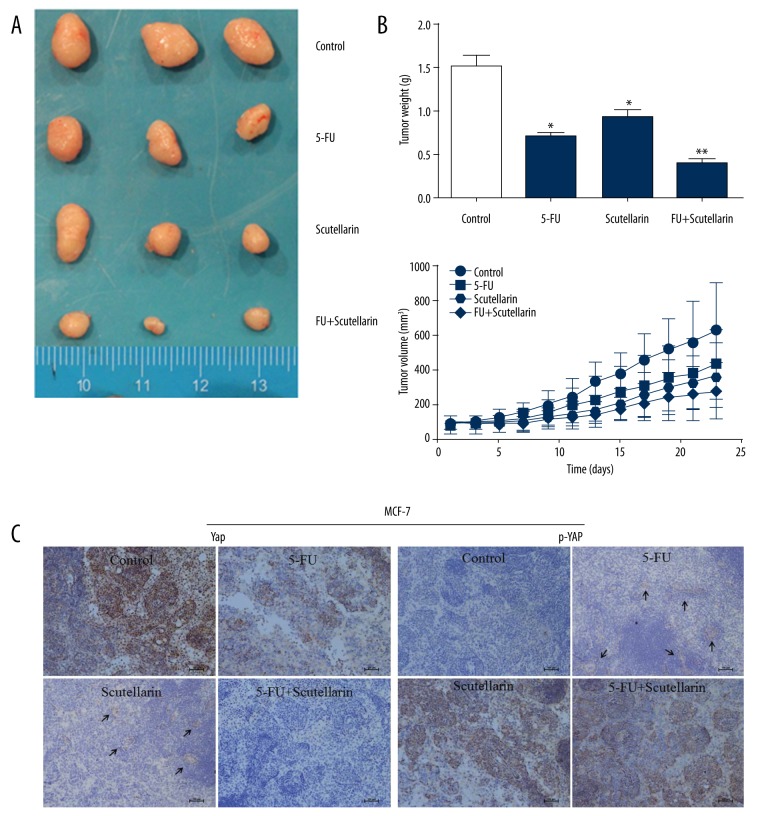
BACKGROUND The present study aimed to investigate the effects of Scutellarin on proliferation, invasion and tumorigenicity in human breast carcinoma MCF-7 cells and its associated molecular mechanisms. MATERIAL AND METHODS The MCF-7 cells were cultured with varies of concentrations of Scutellarin in vitro. The proliferation, invasion, and apoptosis of MCF-7 cells were studied via CCK-8 assay, transwell assay, and flow cytometry. In vivo expression of the HIPPO pathway key proteins YAP and p-YAP of MCF-7 cells were analyzed by immunohistochemistry. RESULTS The inhibition rates of Scutellarin-treated MCF-7 cells were 40.1%, 58.7%, and 70.6% for 24, 48, and 72 h, respectively. The MCF-7 cell proliferation was significantly inhibited by Scutellarin. Treating MCF-7 cells with Scutellarin led to invasion inhibition. The rates apoptotic cells were between 12.4±1.9% and 23.9±2.1% in 40-120 µM Scutellarin-administrated groups, which had a significant rise compared with the control group (7.8±1.9%, P<0.05). Scutellarin significantly inhibited MCF-7 xenograft tumor growth. Immunohistochemical analysis showed that the inhibition of tumor growth in Scutellarin-treated mice was associated with increased p-YAP and decreased YAP expression in vivo. CONCLUSIONS Scutellarin-treated breast carcinoma MCF-7 cells had significantly inhibited growth and induced apoptosis, which is associated with induction of autophagy through regulation of the HIPPO-YAP signaling pathway, providing support to the clinical use of Scutellarin-based medication to achieve optimized outcome in patients with breast carcinoma.
本研究旨在探讨野黄芩苷对人乳腺癌 MCF-7 细胞增殖、侵袭和致瘤性的影响及其相关分子机制。
体外培养 MCF-7 细胞,用不同浓度的野黄芩苷处理 MCF-7 细胞。通过 CCK-8 法、Transwell 法和流式细胞术研究 MCF-7 细胞的增殖、侵袭和凋亡。采用免疫组化法分析 MCF-7 细胞中 HIPPO 通路关键蛋白 YAP 和磷酸化 YAP(p-YAP)的体内表达。
野黄芩苷处理 MCF-7 细胞 24、48 和 72 h 的抑制率分别为 40.1%、58.7%和 70.6%。野黄芩苷显著抑制 MCF-7 细胞增殖。野黄芩苷处理 MCF-7 细胞可抑制侵袭。40-120 µM 野黄芩苷处理组的凋亡细胞率分别为 12.4±1.9%和 23.9±2.1%,与对照组(7.8±1.9%)相比显著升高(P<0.05)。野黄芩苷显著抑制 MCF-7 异种移植瘤的生长。免疫组化分析显示,野黄芩苷处理组肿瘤生长抑制与体内 p-YAP 表达增加和 YAP 表达减少有关。
野黄芩苷处理的乳腺癌 MCF-7 细胞生长明显受到抑制并诱导凋亡,这与通过调节 HIPPO-YAP 信号通路诱导自噬有关,为临床应用野黄芩苷类药物治疗乳腺癌患者提供了支持,以达到优化的治疗效果。