Department of Chemistry, Stanford University, Stanford, CA, 94305, USA.
Department of Applied Physics, Stanford University, Stanford, CA, 94305, USA.
Nat Commun. 2017 Oct 27;8(1):1178. doi: 10.1038/s41467-017-01041-1.
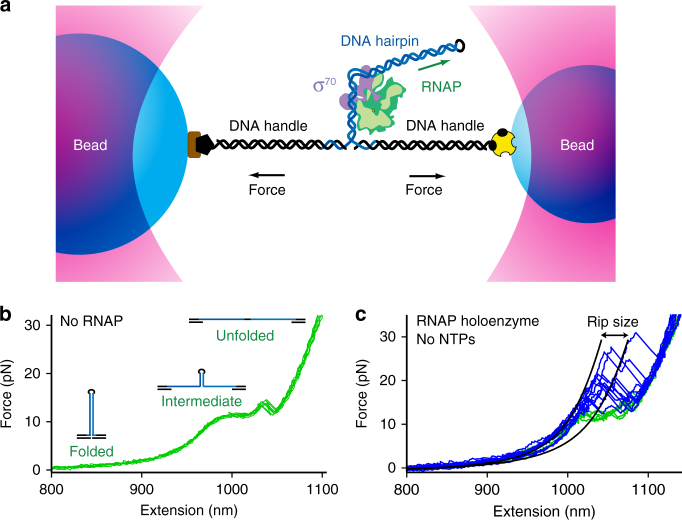
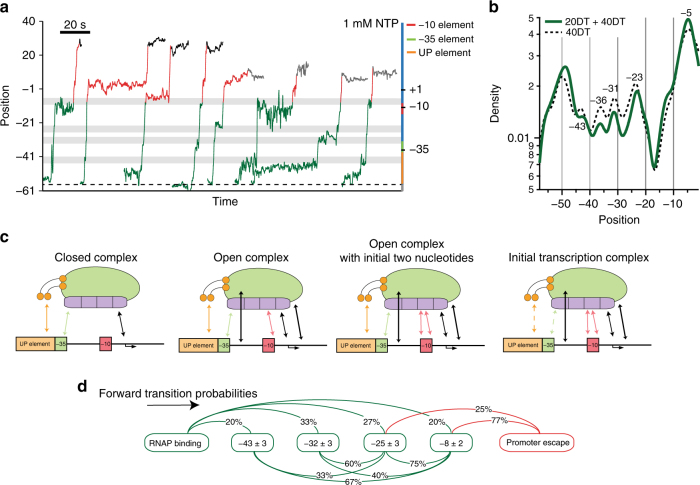
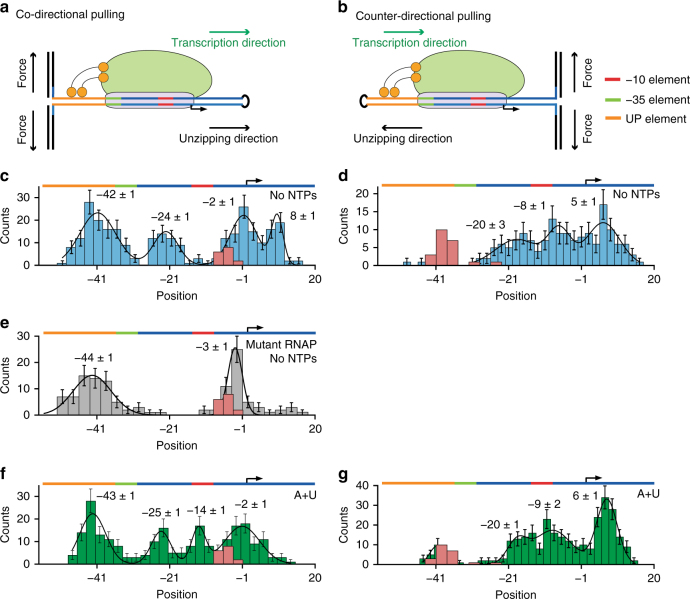
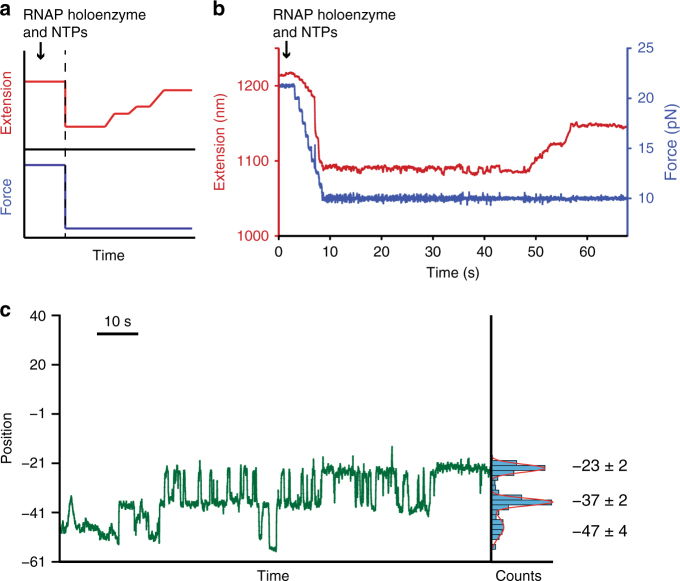
Critical contacts made between the RNA polymerase (RNAP) holoenzyme and promoter DNA modulate not only the strength of promoter binding, but also the frequency and timing of promoter escape during transcription. Here, we describe a single-molecule optical-trapping assay to study transcription initiation in real time, and use it to map contacts formed between σ RNAP holoenzyme from E. coli and the T7A1 promoter, as well as to observe the remodeling of those contacts during the transition to the elongation phase. The strong binding contacts identified in certain well-known promoter regions, such as the -35 and -10 elements, do not necessarily coincide with the most highly conserved portions of these sequences. Strong contacts formed within the spacer region (-10 to -35) and with the -10 element are essential for initiation and promoter escape, respectively, and the holoenzyme releases contacts with promoter elements in a non-sequential fashion during escape.
关键接触由 RNA 聚合酶(RNAP)全酶和启动子 DNA 形成,不仅调节启动子结合的强度,还调节转录过程中启动子逃逸的频率和时间。在这里,我们描述了一种单分子光学捕获测定法来实时研究转录起始,并使用它来绘制大肠杆菌 σ RNAP 全酶与 T7A1 启动子之间形成的接触,以及观察在向延伸阶段过渡过程中这些接触的重塑。在某些已知的启动子区域(如-35 和-10 元件)中形成的强结合接触不一定与这些序列的最保守部分重合。在间隔区(-10 到-35)内形成的强接触以及与-10 元件的强接触对于起始和启动子逃逸分别是必需的,并且在逃逸过程中,全酶以非顺序的方式释放与启动子元件的接触。