Hara-Skrzypiec Agnieszka, Śliwka J, Jakuczun H, Zimnoch-Guzowska E
Plant Breeding and Acclimatization Institute, National Research Institute, Młochów, Platanowa 19, 05-831, Młochów, Poland.
Mol Genet Genomics. 2018 Apr;293(2):331-342. doi: 10.1007/s00438-017-1387-0. Epub 2017 Oct 27.
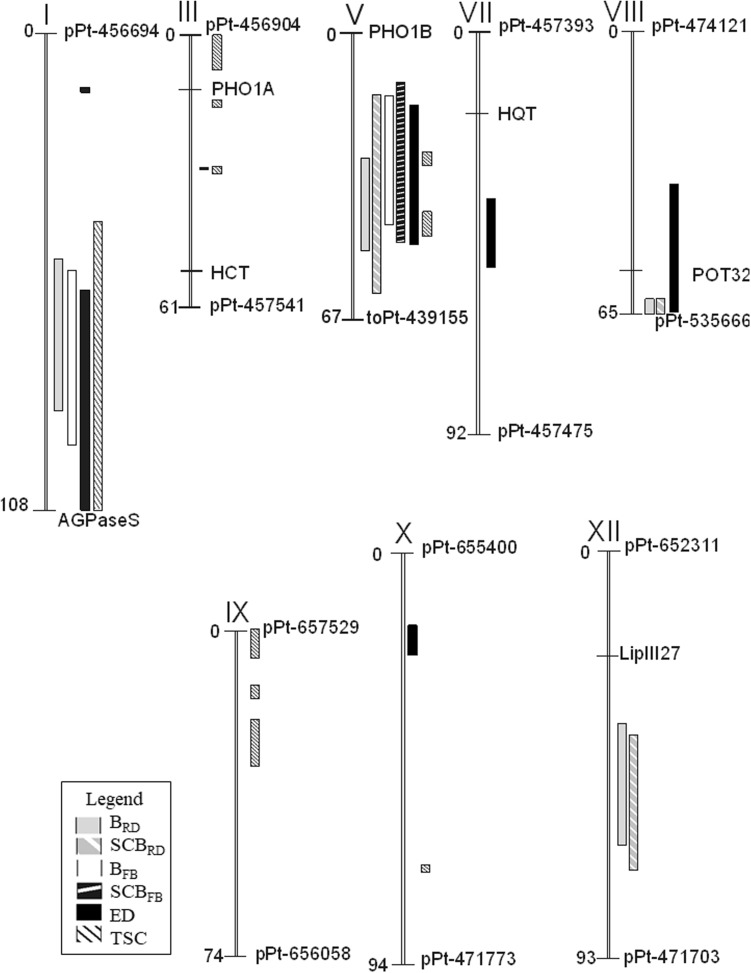
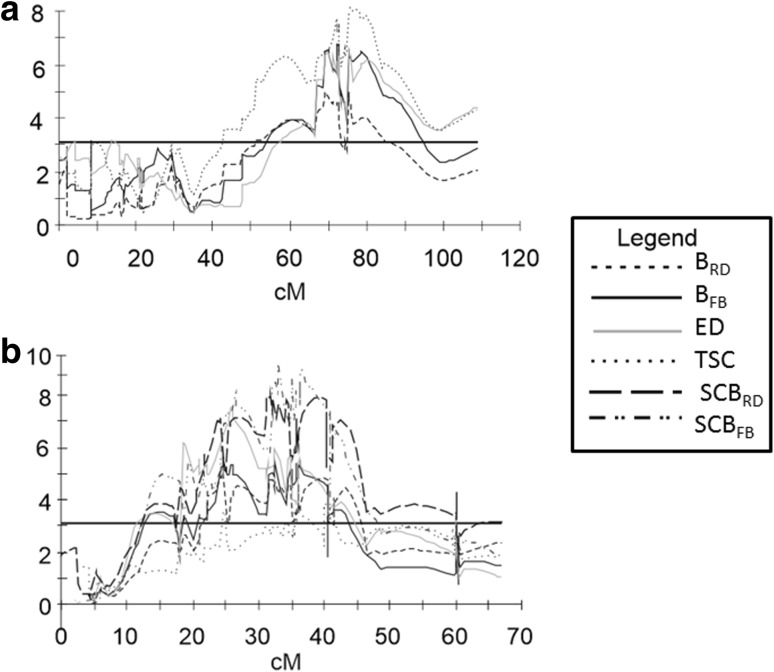
Tuber tissue discolorations caused by impact (blackspot bruising) and enzymatic discoloration (ED) after tuber cutting are crucial quality traits of the cultivated potato. To understand the complex genetics of the traits, quantitative trait locus (QTL) analysis using diploid mapping population and diversity array technology (DArT) markers was performed. The phenotypic assessment included the complex evaluation of blackspot bruising susceptibility through two methods: rotating drum (B ) and falling bolt (B ) in combination with the evaluation of enzymatic discoloration. Because of observed in-practice relationship between bruising susceptibility and tuber starch content (TSC), analysis of starch content-corrected bruising susceptibility (SCB) was performed. QTLs for bruising were detected on chromosomes I, V with both test methods. The rotating drum method enabled the detection of additional QTLs on chromosomes VIII and XII. Analysis of SCB enabled the identification of the major QTL on chromosome V and two weaker QTLs on chromosomes VIII and XII, independently of starch content. The QTL for bruising detected on chromosome I overlapped with the most significant QTL for tuber starch content. This QTL was not significant for starch content-corrected bruising susceptibility, and the effect of the QTL on chromosome V was enhanced for this trait. The QTL analysis of ED revealed the contribution of seven QTLs for the trait, located on six chromosomes, including these detected for the first time: a major locus on chromosome V and minor QTLs on chromosomes VII and X, which were specific for the trait. The QTL for ED on chromosome VIII was co-localized with the marker for polyphenol oxidase (POT32). The phenotypic correlation between bruising and ED was confirmed in QTL analyses of both traits, and the QTLs detected for these traits overlapped on chromosomes I, V, and VIII. Our results should provide a basis for further studies on candidate genes affecting blackspot bruise susceptibility and enzymatic discoloration.
由撞击引起的块茎组织变色(黑斑瘀伤)以及块茎切割后的酶促变色是栽培马铃薯的关键品质性状。为了解这些性状的复杂遗传学,利用二倍体作图群体和多样性阵列技术(DArT)标记进行了数量性状位点(QTL)分析。表型评估包括通过两种方法对黑斑瘀伤易感性进行综合评估:转鼓法(B)和落锤法(B),并结合酶促变色评估。由于观察到瘀伤易感性与块茎淀粉含量(TSC)之间的实际关系,因此对淀粉含量校正后的瘀伤易感性(SCB)进行了分析。两种测试方法均在第I、V号染色体上检测到了瘀伤的QTL。转鼓法能够在第VIII和XII号染色体上检测到额外的QTL。对SCB的分析能够独立于淀粉含量,鉴定出第V号染色体上的主要QTL以及第VIII和XII号染色体上的两个较弱QTL。在第I号染色体上检测到的瘀伤QTL与块茎淀粉含量最显著的QTL重叠。该QTL对淀粉含量校正后的瘀伤易感性不显著,并且该性状在第V号染色体上的QTL效应增强。酶促变色的QTL分析揭示了该性状的7个QTL的贡献,这些QTL位于6条染色体上,包括首次检测到的:第V号染色体上的一个主要位点以及第VII和X号染色体上的次要QTL,这些QTL对该性状具有特异性。第VIII号染色体上的酶促变色QTL与多酚氧化酶(POT32)标记共定位。两种性状的QTL分析均证实了瘀伤与酶促变色之间的表型相关性,并且在第I、V和VIII号染色体上检测到的这些性状的QTL重叠。我们的结果应为进一步研究影响黑斑瘀伤易感性和酶促变色的候选基因提供基础。