Centre for Psychiatry Research, Department of Clinical Neuroscience, Karolinska Institute, Stockholm, Sweden.
Stockholm Health Care Services, Stockholm County Council, Stockholm, Sweden.
Psychol Psychother. 2018 Sep;91(3):302-316. doi: 10.1111/papt.12161. Epub 2017 Oct 28.
In published clinical and autobiographical accounts of eating disorders, patients often describe their disorder in personified ways, that is, relating to the disorder as if it were an entity, and treatment often involves techniques of externalization. By encouraging patients to think about their eating disorder as a relationship, this study aimed to examine how young female patients experience their eating disorder as acting towards them, how they react in response, and whether these interactions are associated with symptoms, illness duration, and self-image.
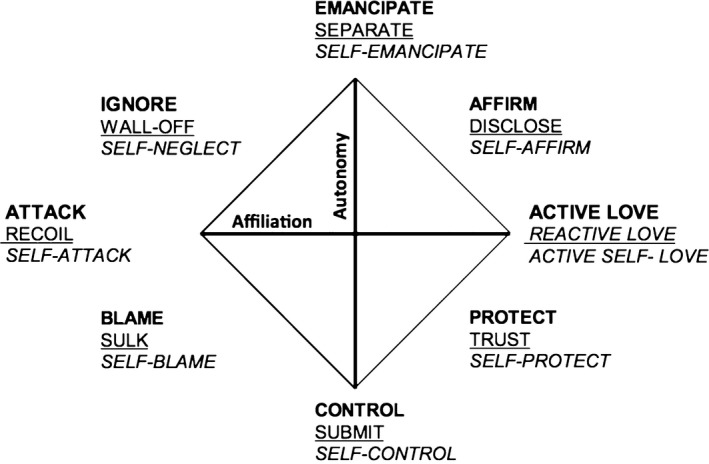
Structural Analysis of Social Behavior (SASB) was used to operationalize how patients experience the actions of their eating disorder and their own reactions to the disorder.
The relationship between patients (N = 150) and their eating disorders was examined with respect to symptoms, duration of illness, and self-image. Patients were also compared on their tendency to react with affiliation in relation to their disorder.
Patients' responses on the SASB indicated that they tended to conceptualize their eating disorders as blaming and controlling, and they themselves as sulking and submitting in response. Greater experience of the eating disorder as being controlling was associated with higher levels of symptomatology. Patients reacting with more negative affiliation towards their disorder were less symptomatic.
When encouraging patients to think about their eating disorder as a relationship, comprehensible relationship patterns between patients and their eating disorders emerged. The idea that this alleged relationship may resemble a real-life relationship could have theoretical implications, and its exploration may be of interest in treatment.
Patients were able to conceptualize their eating disorder as a significant other to whom they relate when encouraged to do so. Patients tended to experience their disorder as controlling and domineering. Exploring the hypothetical patient-eating disorder relationship may prove helpful in understanding dysfunctional relational patterns. Helping patients to rebel against their eating disorder could potentially aid in symptom reduction.
在已发表的饮食失调症的临床和自传体病例中,患者常以人格化的方式描述自己的疾病,即把疾病当作一个实体来对待,而治疗通常涉及外化技术。本研究旨在通过鼓励患者将其饮食障碍视为一种关系,来探讨年轻女性患者如何体验其饮食障碍对自己的作用,以及她们如何对此做出反应,以及这些相互作用是否与症状、疾病持续时间和自我形象有关。
采用社会行为结构分析(Structural Analysis of Social Behavior,SASB)来操作化患者如何体验饮食障碍的行为及其对障碍的自身反应。
根据症状、疾病持续时间和自我形象,研究了患者(N=150)与饮食障碍的关系。还比较了患者对与疾病相关的依恋倾向。
SASB 上患者的反应表明,他们倾向于将自己的饮食障碍概念化为责备和控制,而自己则表现为赌气和顺从。对饮食障碍的控制体验越强,症状水平越高。对自己的疾病反应带有更多消极依恋的患者症状较少。
当鼓励患者将其饮食障碍视为一种关系时,患者和其饮食障碍之间出现了可理解的关系模式。认为这种所谓的关系可能类似于现实生活中的关系,这可能具有理论意义,对其探索可能对治疗具有意义。
当鼓励患者将其饮食障碍视为一种关系时,患者能够将其饮食障碍概念化为与之相关的重要他人。患者倾向于体验其障碍具有控制和支配性。探索假设的患者-饮食障碍关系可能有助于理解功能失调的关系模式。帮助患者反抗其饮食障碍可能有助于减少症状。