Sakari Jokiranta T, Viklicky Ondrej, Al Shorafa Saleh, Coppo Rosanna, Gasteyger Christoph, Macia Manuel, Pankratenko Tatiana, Shenoy Mohan, Soylemezoglu Oğuz, Tsimaratos Michel, Wetzels Jack, Haller Hermann
Research Programs Unit, University of Helsinki and Helsinki University Central Hospital, Helsinki, Finland.
Institute for Clinical and Experimental Medicine, Prague, Czech Republic.
BMC Nephrol. 2017 Oct 28;18(1):324. doi: 10.1186/s12882-017-0727-y.
The differential diagnosis of thrombotic microangiopathy (TMA) is complex however the rapid diagnosis of the underlying condition is vital to inform urgent treatment decisions. A survey was devised with the objective of understanding current practices across Europe and the Middle East, and of challenges when diagnosing the cause of TMA.
Over 450 clinicians, from 16 countries were invited to complete an online survey.
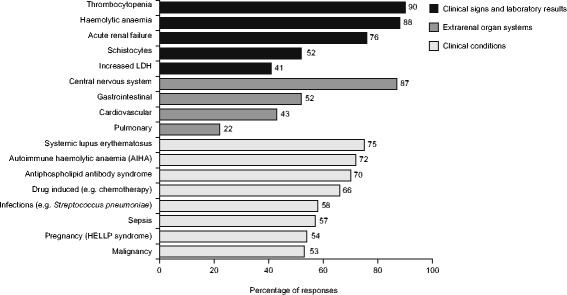
Of 254 respondents, the majority were nephrologists, had >10 years' experience in their specialty, and had diagnosed a patient with TMA. The triad of thrombocytopenia, haemolytic anaemia and acute kidney injury are the main diagnostic criteria used. Responses indicate that a differential diagnosis of TMA is usually made within 1-2 (53%) or 3-4 days (26%) of presentation. Similarly, therapy is usually initiated within the first 4 days (74%), however 13% report treatment initiation >1-week post-presentation. Extrarenal symptoms and a panoply of other conditions are considered when assessing the differential diagnosis of TMA. While 70 and 78% of respondents stated they always request complement protein levels and ADAMTS13 activity, respectively. Diagnostic considerations of paediatric and adult nephrologists varied. A greater proportion of paediatric than adult nephrologists consider extrarenal manifestations clinically related to a diagnosis of TMA; pulmonary (45% vs. 18%), gastrointestinal (67% vs. 50%), CNS (96% vs. 84%) and cardiovascular (54% vs. 42%), respectively. Variability in the availability of guidelines and extent of family history taken was also evident.
This survey reveals the variability of current practices and the need for increased urgency among physicians in the differential diagnosis of TMA, despite their experience. Above all, the survey highlights the need for international clinical guidelines to provide systematically developed recommendations for understanding the relevance of complement protein levels, complement abnormalities and ADAMTS13 testing, in making a differential diagnosis of TMA. Such clinical guidelines would enable physicians to make a more rapid and informed diagnosis of TMA, therefore initiate effective treatment earlier, with a consequent improvement in patient outcomes.
血栓性微血管病(TMA)的鉴别诊断很复杂,然而快速诊断潜在病因对于做出紧急治疗决策至关重要。设计了一项调查,目的是了解欧洲和中东地区的当前做法以及诊断TMA病因时面临的挑战。
邀请来自16个国家的450多名临床医生完成一项在线调查。
在254名受访者中,大多数是肾病学家,在其专业领域有超过10年的经验,并且诊断过TMA患者。血小板减少、溶血性贫血和急性肾损伤三联征是主要的诊断标准。回复表明,TMA的鉴别诊断通常在就诊后1 - 2天(53%)或3 - 4天(26%)内做出。同样,治疗通常在头4天内开始(74%),然而13%的人报告在就诊1周后开始治疗。在评估TMA的鉴别诊断时会考虑肾外症状和一系列其他病症。虽然分别有70%和78%的受访者表示他们总是要求检测补体蛋白水平和ADAMTS13活性。儿科和成人肾病学家的诊断考虑有所不同。与成人肾病学家相比,更多比例的儿科肾病学家认为肾外表现与TMA诊断临床相关;分别为肺部(45%对18%)、胃肠道(67%对50%)、中枢神经系统(96%对84%)和心血管系统(54%对42%)。指南的可获取性以及家族史询问范围的差异也很明显。
这项调查揭示了当前做法的差异以及医生在TMA鉴别诊断中提高紧迫性的必要性,尽管他们有经验。最重要的是,该调查强调需要国际临床指南,以便为理解补体蛋白水平、补体异常和ADAMTS13检测在TMA鉴别诊断中的相关性提供系统制定的建议。这样的临床指南将使医生能够更快速、明智地诊断TMA,从而更早地开始有效治疗,进而改善患者的治疗结果。