Wang Jingyi, Lloyd-Evans Brynmor, Giacco Domenico, Forsyth Rebecca, Nebo Cynthia, Mann Farhana, Johnson Sonia
Division of Psychiatry, University College London, Maple House, 149 Tottenham Court Road, London, W1T 7NF, UK.
Unit for Social and Community Psychiatry, (WHO Collaborating Centre for Mental Health Services Development), Queen Mary University of London, London, UK.
Soc Psychiatry Psychiatr Epidemiol. 2017 Dec;52(12):1451-1461. doi: 10.1007/s00127-017-1446-1. Epub 2017 Oct 28.
Social isolation and related concepts have been discussed increasingly in the field of mental health. Despite this, there is a lack of conceptual clarity and consistency in the definition and operationalisation of these terms. This review aimed to provide a clear framework for social isolation and related concepts, and to identify well-established measures in the field of mental health for each conceptual domain discussed.
We used an iterative strategy of expert consultation and literature searching. A multi-disciplinary group of senior academics was consulted both before and after the literature searching to identify relevant terms, conceptual papers, or recommended measures. Our conceptual framework was also validated through expert consultation. We searched the Web of Science database using terms suggested by experts and subsequently identified further relevant studies through review articles and by reading full texts and reference lists of included studies. A narrative synthesis was conducted.
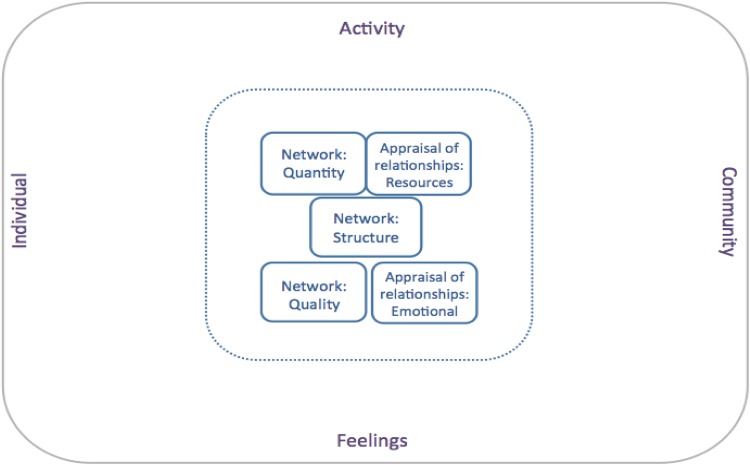
We developed a model with five domains incorporating all the concepts relevant to social isolation in regular use in the mental health research literature. These five domains are: social network-quantity; social network-structure; social network-quality; appraisal of relationships-emotional; and appraisal of relationships-resources. We also identified well-developed measures suitable for assessing each of the five conceptual domains or covering multi-domains.
Our review proposes a conceptual model to encompass and differentiate all terms relating to social isolation. Potential uses are in allowing researchers and intervention developers to identify precisely the intended outcomes of interventions, and to choose the most appropriate measures to use in mental health settings.
社会隔离及相关概念在心理健康领域的讨论日益增多。尽管如此,这些术语的定义和操作化仍缺乏概念清晰度和一致性。本综述旨在为社会隔离及相关概念提供一个清晰的框架,并确定心理健康领域针对所讨论的每个概念领域已确立的测量方法。
我们采用了专家咨询和文献检索的迭代策略。在文献检索前后,咨询了一个多学科的资深学者小组,以确定相关术语、概念性论文或推荐的测量方法。我们的概念框架也通过专家咨询得到了验证。我们使用专家建议的术语搜索了科学网数据库,随后通过综述文章以及阅读纳入研究的全文和参考文献列表,确定了更多相关研究。进行了叙述性综合分析。
我们开发了一个包含五个领域的模型,纳入了心理健康研究文献中经常使用的与社会隔离相关的所有概念。这五个领域是:社会网络——数量;社会网络——结构;社会网络——质量;关系评估——情感;关系评估——资源。我们还确定了适用于评估五个概念领域中每个领域或涵盖多个领域的完善测量方法。
我们的综述提出了一个概念模型,以涵盖和区分与社会隔离相关的所有术语。潜在用途在于使研究人员和干预措施开发者能够准确确定干预措施的预期结果,并选择在心理健康环境中使用的最合适测量方法。