Ibănescu Iulian, Leiding Claus, Bollwein Heinrich
Besamungsverein Neustadt a. d. Aisch e.V., 91413 Neustadt an der Aisch, Germany.
Faculty of Veterinary Medicine, University of Agricultural Sciences and Veterinary Medicine, 700489 Iasi, Romania.
J Reprod Dev. 2018 Feb 27;64(1):33-39. doi: 10.1262/jrd.2017-083. Epub 2017 Oct 28.
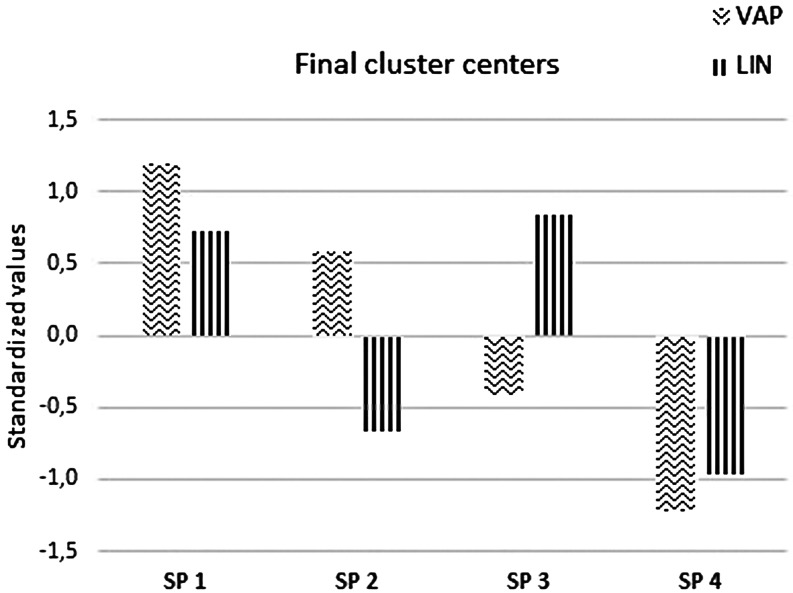
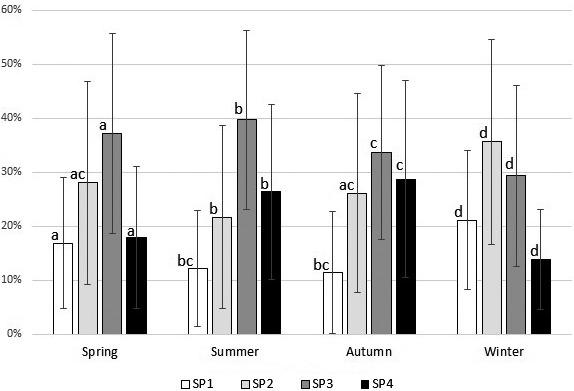
This study aimed to identify motile sperm subpopulations in extended boar semen and to observe the presumptive seasonal variation in their distribution. Data from 4837 boar ejaculates collected over a two-year period were analyzed in terms of kinematic parameters by Computer Assisted Sperm Analysis (CASA). Individual sperm data were used to determine subgroups of motile sperm within the ejaculates using cluster analysis. Four motile sperm subpopulations (SP) were identified, with distinct movement patterns: SP1 sperm with high velocity and high linearity; SP2 sperm with high velocity but low linearity; SP3 sperm with low velocity but high linearity; and SP4 sperm with low velocity and low linearity. SP1 constituted the least overall proportion within the ejaculates (P < 0.05). Season of semen collection significantly influenced the different proportions of sperm subpopulations. Spring was characterized by similar proportions of SP1 and SP4 (NS) and higher proportions of SP3. Summer brought a decrease in both subgroups containing fast sperm (SP1 and SP2) (P < 0.05). During autumn, increases in SP2 and SP4 were recorded. Winter substantially affected the proportions of all sperm subpopulations (P < 0.05) and SP2 became the most represented subgroup, while SP1 (fast and linear) reached its highest proportion compared to other seasons. In conclusion, extended boar semen is structured in distinct motile sperm subpopulations whose proportions vary according to the season of collection. Summer and autumn seem to have a negative impact on the fast and linear subpopulation. Cluster analysis can be useful in revealing differences in semen quality that are not normally detected by classical evaluation based on mean values.
本研究旨在鉴定稀释后的公猪精液中具有运动能力的精子亚群,并观察其分布可能存在的季节性变化。通过计算机辅助精子分析(CASA)对两年期间收集的4837份公猪射精样本的运动学参数数据进行了分析。利用聚类分析,根据个体精子数据确定射精样本中具有运动能力的精子亚群。鉴定出四个具有不同运动模式的具有运动能力的精子亚群(SP):SP1为高速且高线性的精子;SP2为高速但低线性的精子;SP3为低速但高线性的精子;SP4为低速且低线性的精子。SP1在射精样本中的总体占比最小(P < 0.05)。精液采集季节对精子亚群的不同占比有显著影响。春季的特点是SP1和SP4的占比相似(无显著差异)且SP3的占比更高。夏季含有快速运动精子的两个亚群(SP1和SP2)的占比均下降(P < 0.05)。秋季记录到SP2和SP4的占比增加。冬季对所有精子亚群的占比均有显著影响(P < 0.05),SP2成为占比最高的亚群,而SP1(快速且线性)与其他季节相比达到了最高占比。总之,稀释后的公猪精液由不同的具有运动能力的精子亚群构成,其占比随采集季节而变化。夏季和秋季似乎对快速且线性的亚群有负面影响。聚类分析有助于揭示精液质量的差异,而这些差异通常无法通过基于平均值的传统评估方法检测到。