Butti Loris, Bierti Olga, Lanfrit Raffaela, Bertolini Romina, Chittaro Sara, Delli Compagni Stefania, Del Russo Davide, Mancusi Rossella Letizia, Pertoldi Franco
S.O.C. Emergency Medicine, AAS3 Ospedale Sant'Antonio di San Daniele del Friuli.
C.R.E.A. Sanità, University of Tor Vergata, Rome, Italy.
J Pain Res. 2017 Oct 16;10:2479-2488. doi: 10.2147/JPR.S138850. eCollection 2017.
Pain is a common symptom presented in the emergency department (ED) although it is often underestimated, poorly evaluated and treated. The application of a protocol for timely pain management ensured by the nurse can avoid the delays in the analgesic treatment and improve the patient's quality of waiting.
To check the effectiveness and efficiency of the protocol aimed at early pain management in triage, active in our ED. In particular, the response to analgesic treatment was evaluated 60 minutes after the administration and at discharge. Patient satisfaction was also evaluated using two anonymous questionnaires both at discharge and 48 hours later via telephone.
A single-center, observational study was conducted on a prospective cohort of patients (aged ≥4 years) with a pain symptom at admission in ED with no surgical picture.
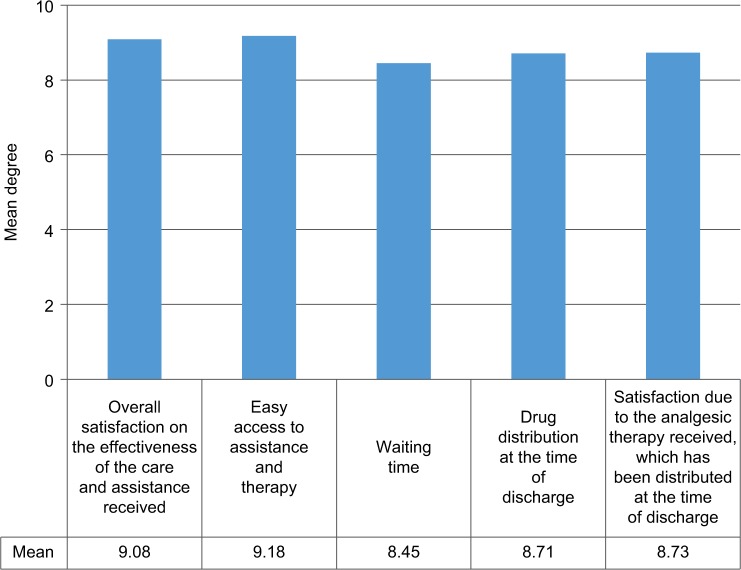
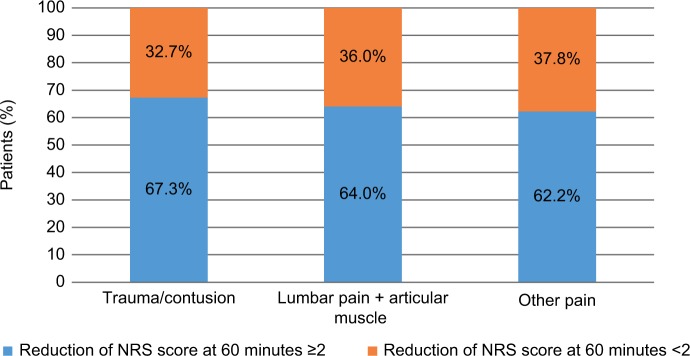
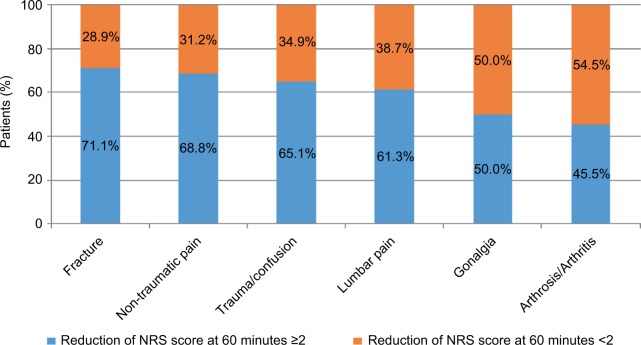
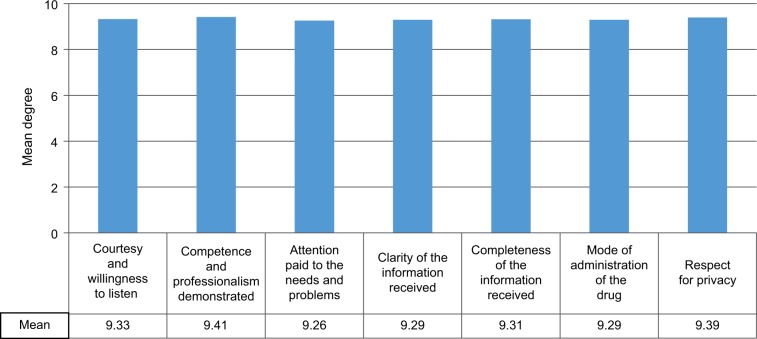
In the observation period (June 2015-May 2016), 382 patients were enrolled, and of these, 312 (84.8%) accepted pain therapy during triage stage in the ED. In 97.4% of the cases, orosoluble paracetamol 1000 mg was administered. In the re-evaluation done 60 minutes later, 65.9% of the patients showed a reduction of at least 2 points on Numeric Rating Scale (NRS), equal to a mean reduction of 2.24 points (95% CI: 2.03-2.45). The mean time of analgesia intake was equal to 5.9 minutes (95% CI: 3.8-8.1). In the re-evaluation done at discharge, 33.2% of the patients showed a reduction of NRS score >50%, leading to a mean reduction of 39% (95% CI: 35.3%-41.9%). The level of patient satisfaction was high with a mean value >9 points (maximum satisfaction =10).
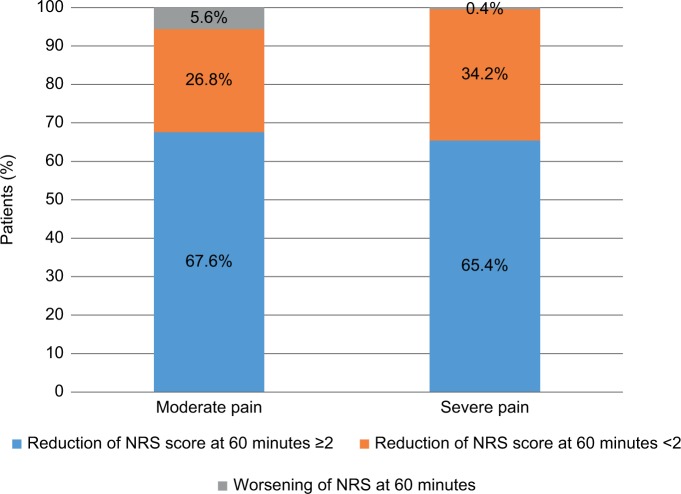
This protocol shows that optimal pain management was achieved by patients rapidly receiving an effective painkiller therapy at triage, leading to substantial patient satisfaction. In moderate pain, orosoluble paracetamol 1000 mg provided a reduction of NRS score by 2 points in 67.6% of the patients, confirming to be the analgesic of choice in ED.
疼痛是急诊科常见的症状,但其常常被低估、评估不足且治疗不当。由护士确保实施及时疼痛管理方案可避免镇痛治疗延误,提高患者等待质量。
检验我们急诊科实施的旨在早期疼痛管理的分诊方案的有效性和效率。特别是,在给药60分钟后及出院时评估镇痛治疗的反应。还通过两份匿名问卷在出院时及48小时后通过电话评估患者满意度。
对急诊科入院时伴有疼痛症状且无外科情况的≥4岁患者前瞻性队列进行单中心观察性研究。
在观察期(2015年6月 - 2016年5月),纳入382例患者,其中312例(84.8%)在急诊科分诊阶段接受了疼痛治疗。97.4%的病例给予了1000毫克可溶型对乙酰氨基酚。60分钟后重新评估时,65.9%的患者数字评分量表(NRS)至少降低2分,平均降低2.24分(95%置信区间:2.03 - 2.45)。镇痛药物摄入的平均时间为5.9分钟(95%置信区间:3.8 - 8.1)。出院时重新评估时,33.2%的患者NRS评分降低>50%,平均降低39%(95%置信区间:35.3% - 41.9%)。患者满意度较高,平均值>9分(最高满意度 = 10)。
该方案表明,通过患者在分诊时迅速接受有效的止痛治疗实现了最佳疼痛管理,从而使患者满意度大幅提高。在中度疼痛中,1000毫克可溶型对乙酰氨基酚使67.6%的患者NRS评分降低2分,证实其为急诊科的首选镇痛药。