Bezu Mekite, Maliković Jovana, Kristofova Martina, Engidawork Ephrem, Höger Harald, Lubec Gert, Korz Volker
Department of Pediatrics, Medical University of Vienna, Vienna, Austria.
Department of Pharmaceutical Chemistry, University of Vienna, Vienna, Austria.
Front Behav Neurosci. 2017 Oct 13;11:196. doi: 10.3389/fnbeh.2017.00196. eCollection 2017.
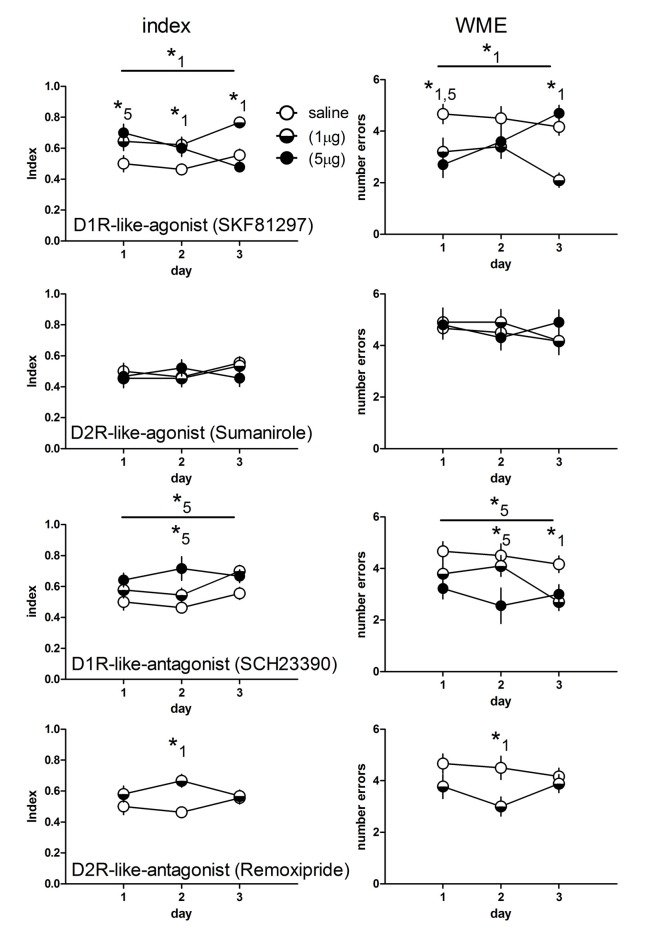
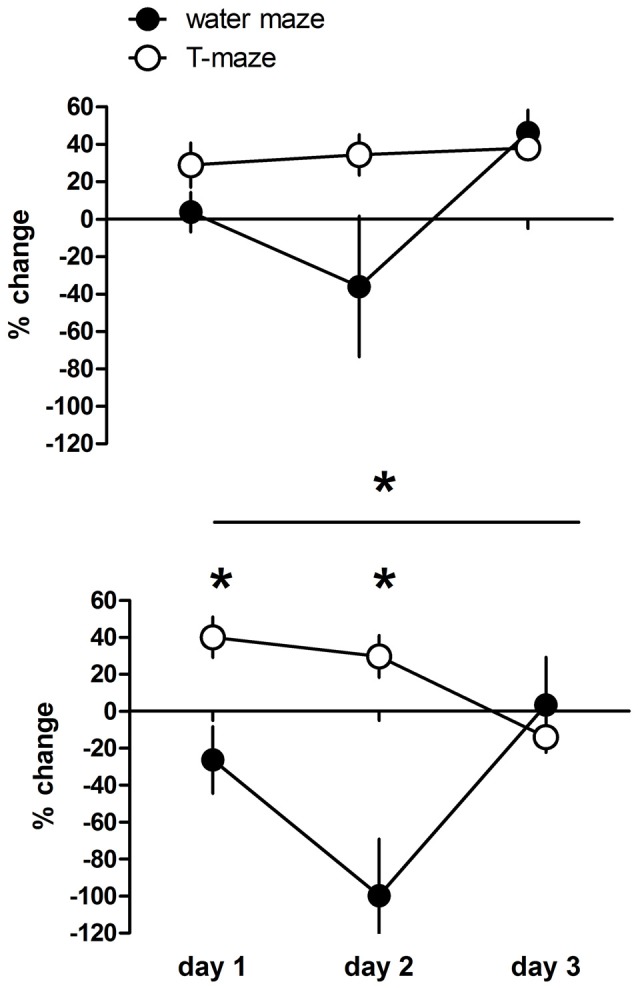
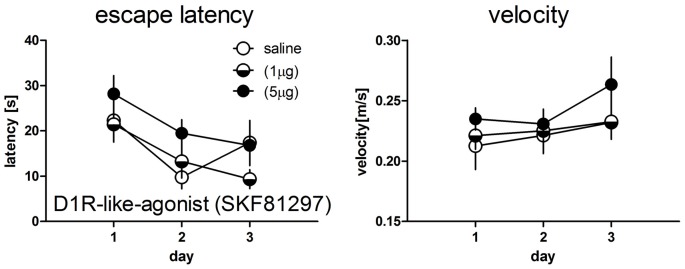
The dopaminergic system is known to be involved in working memory processed by several brain regions like prefrontal cortex (PFC), hippocampus, striatum. In an earlier study we could show that Levodopa but not Modafinil enhanced working memory in a T-maze only during the early phase of training (day 3), whereas the later phase remained unaffected. Rats treated with a higher dose performed better than low dose treated rats. Here we could more specifically segregate the contributions of dopamine type 1- and 2- like receptors (D1R; D2R) to the training state dependent modulation of spatial working memory by intracerebroventricular (ICV) application of a D1R-like (SKF81297) and D2R-like agonist (Sumanirole) and antagonist (SCH23390, Remoxipride) at a low and high dose through 3 days of training. The D1R-like-agonist at both doses enhanced working memory at day 1 but only in the low dose treated rats enhancement persists over training compared to control rats. Rats treated with a high dose of a D1R-like-antagonist show persistent enhancement of working memory over training, whereas in low dose treated rats no statistical difference at any time point could be determined compared to controls. The D2R-like-agonist at both doses does not show an effect at any time point when compared to control animals, whereas the D2R-like antagonist at a low dose enhanced working memory at day 2. For the most effective D1R-like agonist, we repeated the experiments in a water maze working memory task, to test for task dependent differences in working memory modulations. Treated rats at both doses did not differ as compared to controls, but the temporal behavioral performance of all groups was different compared to T-maze trained rats. The results are in line with the view that spatial working memory is optimized within a limited range of dopaminergic transmission, however suggest that these ranges vary during spatial training.
已知多巴胺能系统参与由前额叶皮层(PFC)、海马体、纹状体等多个脑区处理的工作记忆。在早期的一项研究中,我们发现左旋多巴而非莫达非尼仅在训练早期(第3天)增强了T迷宫中的工作记忆,而后期则不受影响。高剂量治疗的大鼠比低剂量治疗的大鼠表现更好。在这里,我们可以更具体地通过在3天训练期间脑室内(ICV)应用低剂量和高剂量的D1样受体(D1R)和D2样受体激动剂(舒马普坦)及拮抗剂(SCH23390、瑞莫必利)来区分D1和D2类多巴胺受体对空间工作记忆训练状态依赖性调节的贡献。两种剂量的D1样激动剂在第1天增强了工作记忆,但与对照大鼠相比,只有低剂量治疗的大鼠在训练过程中增强持续存在。高剂量D1样拮抗剂治疗的大鼠在训练过程中工作记忆持续增强,而低剂量治疗的大鼠与对照组相比在任何时间点均无统计学差异。与对照动物相比,两种剂量的D2样激动剂在任何时间点均未显示出效果,而低剂量的D2样拮抗剂在第2天增强了工作记忆。对于最有效的D1样激动剂,我们在水迷宫工作记忆任务中重复了实验,以测试工作记忆调节中任务依赖性差异。与对照组相比,两种剂量治疗的大鼠没有差异,但所有组的时间行为表现与T迷宫训练的大鼠不同。结果符合这样的观点,即空间工作记忆在多巴胺能传递的有限范围内得到优化,但表明这些范围在空间训练期间会有所不同。