Enders Felicity T, Lindsell Christopher J, Welty Leah J, Benn Emma K T, Perkins Susan M, Mayo Matthew S, Rahbar Mohammad H, Kidwell Kelley M, Thurston Sally W, Spratt Heidi, Grambow Steven C, Larson Joseph, Carter Rickey E, Pollock Brad H, Oster Robert A
Division of Biomedical Statistics & Informatics, Department of Health Sciences Research, Mayo Clinic, Rochester, MN, USA.
Department of Emergency Medicine and Center for Clinical and Translational Science and Training, University of Cincinnati, Cincinnati, OH, USA.
J Clin Transl Sci. 2017 Jun;1(3):146-152. doi: 10.1017/cts.2016.31. Epub 2017 May 9.
It is increasingly essential for medical researchers to be literate in statistics, but the requisite degree of literacy is not the same for every statistical competency in translational research. Statistical competency can range from 'fundamental' (necessary for all) to 'specialized' (necessary for only some). In this study, we determine the degree to which each competency is fundamental or specialized.
We surveyed members of 4 professional organizations, targeting doctorally trained biostatisticians and epidemiologists who taught statistics to medical research learners in the past 5 years. Respondents rated 24 educational competencies on a 5-point Likert scale anchored by 'fundamental' and 'specialized.'
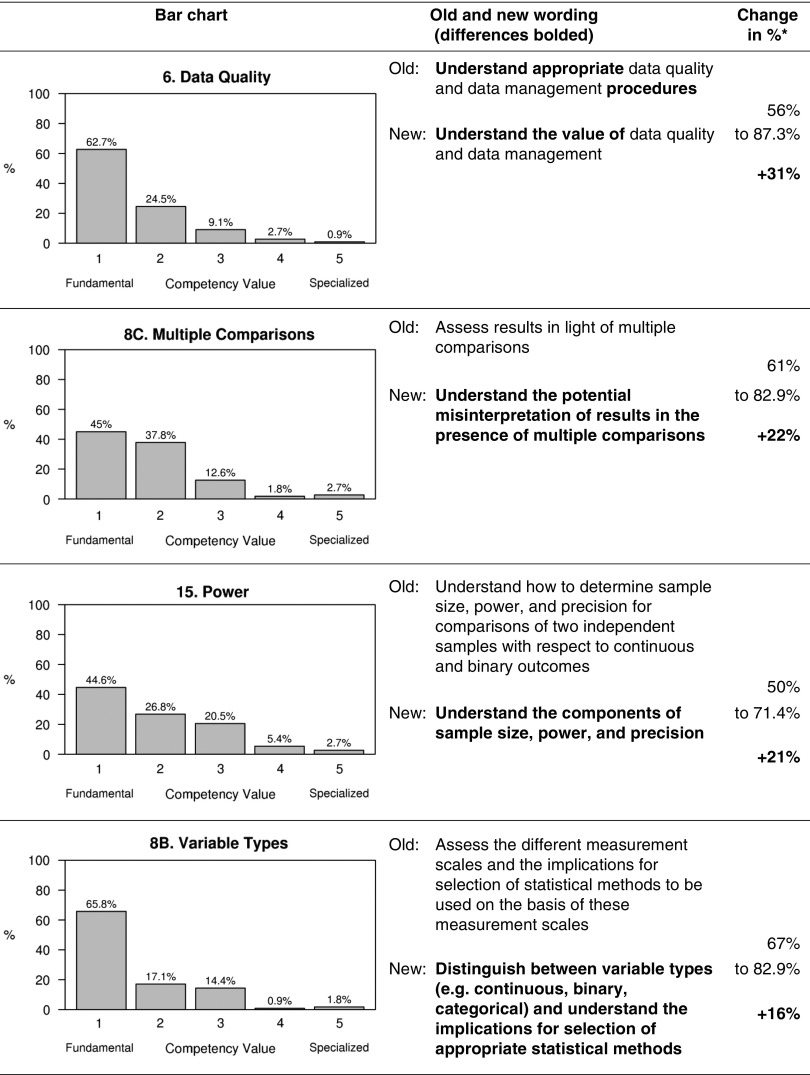
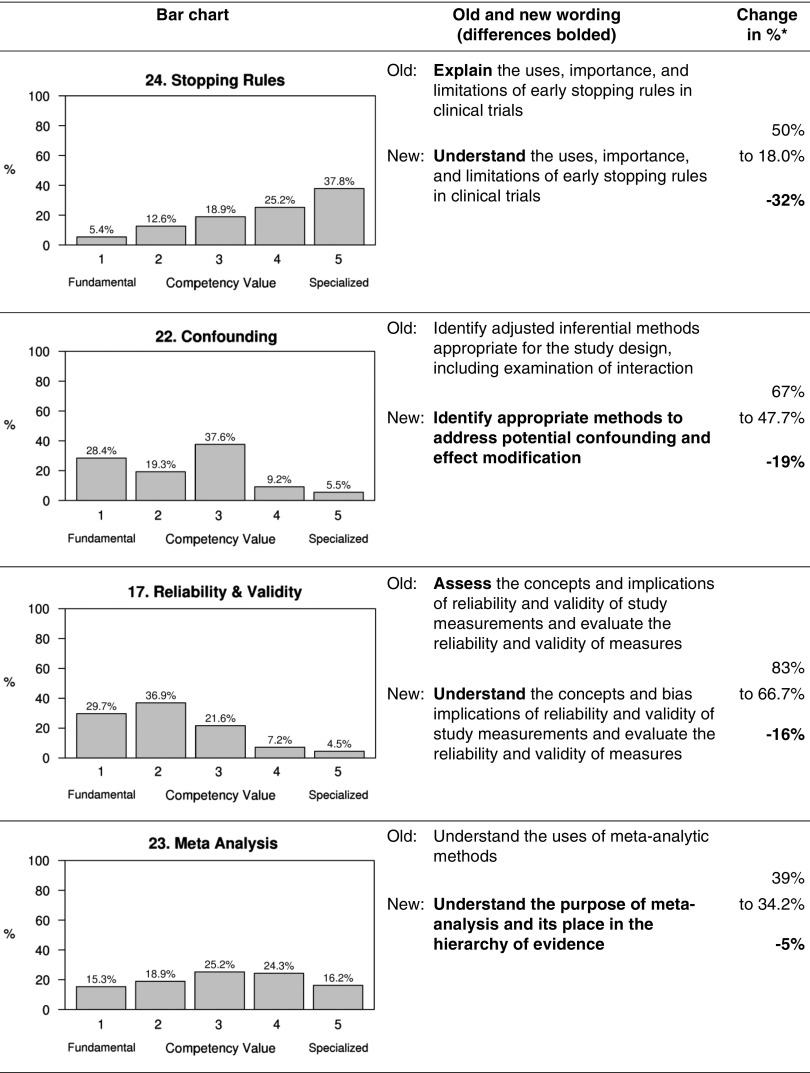
There were 112 responses. Nineteen of 24 competencies were fundamental. The competencies considered most fundamental were assessing sources of bias and variation (95%), recognizing one's own limits with regard to statistics (93%), identifying the strengths, and limitations of study designs (93%). The least endorsed items were meta-analysis (34%) and stopping rules (18%).
We have identified the statistical competencies needed by all medical researchers. These competencies should be considered when designing statistical curricula for medical researchers and should inform which topics are taught in graduate programs and evidence-based medicine courses where learners need to read and understand the medical research literature.
医学研究人员具备统计学知识变得越来越重要,但在转化研究中,每种统计能力所需的知识水平并不相同。统计能力的范围可以从“基础”(所有人都必需)到“专业”(只有部分人需要)。在本研究中,我们确定了每种能力是基础能力还是专业能力的程度。
我们对4个专业组织的成员进行了调查,目标是在过去5年中向医学研究学习者教授统计学的受过博士训练的生物统计学家和流行病学家。受访者以“基础”和“专业”为锚点,在5点李克特量表上对24种教育能力进行评分。
共收到112份回复。24种能力中有19种是基础能力。被认为最基础的能力是评估偏差和变异的来源(95%)、认识自己在统计学方面的局限性(93%)、识别研究设计的优势和局限性(93%)。认可度最低的项目是荟萃分析(34%)和停止规则(18%)。
我们已经确定了所有医学研究人员所需的统计能力。在为医学研究人员设计统计课程时应考虑这些能力,并且这些能力应告知在研究生课程和循证医学课程中教授哪些主题,在这些课程中学习者需要阅读和理解医学研究文献。