Ye Fengchun
Department of Microbiology and Molecular Biology, School of Medicine, Case Western Reserve University, 10900 Euclid avenue, Cleveland, 44106 Ohio, USA.
Inflamm Cell Signal. 2017;4(3). Epub 2017 Oct 17.
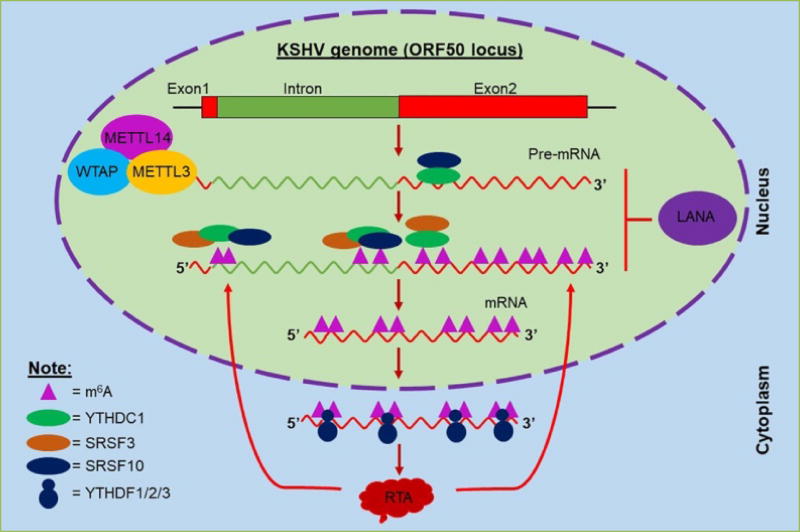
Latency is a hallmark of all herpesviruses, during which the viral genomes are silenced through DNA methylation and suppressive histone modifications. When latent herpesviruses reactivate to undergo productive lytic replication, the suppressive epigenetic marks are replaced with active ones to allow for transcription of viral genes. Interestingly, by using Kaposi's sarcoma-associated herpesvirus (KSHV) as a model, we recently demonstrated that the newly transcribed viral RNAs are also subjected to post-transcriptional N-adenosine methylation (mA). Blockade of this post-transcriptional event abolishes viral protein expression and halts virion production. We found that mA modification controls RNA splicing, stability, and protein translation to regulate viral lytic gene expression and replication. Thus, our finding for the first time reveals a critical role of this epitranscriptomic mechanism in the control of herpesviral replication, which shall shed lights on development of novel strategies for the control of herpesviral infection.
潜伏期是所有疱疹病毒的一个特征,在此期间,病毒基因组通过DNA甲基化和抑制性组蛋白修饰而沉默。当潜伏的疱疹病毒重新激活以进行 productive 裂解复制时,抑制性表观遗传标记被活性标记取代,以允许病毒基因转录。有趣的是,通过使用卡波西肉瘤相关疱疹病毒(KSHV)作为模型,我们最近证明新转录的病毒RNA也会发生转录后N-腺苷甲基化(mA)。阻断这一转录后事件会消除病毒蛋白表达并阻止病毒粒子产生。我们发现mA修饰控制RNA剪接、稳定性和蛋白质翻译,以调节病毒裂解基因表达和复制。因此,我们的发现首次揭示了这种表观转录组学机制在控制疱疹病毒复制中的关键作用,这将为开发控制疱疹病毒感染的新策略提供线索。