Toltz Allison, Hoesl Michaela, Schuemann Jan, Seuntjens Jan, Lu Hsiao-Ming, Paganetti Harald
Department of Physics, McGill University, MUHC Cedars Cancer Centre DS1.7137, Montreal, QC, Canada.
Computational Clinical Medicine, Medical Faculty Mannheim, Heidelberg University, Mannheim, Germany.
J Appl Clin Med Phys. 2017 Nov;18(6):200-205. doi: 10.1002/acm2.12210. Epub 2017 Oct 29.
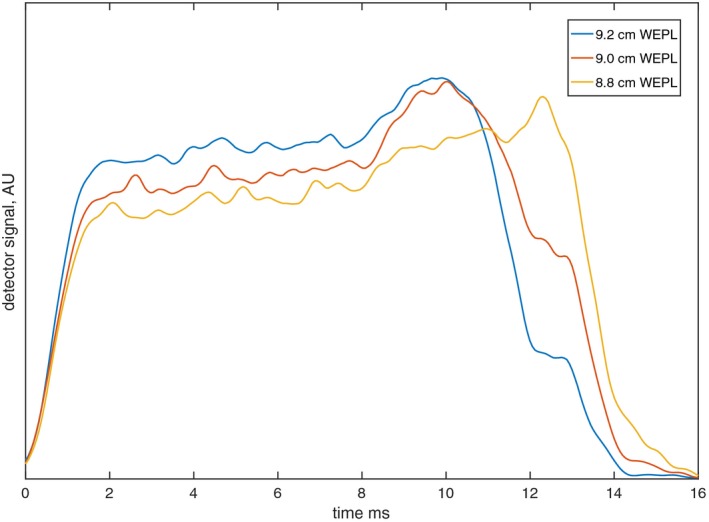
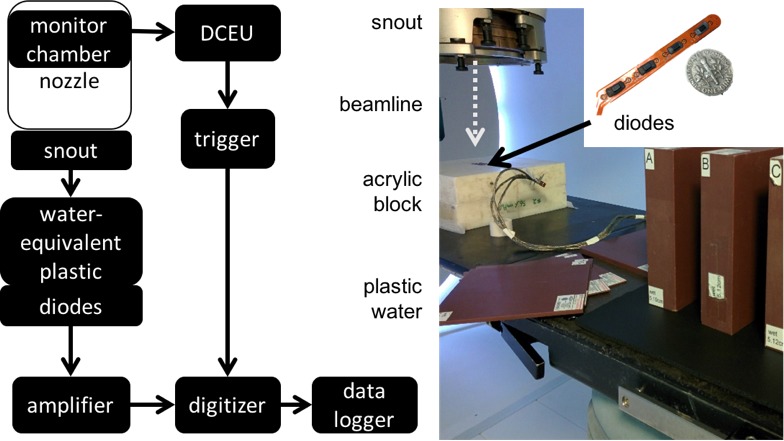
Our group previously introduced an in vivo proton range verification methodology in which a silicon diode array system is used to correlate the dose rate profile per range modulation wheel cycle of the detector signal to the water-equivalent path length (WEPL) for passively scattered proton beam delivery. The implementation of this system requires a set of calibration data to establish a beam-specific response to WEPL fit for the selected 'scout' beam (a 1 cm overshoot of the predicted detector depth with a dose of 4 cGy) in water-equivalent plastic. This necessitates a separate set of measurements for every 'scout' beam that may be appropriate to the clinical case. The current study demonstrates the use of Monte Carlo simulations for calibration of the time-resolved diode dosimetry technique.
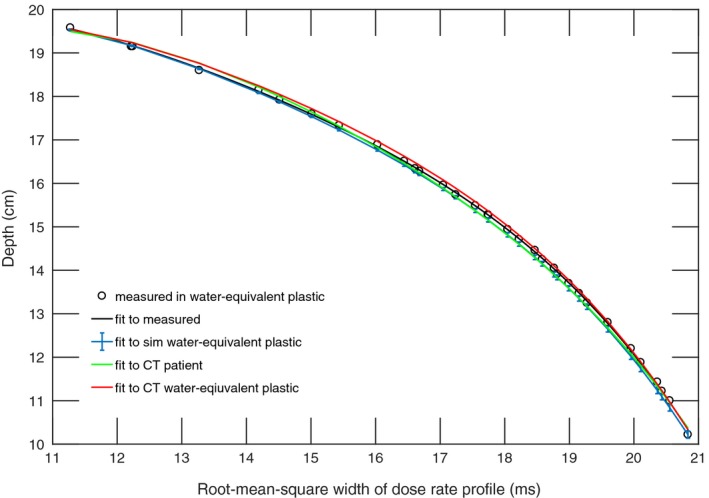
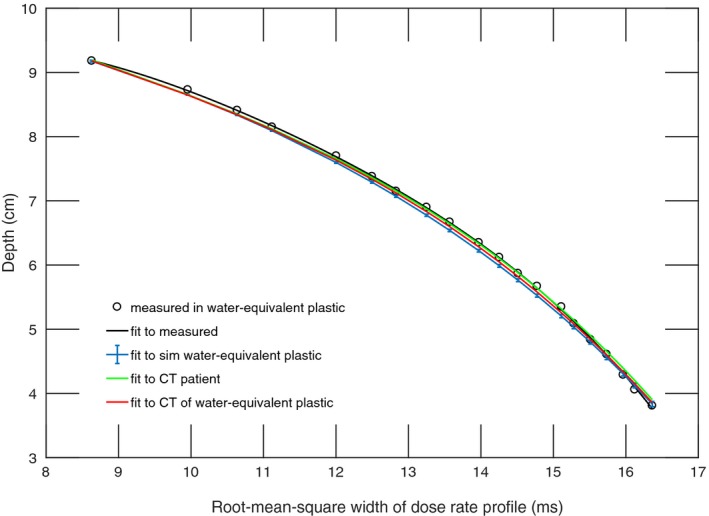
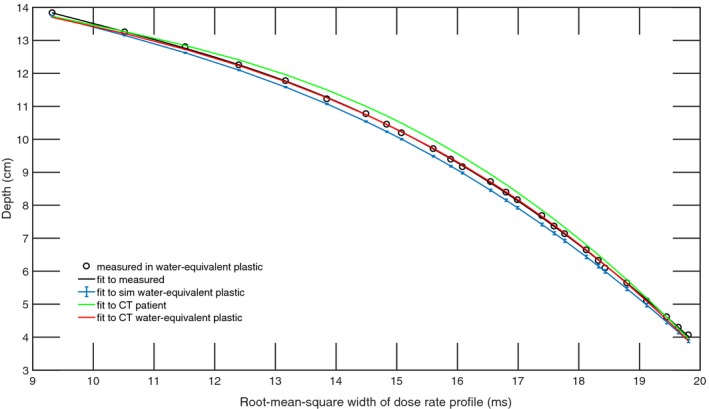
Measurements for three 'scout' beams were compared against simulated detector response with Monte Carlo methods using the Tool for Particle Simulation (TOPAS). The 'scout' beams were then applied in the simulation environment to simulated water-equivalent plastic, a CT of water-equivalent plastic, and a patient CT data set to assess uncertainty.
Simulated detector response in water-equivalent plastic was validated against measurements for 'scout' spread out Bragg peaks of range 10 cm, 15 cm, and 21 cm (168 MeV, 177 MeV, and 210 MeV) to within 3.4 mm for all beams, and to within 1 mm in the region where the detector is expected to lie.
Feasibility has been shown for performing the calibration of the detector response for three 'scout' beams through simulation for the time-resolved diode dosimetry technique in passive scattered proton delivery.
我们的团队之前介绍了一种体内质子射程验证方法,其中使用硅二极管阵列系统将探测器信号每个射程调制轮周期的剂量率分布与被动散射质子束传输的水等效路径长度(WEPL)相关联。该系统的实施需要一组校准数据,以建立针对所选“侦察”束(预测探测器深度超出1厘米,剂量为4 cGy)在水等效塑料中的特定束对WEPL拟合的响应。这就需要针对每个可能适用于临床病例的“侦察”束进行单独的测量。当前研究展示了使用蒙特卡罗模拟对时间分辨二极管剂量测定技术进行校准。
使用粒子模拟工具(TOPAS)通过蒙特卡罗方法将三个“侦察”束的测量结果与模拟探测器响应进行比较。然后将“侦察”束应用于模拟环境中的模拟水等效塑料、水等效塑料的CT以及患者CT数据集,以评估不确定性。
对于射程为10厘米、15厘米和21厘米(168兆电子伏特、177兆电子伏特和210兆电子伏特)的“侦察”扩展布拉格峰,在水等效塑料中的模拟探测器响应与测量结果的验证在所有束的3.4毫米范围内,在探测器预期所在区域内为1毫米以内。
已证明通过模拟对被动散射质子传输中的时间分辨二极管剂量测定技术的三个“侦察”束的探测器响应进行校准是可行的。