Department of Orthopaedic Surgery, The University of Iowa Hospitals & Clinics, Iowa City, IA, USA.
Department of Epidemiology, College of Public Health, The University of Iowa, Iowa City, IA, USA.
J Bone Miner Res. 2018 Apr;33(4):580-588. doi: 10.1002/jbmr.3325. Epub 2017 Nov 27.
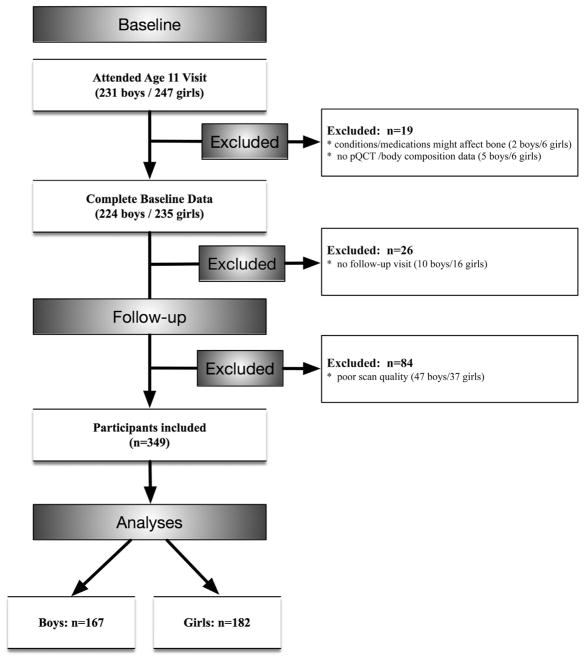
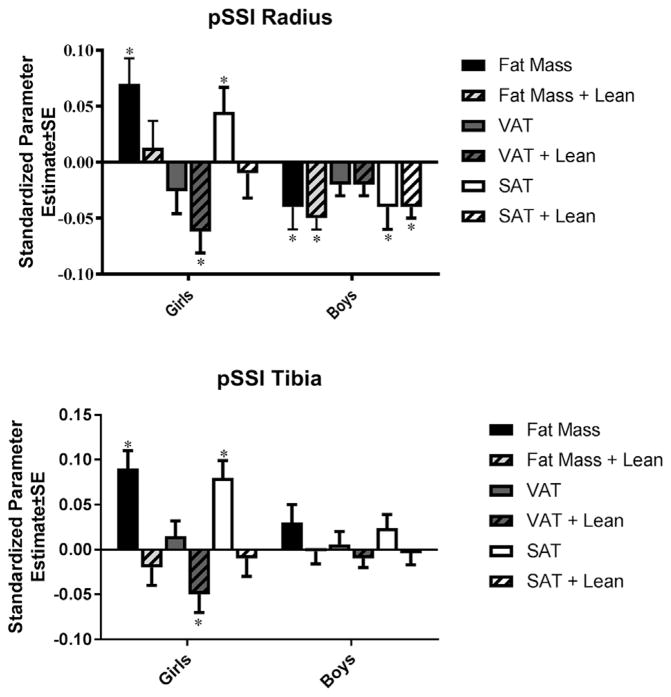
This study evaluated the longitudinal relationships among visceral adipose tissue (VAT), subcutaneous adipose tissue (SAT), and peripheral bone strength during adolescence. Fat and lean mass, VAT and SAT area, and android/gynoid (A/G) ratio were estimated with DXA. Our main outcome was strength-strain index (SSI), an indicator of peripheral bone strength estimated by pQCT at the radius and tibia. Sex-specific analyses evaluated the longitudinal bone-fat relationship from ages 11 to 19 years with linear mixed models using biological age as the time variable and adjusted for limb length and lean mass in 182 girls and 167 boys. Variables were standardized (mean = 0, SD = 1) prior to model fitting and results shown are parameter estimates ± SE. Fat mass and SAT were positively associated with SSI (radius: 0.07 ± 0.02, p = 0.003 and 0.05 ± 0.02, 0.041, respectively; tibia: 0.09 ± 0.02, p < 0.001 and 0.08 ± 0.02, p < 0.001, respectively) prior to, but not following adjustment for lean mass in girls. In contrast, fat mass and SAT were negatively associated with radial SSI, both before and after adjustment for lean mass in boys (fat mass: -0.05 ± 0.01, p = 0.001; SAT: -0.04 ± 0.01, p = 0.004). In full models, negative associations were limited to VAT in girls and included radial (-0.06 ± 0.02, p = 0.001) and tibial SSI (-0.04 ± 0.02, p = 0.033). For boys, there were no significant associations present between VAT and SSI at the radius or tibia. In analyses limited to obese participants, an A/G ratio was not significantly associated with SSI in girls, but was negatively associated with radial SSI regardless of adjustment for lean mass in boys (-0.06 ± 0.02, p = 0.018). These results that show a negative relationship between peripheral bone strength and VAT in girls, but greater total and central adiposity in boys, suggest these factors play a role in adequate acquisition of bone strength during adolescence. © 2017 American Society for Bone and Mineral Research.
这项研究评估了青少年时期内脏脂肪组织(VAT)、皮下脂肪组织(SAT)和外周骨强度之间的纵向关系。使用 DXA 估计脂肪和瘦肉量、VAT 和 SAT 区域以及安卓/女性(A/G)比例。我们的主要结果是强度应变指数(SSI),这是通过 pQCT 在桡骨和胫骨上估计的外周骨强度的指标。性别特异性分析使用线性混合模型评估了从 11 岁到 19 岁的纵向骨-脂肪关系,将生物学年龄作为时间变量,并根据 182 名女孩和 167 名男孩的肢体长度和瘦肉量进行了调整。在模型拟合之前,对变量进行了标准化(均值=0,标准差=1),结果显示为参数估计值±SE。脂肪量和 SAT 与 SSI 呈正相关(桡骨:0.07±0.02,p=0.003 和 0.05±0.02,0.041,分别;胫骨:0.09±0.02,p<0.001 和 0.08±0.02,p<0.001,分别),但在女孩的瘦肉量调整之前,而不是之后。相比之下,脂肪量和 SAT 与男孩的桡骨 SSI 呈负相关,无论是在调整瘦肉量之前还是之后(脂肪量:-0.05±0.01,p=0.001;SAT:-0.04±0.01,p=0.004)。在全模型中,与 SAT 相比,女孩的 VAT 与 SSI 之间的负相关仅局限于 VAT,包括桡骨(-0.06±0.02,p=0.001)和胫骨 SSI(-0.04±0.02,p=0.033)。对于男孩,在桡骨或胫骨处,VAT 与 SSI 之间没有显著的相关性。在仅限于肥胖参与者的分析中,A/G 比值与女孩的 SSI 没有显著相关性,但与男孩的桡骨 SSI 呈负相关,无论是否调整瘦肉量(-0.06±0.02,p=0.018)。这些结果表明,女孩的外周骨强度与 VAT 呈负相关,而男孩的总脂肪量和中心性肥胖程度更大,这表明这些因素在青少年时期适当获得骨强度方面发挥了作用。©2017 年美国骨骼与矿物质研究协会。