Torabi Alireza, Ordonez Javier, Su Brenda Bin, Palmer Laura, Mao Chunxiang, Lara Katherine E, Rubin Lewis P, Xu Chun
Department of Pathology, TTUHSC, El Paso 79905, TX, USA.
Department of Biomedical Science, TTUHSC, El Paso 79905, TX, USA.
Med Sci (Basel). 2016 Aug 3;4(3):12. doi: 10.3390/medsci4030012.
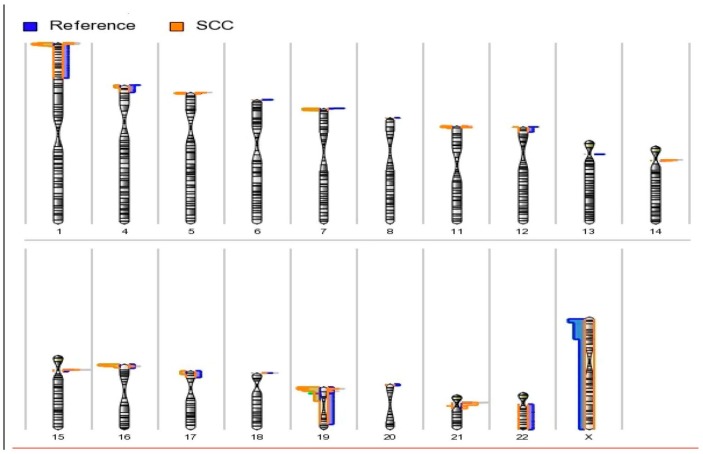
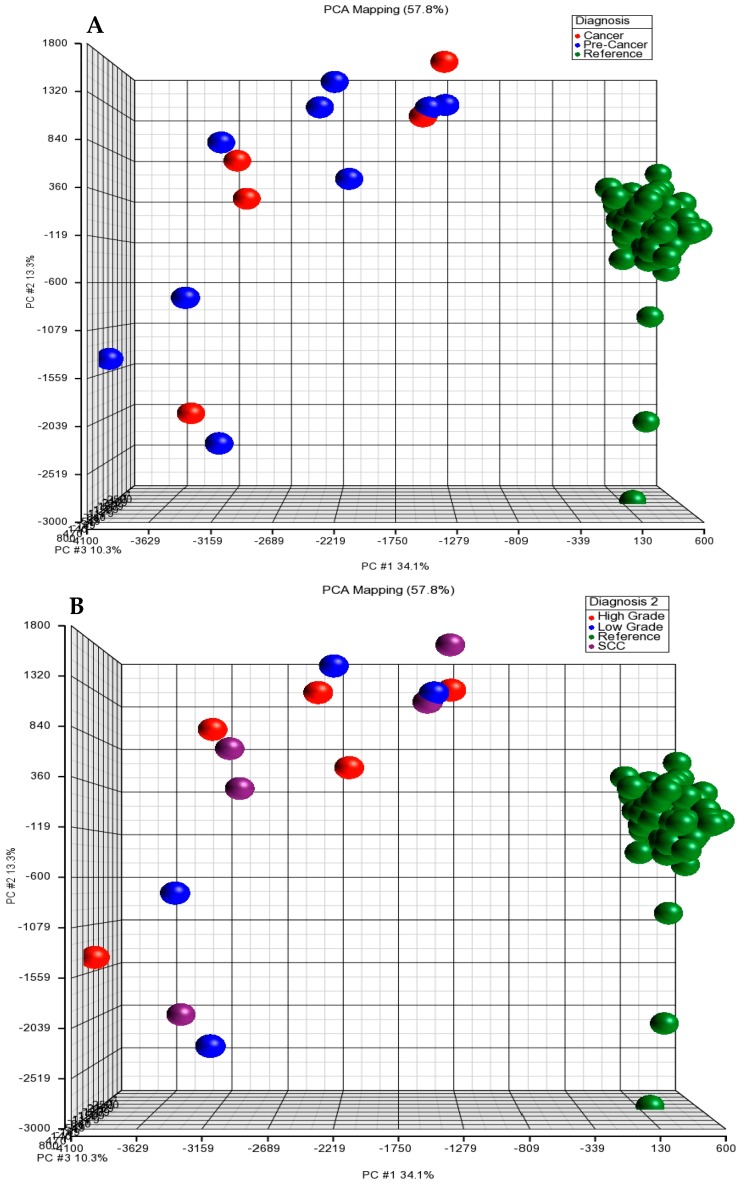
Cervical cancer affects millions of Americans, but the rate for cervical cancer in the Mexican American is approximately twice that for non-Mexican Americans. The etiologies of cervical cancer are still not fully understood. A number of somatic mutations, including several copy number alterations (CNAs), have been identified in the pathogenesis of cervical carcinomas in non-Mexican Americans. Thus, the purpose of this study was to investigate CNAs in association with cervical cancer in the Mexican American population. We conducted a pilot study of genome-wide CNA analysis using 2.5 million markers in four diagnostic groups: reference ( = 125), low grade dysplasia (cervical intraepithelial neoplasia (CIN)-I, = 4), high grade dysplasia (CIN-II and -III, = 5) and invasive carcinoma (squamous cell carcinoma (SCC), = 5) followed by data analyses using Partek. We observed a statistically-significant difference of CNA burden between case and reference groups of different sizes (>100 kb, 10-100 kb and 1-10 kb) of CNAs that included deletions and amplifications, e.g., a statistically-significant difference of >100 kb deletions was observed between the reference (6.6%) and pre-cancer and cancer (91.3%) groups. Recurrent aberrations of 98 CNA regions were also identified in cases only. However, none of the CNAs have an impact on cancer progression. A total of 32 CNA regions identified contained tumor suppressor genes and oncogenes. Moreover, the pathway analysis revealed endometrial cancer and estrogen signaling pathways associated with this cancer ( < 0.05) using Kyoto Encyclopedia of Genes and Genomes (KEGG). This is the first report of CNAs identified for cervical cancer in the U.S. Latino population using high density markers. We are aware of the small sample size in the study. Thus, additional studies with a larger sample are needed to confirm the current findings.
宫颈癌影响着数百万美国人,但墨西哥裔美国人的宫颈癌发病率约是非墨西哥裔美国人的两倍。宫颈癌的病因仍未完全明确。在非墨西哥裔美国人宫颈癌的发病机制中,已发现了一些体细胞突变,包括若干拷贝数改变(CNA)。因此,本研究旨在调查墨西哥裔美国人群中与宫颈癌相关的CNA。我们使用250万个标记对四个诊断组进行了全基因组CNA分析的初步研究:对照组(n = 125)、低级别发育异常(宫颈上皮内瘤变(CIN)-I,n = 4)、高级别发育异常(CIN-II和-III,n = 5)以及浸润性癌(鳞状细胞癌(SCC),n = 5),随后使用Partek进行数据分析。我们观察到不同大小(>100 kb、10 - 100 kb和1 - 10 kb)的CNA(包括缺失和扩增)在病例组和对照组之间的CNA负担存在统计学显著差异,例如,在对照组(6.6%)与癌前病变和癌症组(91.3%)之间观察到>100 kb缺失存在统计学显著差异。仅在病例组中还鉴定出98个CNA区域的复发性畸变。然而,这些CNA均未对癌症进展产生影响。共鉴定出32个包含肿瘤抑制基因和癌基因的CNA区域。此外,通路分析使用京都基因与基因组百科全书(KEGG)揭示了与该癌症相关的子宫内膜癌和雌激素信号通路(P < 0.05)。这是首次使用高密度标记在美国拉丁裔人群中鉴定出宫颈癌相关CNA的报告。我们意识到该研究样本量较小。因此,需要进行更多样本量更大的研究来证实当前的发现。