Section for Microbial Ecology and Biotechnology, Department of Plant and Environmental Sciences, University of Copenhagen, Thorvaldsensvej 40, Frederiksberg C, Denmark.
Programa Institucional de Fomento a la Investigación, Desarrollo e Innovación, Universidad Tecnológica Metropolitana, Ignacio Valdivieso 2409, San Joaquín, Santiago, Chile.
BMC Microbiol. 2017 Oct 30;17(1):211. doi: 10.1186/s12866-017-1119-y.
Microbial degradation of phenoxy acid (PA) herbicides in agricultural soils is important to minimize herbicide leaching to groundwater reservoirs. Degradation may, however, be hampered by exposure of the degrader bacteria to toxic metals as copper (Cu) in the soil environment. Exposure to Cu leads to accumulation of intracellular reactive oxygen species (ROS) in some bacteria, but it is not known how Cu-derived ROS and an ensuing oxidative stress affect the degradation of PA herbicides. Based on the previously proposed paradigm that bacteria deal with environmental stress before they engage in biodegradation, we studied how the degradation of the PA herbicide 2-methyl-4-chlorophenoxyacetic acid (MCPA) by the model PA degrader Cupriavidus pinatubonensis AEO106 was affected by Cu exposure.
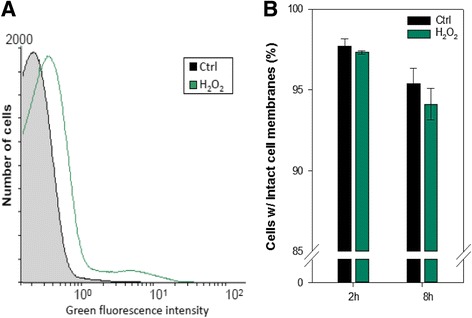
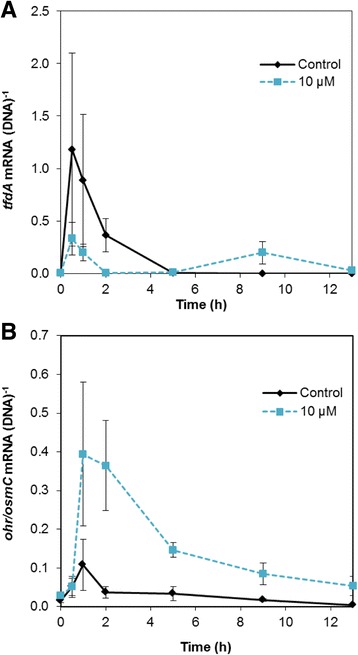
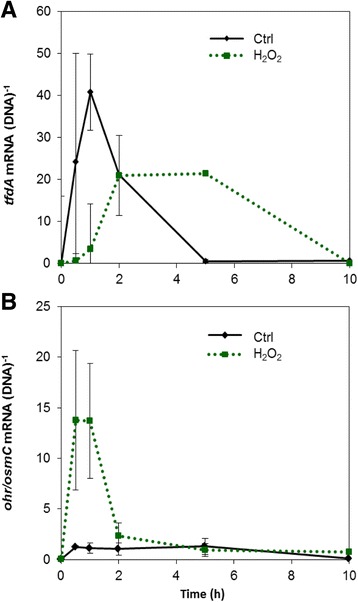
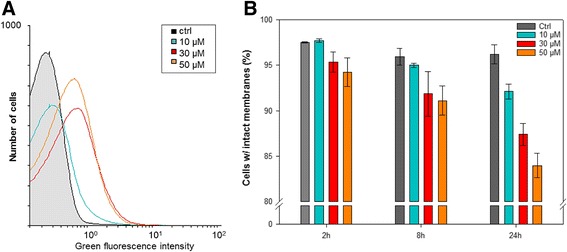
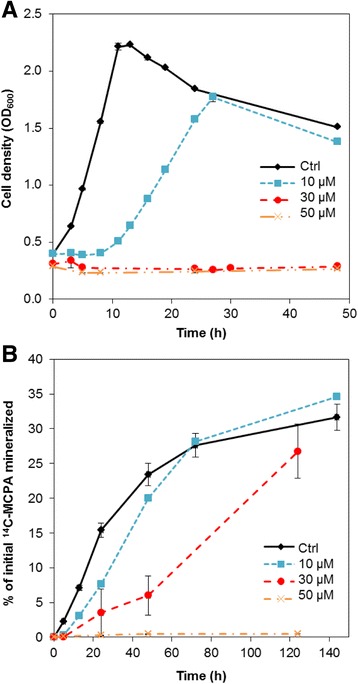
Exposure of C. pinatubonensis in batch culture to sublethal concentrations of Cu increased accumulation of ROS measured by the oxidant sensing probe 2,7-dichlorodihydrofluorescein diacetate and flow cytometry, and resulted in upregulation of a gene encoding a protein belong to the Ohr/OsmC protein family. The ohr/osmC gene was also highly induced by HO exposure suggesting that it is involved in the oxidative stress response in C. pinatubonensis. The increased ROS accumulation and increased expression of the oxidative stress defense coincided with a delay in the catabolic performance, since both expression of the catabolic tfdA gene and MCPA mineralization were delayed compared to unexposed control cells.
The current study suggests that Cu-induced ROS accumulation in C. pinatubonensis activates a stress response involving the product of the ohr/osmC gene. Further, the stress response is launched before induction of the catabolic tfdA gene and mineralization occurs.
在农业土壤中,微生物对苯氧羧酸(PA)除草剂的降解对于将除草剂淋洗到地下水水库的程度最小化非常重要。然而,降解可能会因降解细菌在土壤环境中暴露于有毒金属如铜(Cu)而受到阻碍。暴露于 Cu 会导致一些细菌细胞内活性氧物质(ROS)的积累,但尚不清楚 Cu 衍生的 ROS 和随之而来的氧化应激如何影响 PA 除草剂的降解。基于先前提出的细菌在进行生物降解之前应对环境应激的范式,我们研究了模型 PA 降解菌 Cupriavidus pinatubonensis AEO106 对 2-甲基-4-氯苯氧乙酸(MCPA)的降解如何受到 Cu 暴露的影响。
在分批培养中,C. pinatubonensis 暴露于亚致死浓度的 Cu 会增加氧化剂感应探针 2,7-二氯二氢荧光素二乙酸酯和流式细胞术测量的 ROS 积累,并导致编码属于 Ohr/OsmC 蛋白家族的蛋白质的基因上调。Ohr/osmC 基因也被 HO 暴露高度诱导,表明它参与了 C. pinatubonensis 的氧化应激反应。ROS 积累的增加和氧化应激防御的表达增加与代谢性能的延迟同时发生,因为与未暴露的对照细胞相比,代谢 tfdA 基因的表达和 MCPA 的矿化都被延迟。
本研究表明,C. pinatubonensis 中 Cu 诱导的 ROS 积累激活了涉及 ohr/osmC 基因产物的应激反应。此外,应激反应是在诱导代谢 tfdA 基因和矿化之前启动的。