Howard Hughes Medical Institute, MIT Biology, Whitehead Institute for Biomedical Research, 9 Cambridge Center, Cambridge, MA, 02142, USA.
Department of Organismic and Evolutionary Biology, Harvard University, Cambridge, MA, 02138, USA.
Nat Commun. 2017 Oct 30;8(1):1260. doi: 10.1038/s41467-017-01148-5.
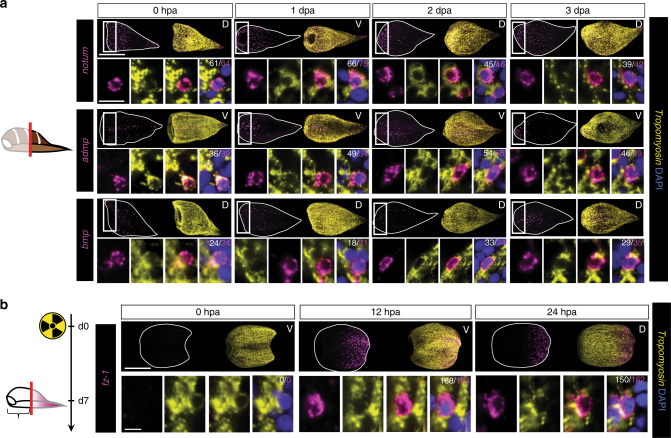
Positional information is required for animal regeneration, yet how it is harbored in adult tissues is poorly understood. In planarians, positional control genes (PCGs) control regeneration outcomes and are regionally expressed predominately in the musculature. Acoels are early diverging bilaterally symmetric animals, having separated from other bilaterians > 550 million years ago. Here, we find that PCGs in the acoel Hofstenia miamia are expressed together and specifically in a primary differentiated cell type: muscle. The vast majority of Hofstenia muscle cells in regions tested express PCGs, suggesting positional information is a major feature of muscle. PCG expression domains are dynamic in muscle after injury, consistent with known PCG roles in guiding regeneration. These data demonstrate an instructive positional role for Hofstenia muscle and this similarity with planarians suggests mesodermal muscle originated at the base of the Bilateria not only for contraction, but also as the source of positional information guiding regeneration.
位置信息对于动物再生是必需的,但它在成年组织中是如何被储存的还知之甚少。在水螅中,位置控制基因(PCG)控制再生结果,并主要在肌肉中呈区域性表达。粘体动物是早期分化的两侧对称动物,它们与其他两侧对称动物分离已有超过 5.5 亿年的历史。在这里,我们发现,粘体动物 Hofstenia miamia 中的 PCG 一起表达,并且特异性地表达在一种主要分化的细胞类型中:肌肉。在所测试的 Hofstenia 肌肉的绝大多数细胞中都表达了 PCG,这表明位置信息是肌肉的主要特征。PCG 表达域在肌肉损伤后是动态的,这与已知的 PCG 在指导再生中的作用一致。这些数据表明 Hofstenia 肌肉具有指导位置的作用,这种与水螅的相似性表明中胚层肌肉不仅起源于两侧对称动物的基部,用于收缩,而且还是指导再生的位置信息的来源。