Gonçalo Moniz Institut, Oswaldo Cruz Foundation (FIOCRUZ-BA), 40296-710, Salvador, BA, Brazil.
Center of Biological Sciences and Health, Federal University of Western Bahia (UFOB), 47808-021, Barreiras, BA, Brazil.
Sci Rep. 2017 Oct 30;7(1):14321. doi: 10.1038/s41598-017-14229-8.
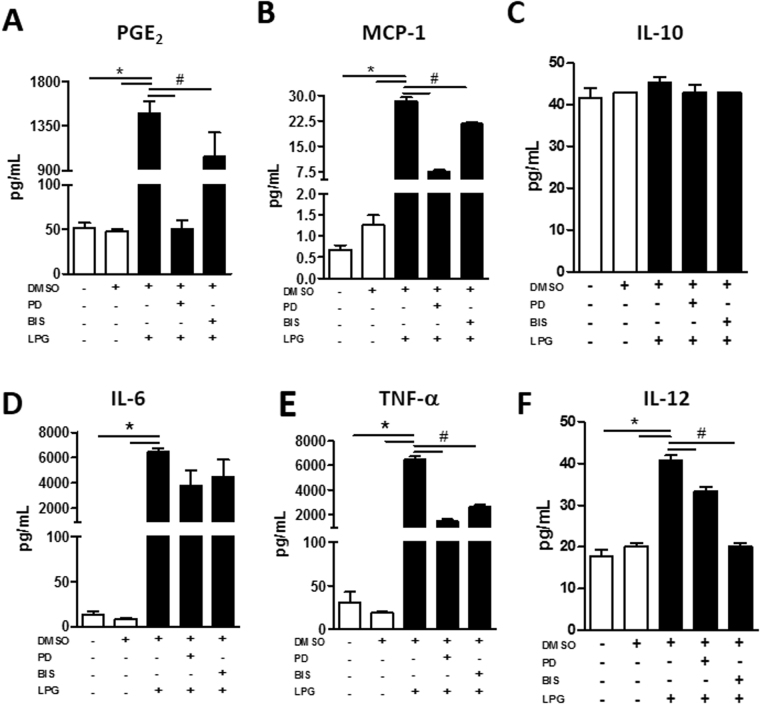
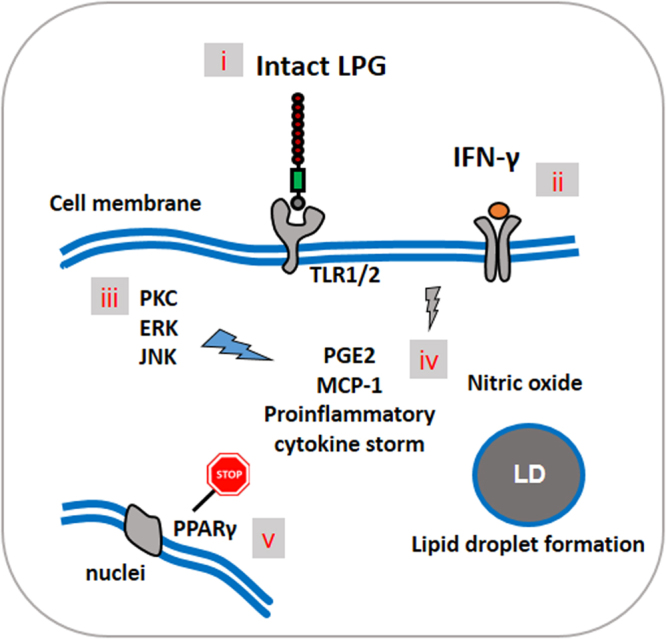
Lipophosphoglycan (LPG) is a key virulence factor expressed on the surfaces of Leishmania promastigotes. Although LPG is known to activate macrophages, the underlying mechanisms resulting in the production of prostaglandin E (PGE) via signaling pathways remain unknown. Here, the inflammatory response arising from stimulation by Leishmania infantum LPG and/or its lipid and glycan motifs was evaluated with regard to PGE induction. Intact LPG, but not its glycan and lipid moieties, induced a range of proinflammatory responses, including PGE and nitric oxide (NO) release, increased lipid droplet formation, and iNOS and COX2 expression. LPG also induced ERK-1/2 and JNK phosphorylation in macrophages, in addition to the release of PGE, MCP-1, IL-6, TNF-α and IL-12p70, but not IL-10. Pharmacological inhibition of ERK1/2 and PKC affected PGE and cytokine production. Moreover, treatment with rosiglitazone, an agonist of peroxisome proliferator-activated receptor gamma (PPAR-γ), also modulated the release of PGE and other proinflammatory mediators. Finally, we determined that LPG-induced PPAR-γ signaling occurred via TLR1/2. Taken together, these results reinforce the role played by L. infantum-derived LPG in the proinflammatory response seen in Leishmania infection.
脂磷壁酸 (LPG) 是一种在利什曼原虫前鞭毛体表面表达的关键毒力因子。尽管已知 LPG 能够激活巨噬细胞,但导致通过信号通路产生前列腺素 E (PGE) 的潜在机制尚不清楚。在这里,评估了由婴儿利什曼原虫 LPG 及其脂质和糖基基序刺激引起的炎症反应,以诱导 PGE。完整的 LPG,但不是其糖基和脂质部分,诱导了一系列促炎反应,包括 PGE 和一氧化氮 (NO) 的释放、脂滴形成的增加、诱导型一氧化氮合酶 (iNOS) 和环氧化酶 2 (COX2) 的表达。LPG 还诱导巨噬细胞中 ERK-1/2 和 JNK 的磷酸化,除了 PGE、MCP-1、IL-6、TNF-α 和 IL-12p70 的释放外,还释放了 IL-10。ERK1/2 和 PKC 的药理学抑制影响 PGE 和细胞因子的产生。此外,用罗格列酮(过氧化物酶体增殖物激活受体 γ (PPAR-γ) 的激动剂)治疗也调节了 PGE 和其他促炎介质的释放。最后,我们确定 LPG 诱导的 PPAR-γ 信号通过 TLR1/2 发生。总之,这些结果加强了婴儿利什曼原虫衍生的 LPG 在利什曼原虫感染中观察到的促炎反应中的作用。