Dipartimento di Fisica, Sapienza Università di Roma, Piazzale Aldo Moro 5, I-00185, Roma, Italy.
Istituto di Fotonica e Nanotecnologie, Consiglio Nazionale delle Ricerche (IFN-CNR), Piazza Leonardo da Vinci, 32, I-20133, Milano, Italy.
Sci Rep. 2017 Oct 30;7(1):14316. doi: 10.1038/s41598-017-14680-7.
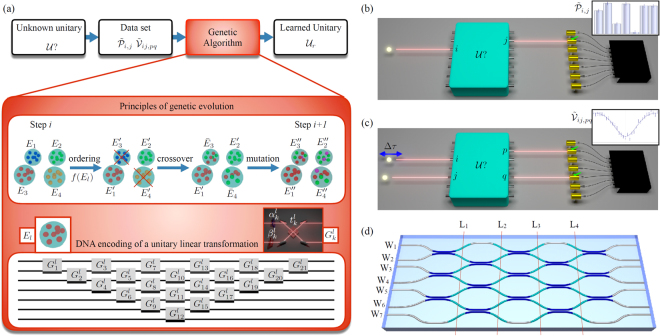
Recent developments in integrated photonics technology are opening the way to the fabrication of complex linear optical interferometers. The application of this platform is ubiquitous in quantum information science, from quantum simulation to quantum metrology, including the quest for quantum supremacy via the boson sampling problem. Within these contexts, the capability to learn efficiently the unitary operation of the implemented interferometers becomes a crucial requirement. In this letter we develop a reconstruction algorithm based on a genetic approach, which can be adopted as a tool to characterize an unknown linear optical network. We report an experimental test of the described method by performing the reconstruction of a 7-mode interferometer implemented via the femtosecond laser writing technique. Further applications of genetic approaches can be found in other contexts, such as quantum metrology or learning unknown general Hamiltonian evolutions.
近年来,集成光子学技术的发展为制造复杂的线性光学干涉仪开辟了道路。该平台的应用在量子信息科学中无处不在,从量子模拟到量子计量学,包括通过玻色子抽样问题寻求量子优势。在这些背景下,有效地学习所实现干涉仪的幺正操作的能力成为一个关键要求。在这封信中,我们开发了一种基于遗传方法的重建算法,该算法可作为一种工具来表征未知的线性光学网络。我们通过使用飞秒激光写入技术实现的 7 模式干涉仪的重建实验来验证了该方法。遗传方法的进一步应用可以在其他领域找到,例如量子计量学或学习未知的一般哈密顿演化。