Koshy Benson, Gopal Das C M, Rajashekarachar Yogananda, Bharathi D R, Hosur Shashank S
Departments of Pharmacy Practice, SJMCP, Chitradurga, Karnataka, India.
Department of Psychiatry, BMCH and RC, Chitradurga, Karnataka, India.
Indian J Psychiatry. 2017 Jul-Sep;59(3):333-340. doi: 10.4103/psychiatry.IndianJPsychiatry_126_16.
The concept of quality of life (QoL) is becoming an important measure of the impact of psychiatric disorders. It is natural that once patient achieves remission, QoL would improve, but very few studies are conducted under this phase. This study compares the differences in QoL in remitted patients with monotherapy and polypharmacy.
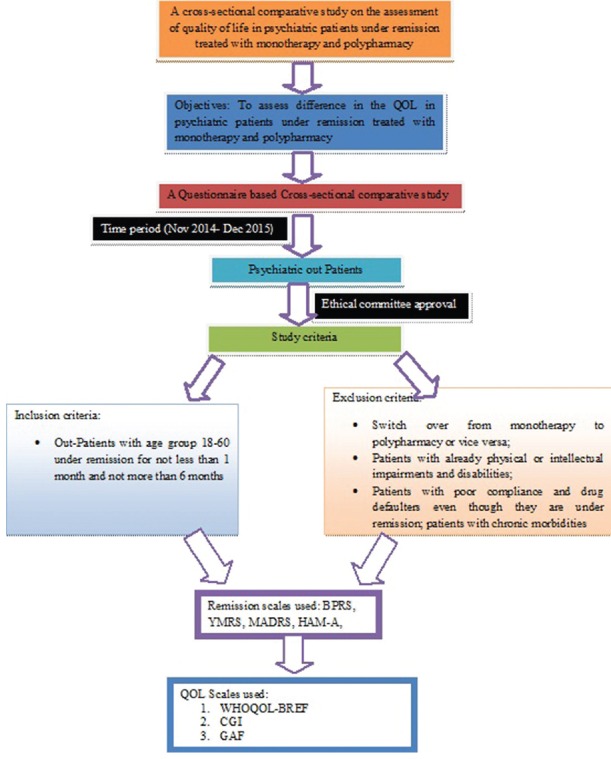
The aim of this study is to compare the QoL between psychiatric patients in remission treated with monotherapy and polypharmacy.
It is a questionnaire based cross-sectional comparative study.
This study included outpatients under remission who come for follow-up in psychiatric department. Semi-structured data collection form was used. Remission was confirmed using suitable scales, and QoL was assessed using the World Health Organization quality of life-Brief (WHOQOL-BREF) scale. Clinical Global Impression (CGI) and Global Assessment of Functioning (GAF) were applied to understand the overall improvement and functioning levels.
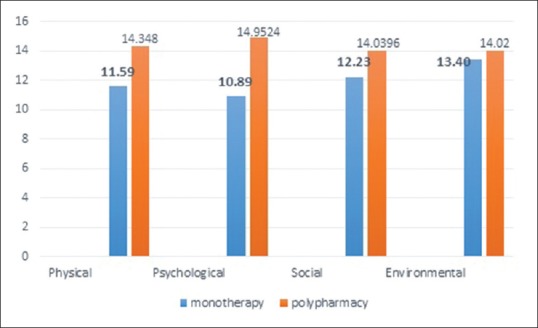
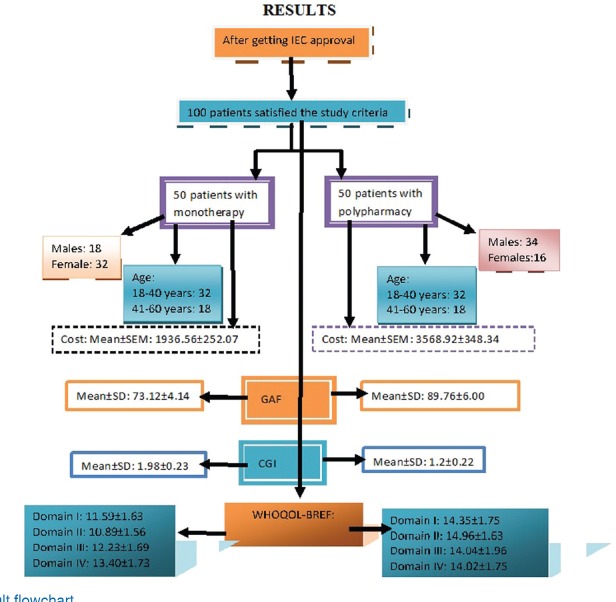
Out of the total 100 patients enrolled in the study, fifty patients were on monotherapy and fifty patients on polypharmacy. The cost of medication was comparatively high for polypharmacy (Rs. 3568.92 [±348.54]) than monotherapy (Rs. 1936.56 [±252.07]). The QoL in physical, psychological, and social domains was significantly high in patients on polypharmacy rather than monotherapy when assessed using the WHOQOL-BREF scale. Ninety-six percent of monotherapy patients had CGI scores between 1.5 and 2.4 while 74% of polypharmacy patients had scores between 1.0 and 1.5. Ninety-six percent of monotherapy patients had <80 GAF scores while 92% of polypharmacy patients had >80.
Patients treated with polypharmacy had better QoL and also clinical improvement and functioning levels were superior.
生活质量(QoL)的概念正成为衡量精神疾病影响的一项重要指标。患者一旦实现缓解,生活质量自然会改善,但在此阶段进行的研究极少。本研究比较了接受单一疗法和联合药物治疗的缓解期患者在生活质量方面的差异。
本研究的目的是比较接受单一疗法和联合药物治疗的缓解期精神科患者的生活质量。
这是一项基于问卷的横断面比较研究。
本研究纳入了在精神科门诊进行随访的缓解期门诊患者。使用了半结构化数据收集表。使用合适的量表确认缓解情况,并使用世界卫生组织生活质量简表(WHOQOL - BREF)评估生活质量。应用临床总体印象(CGI)和功能总体评估(GAF)来了解总体改善情况和功能水平。
在总共纳入研究的100名患者中,50名患者接受单一疗法,50名患者接受联合药物治疗。联合药物治疗的药物费用(3568.92卢比[±348.54])比单一疗法(1936.56卢比[±252.07])相对较高。使用WHOQOL - BREF量表评估时,联合药物治疗患者在身体、心理和社会领域的生活质量显著高于单一疗法患者。96%的单一疗法患者CGI评分在1.5至2.4之间,而74%的联合药物治疗患者评分在1.0至1.5之间。96%的单一疗法患者GAF评分<80,而92%的联合药物治疗患者GAF评分>80。
接受联合药物治疗的患者生活质量更好,临床改善情况和功能水平也更优。