Wang Ran, An Cuixia, Wang Jincheng, Wang Yumei, Song Mei, Li Na, Chen Yanan, Sun Feifei, Chen Xingshi, Wang Xueyi
Department of Psychiatry, The First Hospital of Hebei Medical University, Shijiazhuang, China.
Mental Health Institute of Hebei Medical University, Shijiazhuang, China.
Front Psychiatry. 2017 Oct 16;8:208. doi: 10.3389/fpsyt.2017.00208. eCollection 2017.
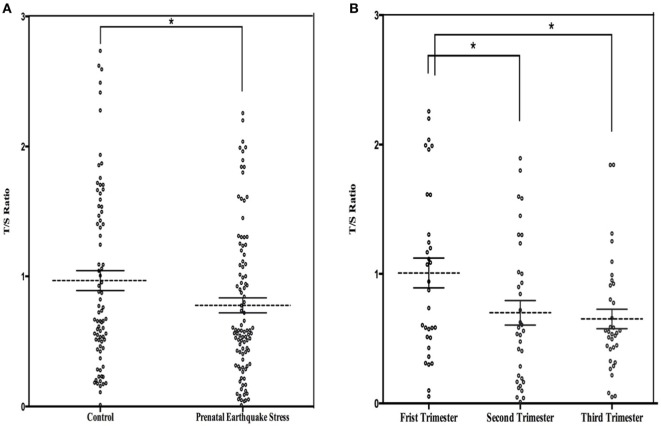
Leukocyte telomere length (LTL) is a predictor of age-related diseases, cancer, and even early mortality. Prenatal stress experience has been suggested to associate with short LTL and an increased disease risk in adult life. The present study aimed to evaluate the 39-year effects of prenatal earthquake stress (PES) exposure on LTL and increased age-related disease risk in adulthood. Here, we compared the LTL in the subjects who were exposed to PES to healthy controls (CN) and evaluated whether stress exposure at different times during pregnancy is associated with a shorter LTL and long-term health conditions in adulthood. LTL was measured in 100 adults who experienced the 1976 7.8 Richter scale Tangshan earthquake of the Hebei province and divided them into first, second, and third trimester groups according to the exposure timing during pregnancy. A total of 80 healthy volunteers from Shijiazhuang of the Hebei province were also assessed for their LTL. The telomere-to-single copy gene (T/S) ratio of the PES group (0.78 ± 0.06, = 0.04) showed a significantly lower LTL than the CN group (0.97 ± 0.08). The results of the LTL analysis indicated that the subjects who experienced PES in the second (0.69 ± 0.09, = 0.04) or third trimester (0.67 ± 0.76, = 0.02) showed significantly shorter LTLs compared with those in the first trimester group (0.99 ± 0.12). A fully adjusted regression model indicated the same conclusions. In addition, we found that systolic pressure (SBP; 129.32 ± 14.86 mmHg, = 0.041), body mass index (BMI; 22.54 ± 2.71, = 0.046), and low-density lipoprotein (LDL; 3.09 ± 0.98 mmol/L, = 0.048) in the subjects with PES were significantly higher than those measurements in the CN subjects (SBP; 122.06 ± 10.55 mmHg; BMI; 20.24 ± 2.13; LDL; 2.91 ± 0.76 mmol/L), and there was a significant negative correlation between an increased adult hypertension risk and a shorter LTL.
白细胞端粒长度(LTL)是与年龄相关疾病、癌症甚至早期死亡率的一个预测指标。产前应激经历被认为与较短的LTL以及成年后疾病风险增加有关。本研究旨在评估产前地震应激(PES)暴露对LTL的39年影响以及成年后与年龄相关疾病风险的增加。在此,我们将暴露于PES的受试者的LTL与健康对照(CN)进行比较,并评估孕期不同时间的应激暴露是否与较短的LTL以及成年后的长期健康状况相关。对100名经历了1976年河北省唐山7.8级地震的成年人测量了LTL,并根据孕期暴露时间将他们分为孕早期、孕中期和孕晚期组。还对来自河北省石家庄的80名健康志愿者的LTL进行了评估。PES组的端粒与单拷贝基因(T/S)比值(0.78±0.06,P = 0.04)显示LTL显著低于CN组(0.97±0.08)。LTL分析结果表明,在孕中期(0.69±0.09,P = 0.04)或孕晚期(0.67±0.76,P = 0.02)经历PES的受试者与孕早期组(0.99±0.12)相比,LTL显著更短。一个完全调整的回归模型得出了相同的结论。此外,我们发现,PES受试者的收缩压(SBP;129.32±14.86mmHg,P = 0.041)、体重指数(BMI;22.54±2.71,P = 0.046)和低密度脂蛋白(LDL;3.09±0.98mmol/L,P = 0.048)显著高于CN受试者的这些测量值(SBP;122.06±10.55mmHg;BMI;20.24±2.13;LDL;2.91±0.76mmol/L),并且成人高血压风险增加与较短的LTL之间存在显著负相关。