Asadi Parvin, Khodarahmi Ghadamali, Jahanian-Najafabadi Ali, Saghaie Lotfollah, Hassanzadeh Farshid
Department of Medicinal Chemistry, School of Pharmacy and Pharmaceutical Sciences, Isfahan University of Medical Sciences, Isfahan, Iran.
Department of Pharmaceutical Biotechnology, School of Pharmacy and Pharmaceutical Sciences, Isfahan University of Medical Sciences, Isfahan, Iran.
Iran J Basic Med Sci. 2017 Sep;20(9):975-989. doi: 10.22038/IJBMS.2017.9260.
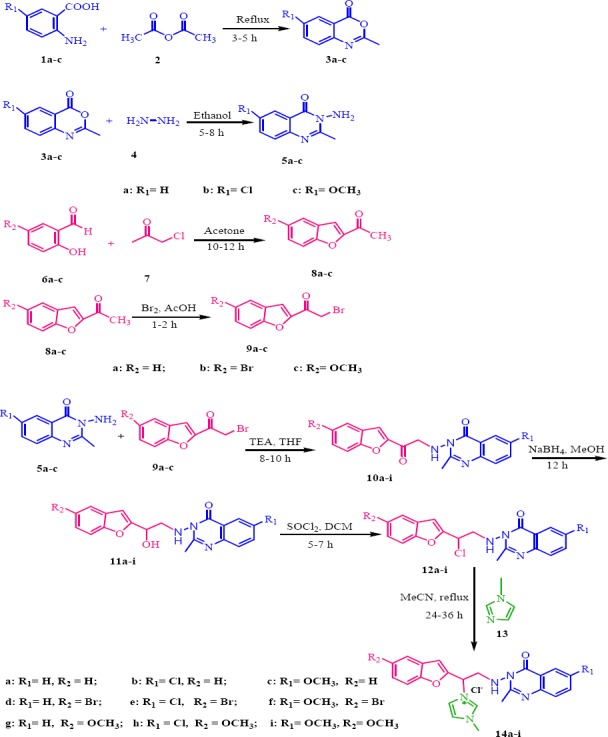
Hybridization of bioactive natural and synthetic compounds is one of the most promising novel approaches for the design of hit and lead compounds with new molecular structures. In this investigation, a series of novel hybrid structures bearing quinazolinone, benzofuran and imidazolium moieties were designed and synthesized.
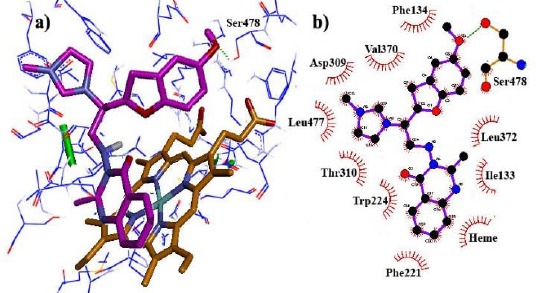
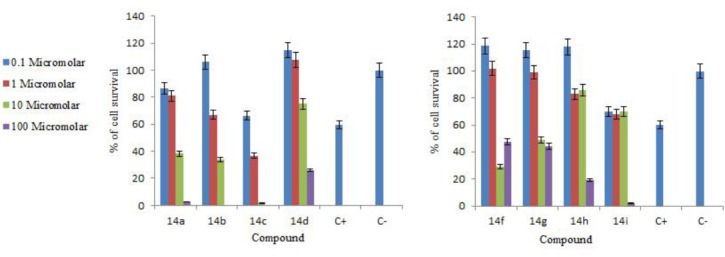
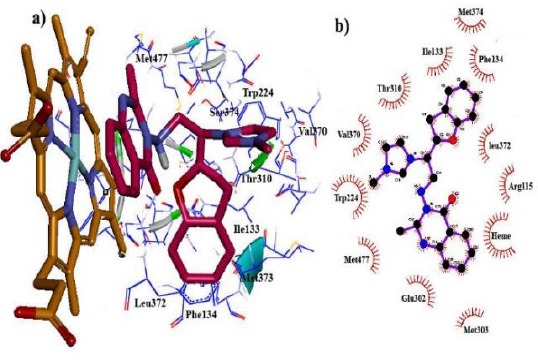
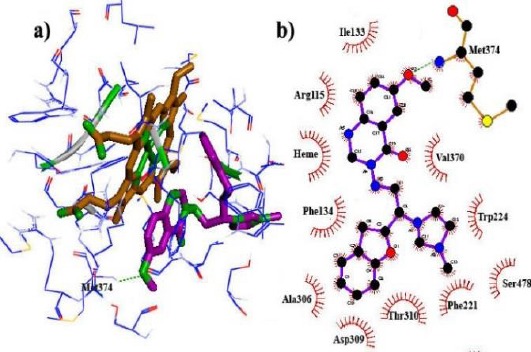
Novel hybrid compounds were prepared and their structures were characterized by spectral and analytical data. In order to evaluate the biological activities, the synthesized hybrid compounds were studied for antibacterial activity against three Gram positive bacteria (, and three Gram-negative bacteria , , ) and also, as one yeast-like fungi strain. Cytotoxic activities of the synthesized compounds were also evaluated by the MTT assay in the human breast cancer cell line (MCF-7) and finally docking studies of cytotoxic derivatives were performed on aromatase enzyme.
The results of antimicrobial activity showed that compound 14e, with two halogen atoms on quinazolinone and benzofuran was the most active against all the tested strains of microorganisms with the MIC value 16-128 µg/ml. Some of the tested compounds showed good cytotoxicity on MCF-7, and compound 14c with IC=0.59 micromolar (μM) was found to be the most cytotoxic compound among the studied hybrid derivatives. The docking analysis showed acceptable binding interactions for these compounds.
Based on the obtained results, the hybrid derivatives of quinazolinone, benzofuran and imidazolium could be regarded as efficient candidates for further molecular developments of anticancer and antimicrobial agents.
生物活性天然化合物与合成化合物的杂化是设计具有新分子结构的先导化合物和苗头化合物最有前景的新方法之一。在本研究中,设计并合成了一系列带有喹唑啉酮、苯并呋喃和咪唑鎓部分的新型杂化结构。
制备了新型杂化化合物,并通过光谱和分析数据对其结构进行了表征。为了评估其生物活性,研究了合成的杂化化合物对三种革兰氏阳性菌(、和)和三种革兰氏阴性菌(、、)的抗菌活性,以及对一种酵母样真菌菌株的抗菌活性。还通过MTT法在人乳腺癌细胞系(MCF-7)中评估了合成化合物的细胞毒性,最后对细胞毒性衍生物进行了芳香化酶的对接研究。
抗菌活性结果表明,喹唑啉酮和苯并呋喃上带有两个卤原子的化合物14e对所有测试的微生物菌株活性最强,MIC值为16 - 128μg/ml。一些测试化合物对MCF-7显示出良好的细胞毒性,发现IC = 0.59微摩尔(μM)的化合物14c是所研究的杂化衍生物中细胞毒性最强的化合物。对接分析表明这些化合物具有可接受的结合相互作用。
基于所得结果,喹唑啉酮、苯并呋喃和咪唑鎓的杂化衍生物可被视为抗癌和抗菌药物进一步分子开发的有效候选物。