Bradshaw Abigail R, Thompson Paul A, Wilson Alexander C, Bishop Dorothy V M, Woodhead Zoe V J
Department of Experimental Psychology, University of Oxford, Oxford, United Kingdom.
PeerJ. 2017 Oct 24;5:e3929. doi: 10.7717/peerj.3929. eCollection 2017.
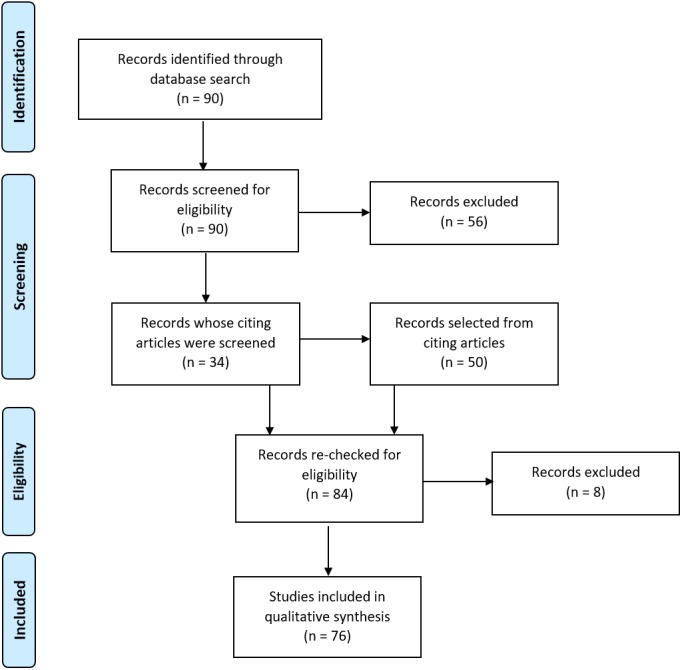
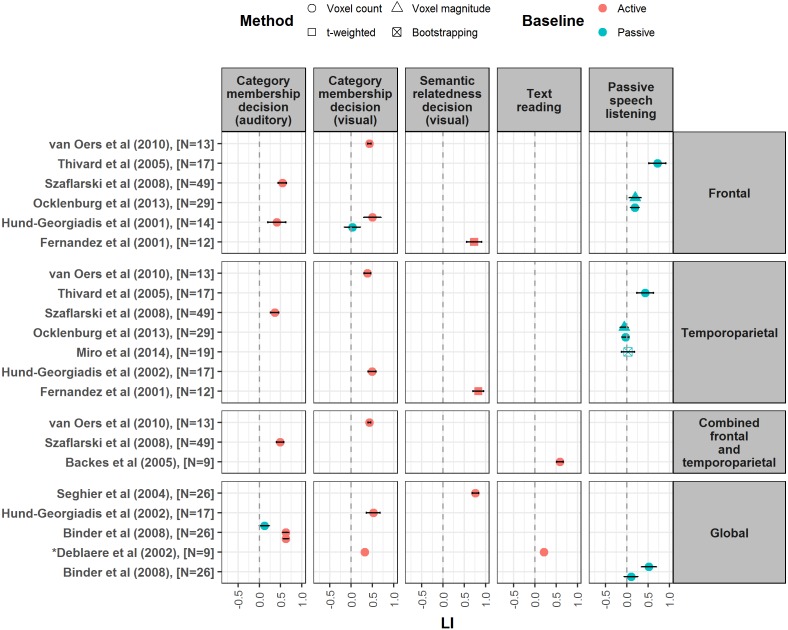
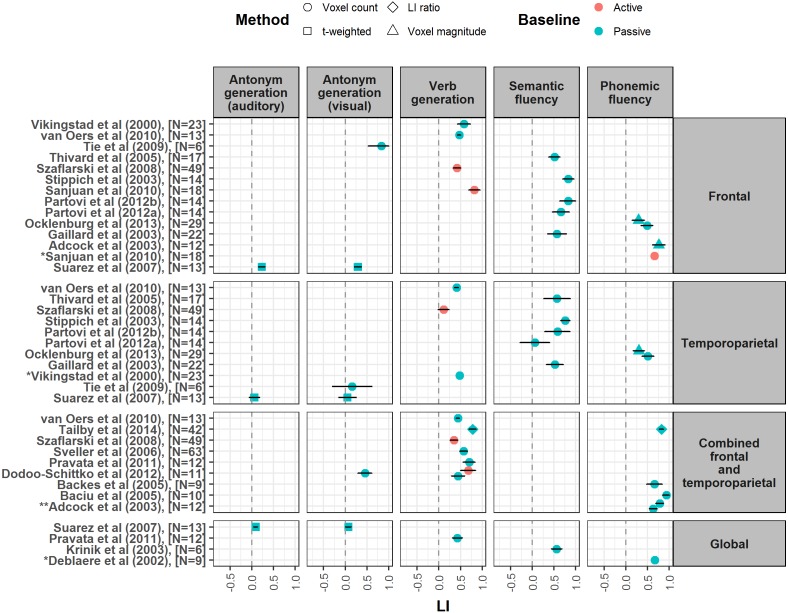
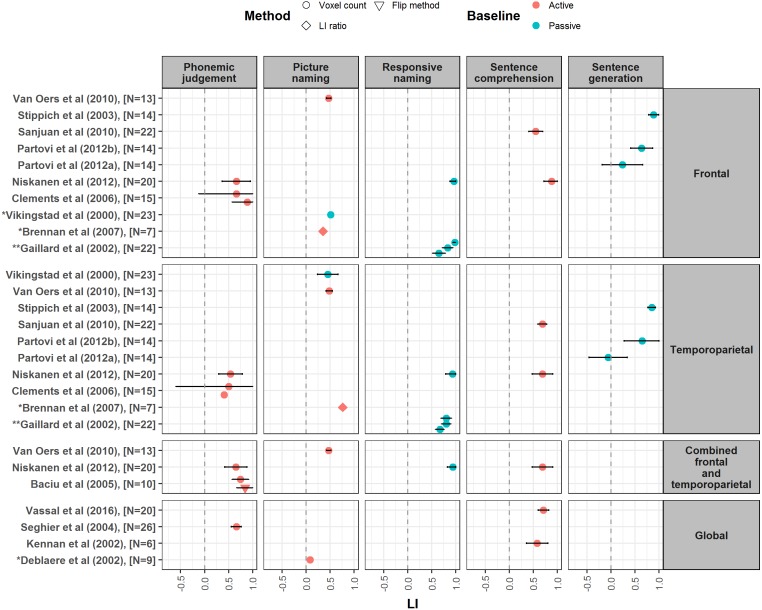
Language lateralisation refers to the phenomenon in which one hemisphere (typically the left) shows greater involvement in language functions than the other. Measurement of laterality is of interest both to researchers investigating the neural organisation of the language system and to clinicians needing to establish an individual's hemispheric dominance for language prior to surgery, as in patients with intractable epilepsy. Recently, there has been increasing awareness of the possibility that different language processes may develop hemispheric lateralisation independently, and to varying degrees. However, it is not always clear whether differences in laterality across language tasks with fMRI are reflective of meaningful variation in hemispheric lateralisation, or simply of trivial methodological differences between paradigms. This systematic review aims to assess different language tasks in terms of the strength, reliability and robustness of the laterality measurements they yield with fMRI, to look at variability that is both dependent and independent of aspects of study design, such as the baseline task, region of interest, and modality of the stimuli. Recommendations are made that can be used to guide task design; however, this review predominantly highlights that the current high level of methodological variability in language paradigms prevents conclusions as to how different language functions may lateralise independently. We conclude with suggestions for future research using tasks that engage distinct aspects of language functioning, whilst being closely matched on non-linguistic aspects of task design (e.g., stimuli, task timings etc); such research could produce more reliable and conclusive insights into language lateralisation. This systematic review was registered as a protocol on Open Science Framework: https://osf.io/5vmpt/.
语言侧化是指一个半球(通常是左半球)在语言功能方面比另一个半球表现出更大参与度的现象。侧化的测量对于研究语言系统神经组织的研究人员以及在手术前需要确定个体语言半球优势的临床医生(如难治性癫痫患者)都具有重要意义。最近,人们越来越意识到不同的语言过程可能独立地、在不同程度上发展出半球侧化。然而,使用功能磁共振成像(fMRI)进行不同语言任务时,侧化差异究竟是反映了半球侧化的有意义变化,还是仅仅反映了不同范式之间微不足道的方法学差异,这并不总是很清楚。本系统综述旨在根据功能磁共振成像产生的侧化测量的强度、可靠性和稳健性来评估不同的语言任务,研究与研究设计方面(如基线任务、感兴趣区域和刺激模态)相关或无关的变异性。提出了可用于指导任务设计的建议;然而,本综述主要强调,目前语言范式中高水平的方法学变异性阻碍了我们得出不同语言功能如何独立侧化的结论。我们最后提出了一些关于未来研究的建议,即使用涉及语言功能不同方面的任务,同时在任务设计的非语言方面(如刺激、任务时间等)进行紧密匹配;这样的研究可能会对语言侧化产生更可靠、更具决定性的见解。本系统综述已在开放科学框架上注册为一项方案:https://osf.io/5vmpt/ 。