Sonntag Ulrike, Peters Harm, Schnabel Kai P, Breckwoldt Jan
Charité - Universitätsmedizin Berlin, Dieter Scheffner Fachzentrum für medizinische Hochschullehre und evidenzbasierte Ausbildungsforschung, Berlin, Germany.
Universität Bern, Institut für Medizinische Lehre, Abteilung für Unterricht und Medien, Bern, Switzerland.
GMS J Med Educ. 2017 Oct 16;34(4):Doc39. doi: 10.3205/zma001116. eCollection 2017.
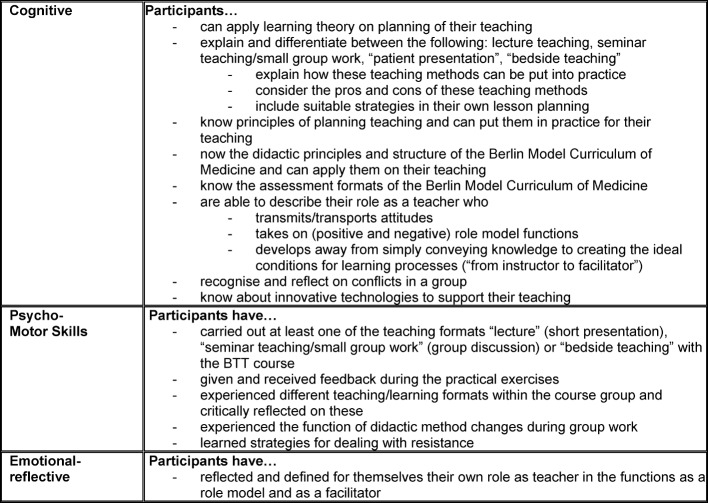
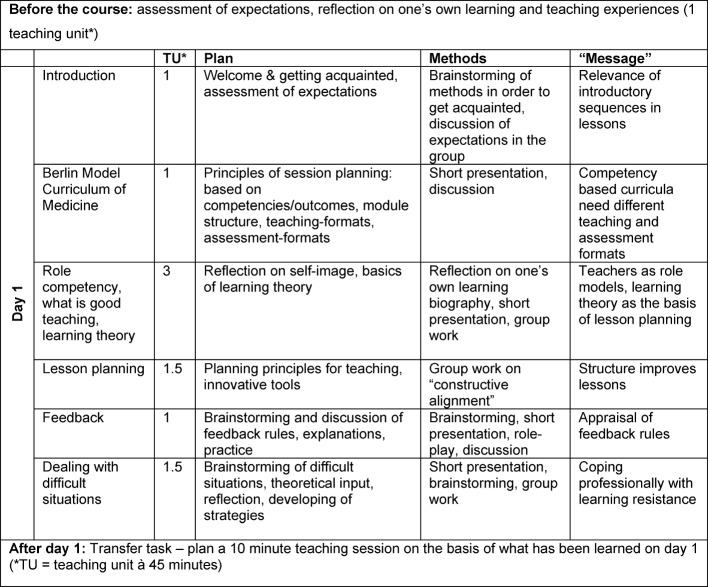
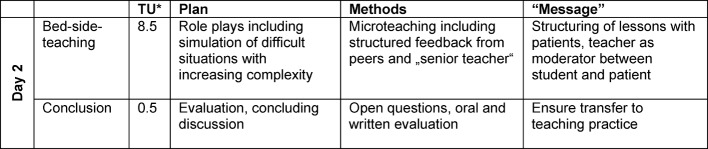
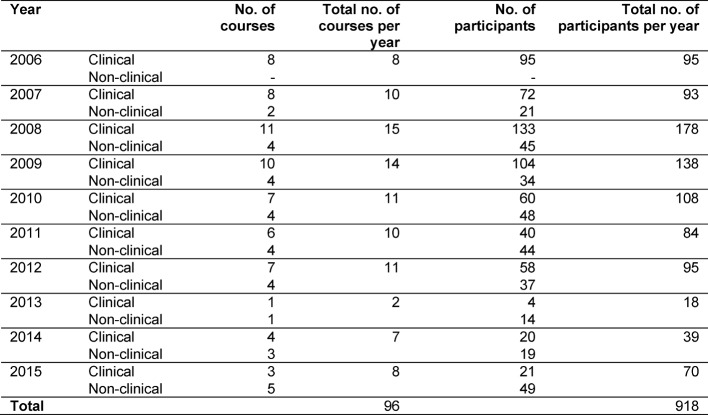
Many medical faculties are introducing faculty development programmes to train their teaching staff with the aim of improving student learning performance. Frequently changing parameters within faculties pose a challenge for the sustainable establishment of such programmes. In this paper, we aim to describe facilitating and hindering parameters using the example of the basic teacher training (BTT) course at the Charité - Universtitätsmedizin Berlin (Charité). After sporadic pilot attempts for university education training, basic teacher training was finally established at the Charité in 2006 for all new teaching staff. An interdisciplinary taskforce at the office for student affairs designed the programme according to the Kern cycle of curriculum development, while the Charité advanced training academy provided the necessary resources. Within ten years more than 900 faculty members have completed the BTT (9% of current active teaching staff at the Charité). The BTT programme underwent several phases (piloting, evaluation, review, personnel and financial boosting), all of which were marked by changes in the staff and organizational framework. Evaluations by participants were very positive, sustainable effects on teaching could be proven to a limited extent. Success factors for the establishment of the programme were the institutional framework set by the faculty directors, the commitment of those involved, the support of research grants and the thoroughly positive evaluation by participants. More challenging were frequent changes in parameters and the allocation of incentive resources for other, format-specific training courses (e.g. PBL) as part of the introduction of the new modular curriculum of the Charité. The sustainment of the programme was enabled through strategic institutional steps taken by the faculty heads. Thanks to the commitment and input by those at a working level as well as management level, the basic teacher training course is today an established part of the faculty development programme at the Charité.
许多医学院系正在推出教师发展计划,以培训其教学人员,目的是提高学生的学习成绩。院系内部频繁变化的参数给此类计划的可持续设立带来了挑战。在本文中,我们旨在以柏林夏里特大学医学院(Charité)的基础教师培训(BTT)课程为例,描述促进和阻碍该计划的参数。在对大学教育培训进行了零星的试点尝试之后,基础教师培训最终于2006年在夏里特大学为所有新教学人员设立。学生事务办公室的一个跨学科特别工作组根据课程开发的克恩循环设计了该计划,而夏里特高级培训学院提供了必要的资源。在十年内,超过900名教职员工完成了BTT(占夏里特大学目前在职教学人员的9%)。BTT计划经历了几个阶段(试点、评估、审查、人员和资金支持),所有这些阶段都以人员和组织框架的变化为特征。参与者的评价非常积极,对教学的可持续影响在一定程度上得到了证实。该计划设立的成功因素包括院系主任设定的制度框架、相关人员的投入、研究资助的支持以及参与者的完全积极评价。更具挑战性的是参数的频繁变化以及为作为夏里特大学新模块化课程引入一部分的其他特定形式培训课程(如基于问题的学习,PBL)分配激励资源。该计划的持续实施是通过院系负责人采取的战略制度措施实现的。由于工作层面和管理层人员的投入,基础教师培训课程如今已成为夏里特大学教师发展计划的既定组成部分。